

442
although occasionally the entire district is
referred to as Bumthang Valley.
‘Bumthang’ directly translates as ‘beautiful
fi eld’ – ‘thang’ means fi eld or fl at place, and
‘bum’ is said be an abbreviation of either ‘bumpa’
(a vessel for holy water, thus describing the shape
and nature of the valley) or simply ‘bum’ (‘girl’,
indicating this is the valley of beautiful girls).
‘Bumthang’ name came after construction of
Jambay Lhakhang, which was constructed in
landscape of Bumpa (vessel) shape. So thereafter
people name the place as ‘Bumthang’.
The northern two-thirds of the district
(Chhoekhor, Tang Gewogs) belong to Wangchuck
Centennial Park, buffered by pockets of biological corridors. Southern Bumthang (Chhumig,
Tang, Ura Gewogs) is part of another protected
area, Thrumshingla National Park.
21.2.3.1 Geography
Most of Bumthang is part of Bhutan’s extensive
protected area network.
Bumthang is divided into four gewogs:
(a) Chhume Gewog, (b) Choekor Gewog, (c)
Tang Gewog, (d) Ura Gewog
Membar Tsho (Burning Lake): According to
popular belief, sacred scriptures were hidden by
Guru Rinpoche in the eighth century, which were
later recovered by Pema Lingpa in the fi fteenth
century.
21.3 Wetlands of Nepal
Most of the lentic bodies in this Himalayan country are high altitude (HA) lentic bodies. As such,
the lentic bodies of Nepal have been dealt with in
Chap. 6 . However, a brief account of the Koshi
Tappu Wildlife Reserve is given below.
21.3.1 Koshi Tappu Wildlife Reserve
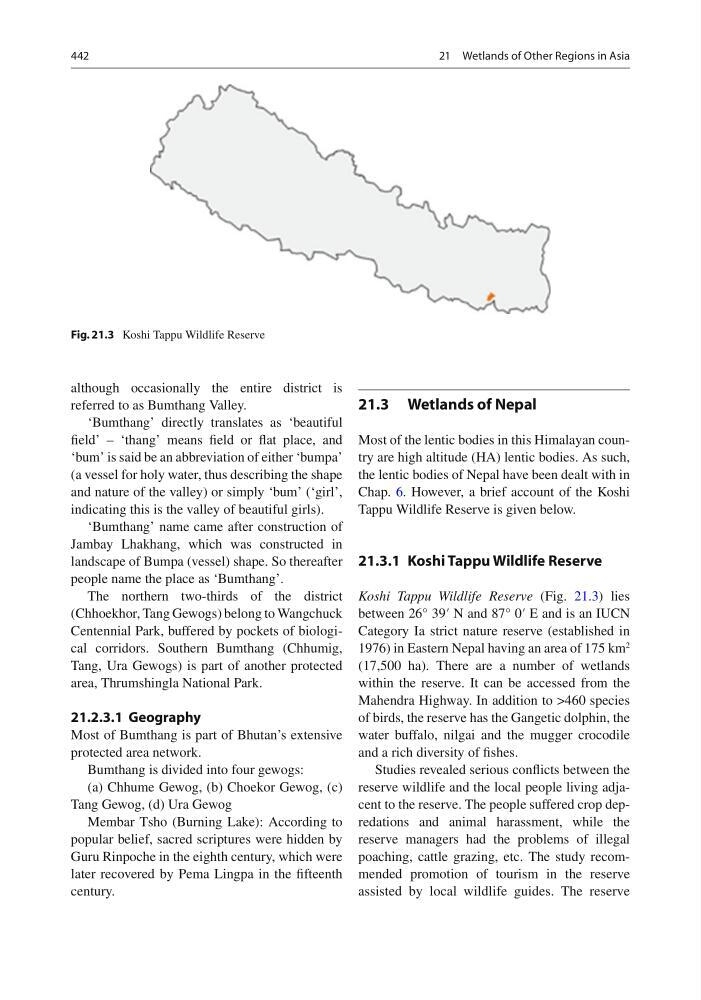
Koshi Tappu Wildlife Reserve (Fig. 21.3 ) lies
between 26° 39′ N and 87° 0′ E and is an IUCN
Category Ia strict nature reserve (established in
1976) in Eastern Nepal having an area of 175 km
2
(17,500 ha). There are a number of wetlands
within the reserve. It can be accessed from the
Mahendra Highway. In addition to >460 species
of birds, the reserve has the Gangetic dolphin, the
water buffalo, nilgai and the mugger crocodile
and a rich diversity of fi shes.
Studies revealed serious confl icts between the
reserve wildlife and the local people living adjacent to the reserve. The people suffered crop depredations and animal harassment, while the
reserve managers had the problems of illegal
poaching, cattle grazing, etc. The study recommended promotion of tourism in the reserve
assisted by local wildlife guides. The reserve
Fig. 21.3 Koshi Tappu Wildlife Reserve
21 Wetlands of Other Regions in Asia
although occasionally the entire district is
referred to as Bumthang Valley.
‘Bumthang’ directly translates as ‘beautiful
fi eld’ – ‘thang’ means fi eld or fl at place, and
‘bum’ is said be an abbreviation of either ‘bumpa’
(a vessel for holy water, thus describing the shape
and nature of the valley) or simply ‘bum’ (‘girl’,
indicating this is the valley of beautiful girls).
‘Bumthang’ name came after construction of
Jambay Lhakhang, which was constructed in
landscape of Bumpa (vessel) shape. So thereafter
people name the place as ‘Bumthang’.
The northern two-thirds of the district
(Chhoekhor, Tang Gewogs) belong to Wangchuck
Centennial Park, buffered by pockets of biological corridors. Southern Bumthang (Chhumig,
Tang, Ura Gewogs) is part of another protected
area, Thrumshingla National Park.
21.2.3.1 Geography
Most of Bumthang is part of Bhutan’s extensive
protected area network.
Bumthang is divided into four gewogs:
(a) Chhume Gewog, (b) Choekor Gewog, (c)
Tang Gewog, (d) Ura Gewog
Membar Tsho (Burning Lake): According to
popular belief, sacred scriptures were hidden by
Guru Rinpoche in the eighth century, which were
later recovered by Pema Lingpa in the fi fteenth
century.
21.3 Wetlands of Nepal
Most of the lentic bodies in this Himalayan country are high altitude (HA) lentic bodies. As such,
the lentic bodies of Nepal have been dealt with in
Chap. 6 . However, a brief account of the Koshi
Tappu Wildlife Reserve is given below.
21.3.1 Koshi Tappu Wildlife Reserve
Koshi Tappu Wildlife Reserve (Fig. 21.3 ) lies
between 26° 39′ N and 87° 0′ E and is an IUCN
Category Ia strict nature reserve (established in
1976) in Eastern Nepal having an area of 175 km
2
(17,500 ha). There are a number of wetlands
within the reserve. It can be accessed from the
Mahendra Highway. In addition to >460 species
of birds, the reserve has the Gangetic dolphin, the
water buffalo, nilgai and the mugger crocodile
and a rich diversity of fi shes.
Studies revealed serious confl icts between the
reserve wildlife and the local people living adjacent to the reserve. The people suffered crop depredations and animal harassment, while the
reserve managers had the problems of illegal
poaching, cattle grazing, etc. The study recommended promotion of tourism in the reserve
assisted by local wildlife guides. The reserve
Fig. 21.3 Koshi Tappu Wildlife Reserve
21 Wetlands of Other Regions in Asia