

424
is dominated by sand with some admixture of mud.
The second zone at the northern region is wholly
muddy. The third zone with sand and mud in equal
parts is overgrown with patches of weeds and is
reported to be rich in benthic biodiversity. Toxicity
levels of heavy metals such as magnesium, lead,
zinc, nickel, cadmium, aluminium and copper and
chemicals such as ammonia, sulphate and fl uoride
in the lake are well within permissible limits.
The lagoon has rich fl oral and faunal diversity,
which supports active commercial fi sheries and a
large and varied bird population. The lake has
rich fi sh diversity, mostly marine species, some
truly brackish water and a few freshwater species. Mullets and catfi sh are the major brackish
water fi sh, which have supported sustained fi shing for the lake fi shermen. The lake is a nursery
for several species of fi sh. Two-thirds of the
settlements in the lake area are in Tamil Nadu and
the balance in Andhra Pradesh. 12,370 fi shermen
live on fulltime fi shery in the lake (6,000 in
Andhra Pradesh and 6,370 in Tamil Nadu).
An average of 1,200 tonnes of fi sh and crustaceans are harvested annually, of which prawns
constitute 60 %, followed by mullets. Seafood
exports of white and tiger prawns, jellyfish,
finfi sh and live lagoon green crabs are some of
the economic benefi ts derived from the lagoon.
A total of 168 fish species have been reported.
The frequently found ones are the mullets
( M. cunnesius , M. jerdoni , M. dussumieri ,
M. cephalus , M. borneensis ) , the blowfi sh ( Tetraodon
nigropunctatus , T. leopardus , Barbus dorsalis ),
catfi sh ( Mystus vittatus ), sardines ( Sardinella
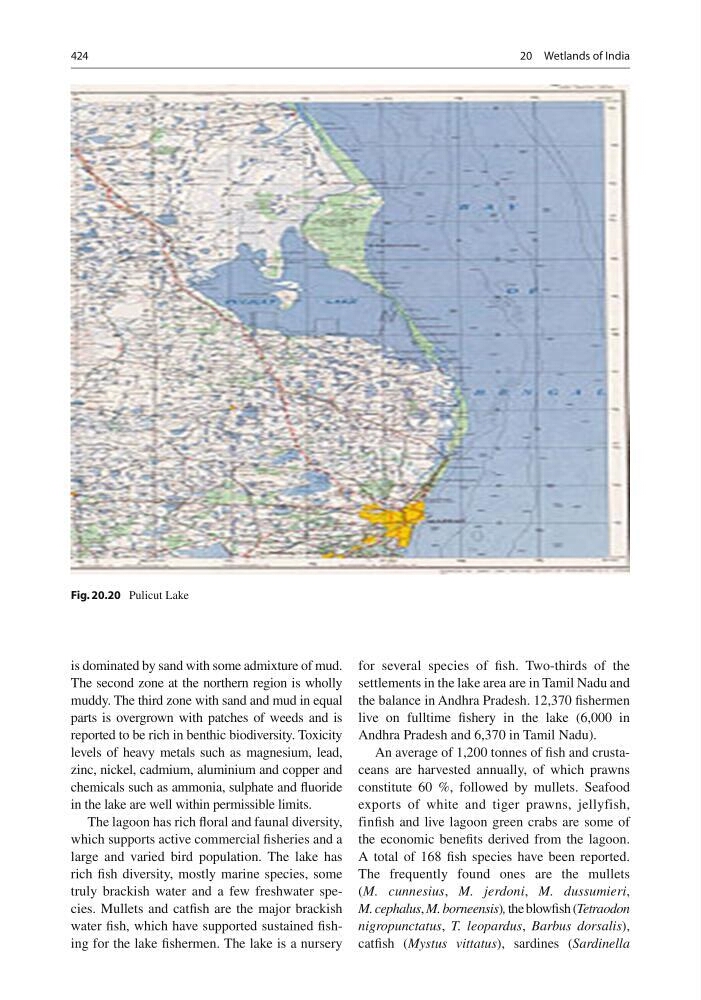
Fig. 20.20 Pulicut Lake
20 Wetlands of India
is dominated by sand with some admixture of mud.
The second zone at the northern region is wholly
muddy. The third zone with sand and mud in equal
parts is overgrown with patches of weeds and is
reported to be rich in benthic biodiversity. Toxicity
levels of heavy metals such as magnesium, lead,
zinc, nickel, cadmium, aluminium and copper and
chemicals such as ammonia, sulphate and fl uoride
in the lake are well within permissible limits.
The lagoon has rich fl oral and faunal diversity,
which supports active commercial fi sheries and a
large and varied bird population. The lake has
rich fi sh diversity, mostly marine species, some
truly brackish water and a few freshwater species. Mullets and catfi sh are the major brackish
water fi sh, which have supported sustained fi shing for the lake fi shermen. The lake is a nursery
for several species of fi sh. Two-thirds of the
settlements in the lake area are in Tamil Nadu and
the balance in Andhra Pradesh. 12,370 fi shermen
live on fulltime fi shery in the lake (6,000 in
Andhra Pradesh and 6,370 in Tamil Nadu).
An average of 1,200 tonnes of fi sh and crustaceans are harvested annually, of which prawns
constitute 60 %, followed by mullets. Seafood
exports of white and tiger prawns, jellyfish,
finfi sh and live lagoon green crabs are some of
the economic benefi ts derived from the lagoon.
A total of 168 fish species have been reported.
The frequently found ones are the mullets
( M. cunnesius , M. jerdoni , M. dussumieri ,
M. cephalus , M. borneensis ) , the blowfi sh ( Tetraodon
nigropunctatus , T. leopardus , Barbus dorsalis ),
catfi sh ( Mystus vittatus ), sardines ( Sardinella
Fig. 20.20 Pulicut Lake
20 Wetlands of India