

418
Land Use
Current land use is designed to enhance the longterm value of the site for scientifi c study, recreation, wildlife-oriented tourism and so on. Land
use involves collection of Vetiveria , fi rewood, etc.
Conservation Measures
Some of these are as follows: (a) regular supply of
water to the wetland mainly for maintenance of
habitat for birds and also for sustenance of fi sh
stock; (b) eradication of grasses like Paspalum
distichum may be through cattle grazing, which
has now become an essential component of integrated management plan for the NP; (c) arrest of
the process of plant succession at a stage suited
for avifauna; (d) spread of invasive grasses like
Vetiveria zizanioides to be controlled through
their harvest; (e) water supply to the wetland during the dry season to be ensured; (f) Cyperus alopecuroides be harvested at the seedling stage; and
(g) additional areas are to be created for maintaining breeding stock of fi sh during the summer.
20.3.13.2 Sambhar Salt Lake
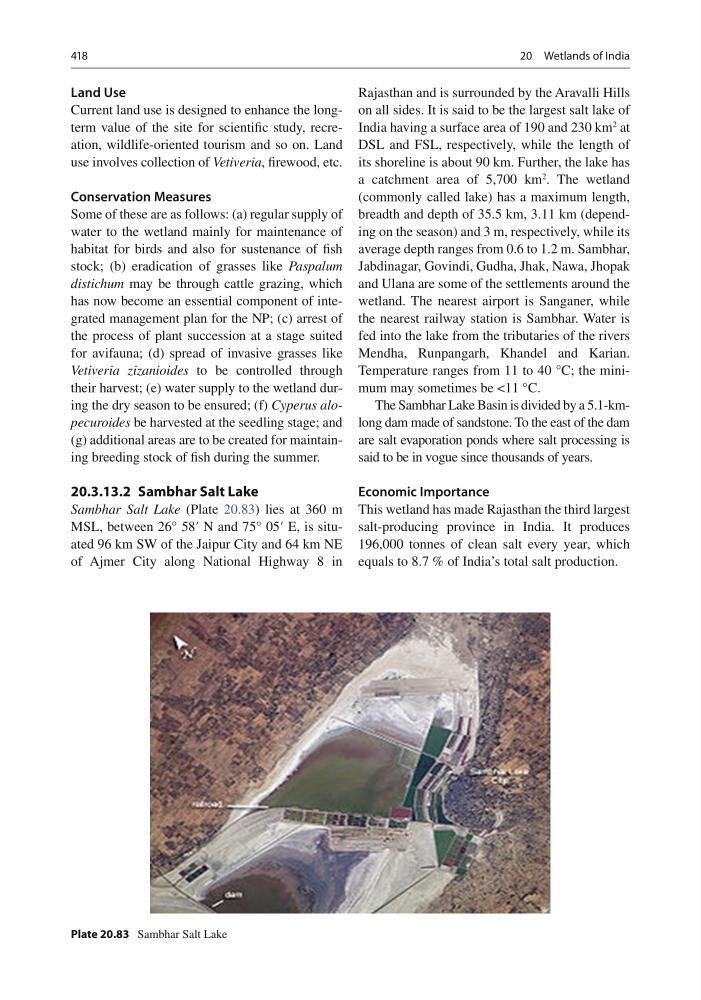
Sambhar Salt Lake (Plate 20.83 ) lies at 360 m
MSL, between 26° 58′ N and 75° 05′ E, is situated 96 km SW of the Jaipur City and 64 km NE
of Ajmer City along National Highway 8 in
Rajasthan and is surrounded by the Aravalli Hills
on all sides. It is said to be the largest salt lake of
India having a surface area of 190 and 230 km
2 at
DSL and FSL, respectively, while the length of
its shoreline is about 90 km. Further, the lake has
a catchment area of 5,700 km
2 . The wetland
(commonly called lake) has a maximum length,
breadth and depth of 35.5 km, 3.11 km (depending on the season) and 3 m, respectively, while its
average depth ranges from 0.6 to 1.2 m. Sambhar,
Jabdinagar, Govindi, Gudha, Jhak, Nawa, Jhopak
and Ulana are some of the settlements around the
wetland. The nearest airport is Sanganer, while
the nearest railway station is Sambhar. Water is
fed into the lake from the tributaries of the rivers
Mendha, Runpangarh, Khandel and Karian.
Temperature ranges from 11 to 40 °C; the minimum may sometimes be <11 °C.
The Sambhar Lake Basin is divided by a 5.1-kmlong dam made of sandstone. To the east of the dam
are salt evaporation ponds where salt processing is
said to be in vogue since thousands of years.
Economic Importance
This wetland has made Rajasthan the third largest
salt-producing province in India. It produces
196,000 tonnes of clean salt every year, which
equals to 8.7 % of India’s total salt production.
Plate 20.83 Sambhar Salt Lake
20 Wetlands of India
Land Use
Current land use is designed to enhance the longterm value of the site for scientifi c study, recreation, wildlife-oriented tourism and so on. Land
use involves collection of Vetiveria , fi rewood, etc.
Conservation Measures
Some of these are as follows: (a) regular supply of
water to the wetland mainly for maintenance of
habitat for birds and also for sustenance of fi sh
stock; (b) eradication of grasses like Paspalum
distichum may be through cattle grazing, which
has now become an essential component of integrated management plan for the NP; (c) arrest of
the process of plant succession at a stage suited
for avifauna; (d) spread of invasive grasses like
Vetiveria zizanioides to be controlled through
their harvest; (e) water supply to the wetland during the dry season to be ensured; (f) Cyperus alopecuroides be harvested at the seedling stage; and
(g) additional areas are to be created for maintaining breeding stock of fi sh during the summer.
20.3.13.2 Sambhar Salt Lake
Sambhar Salt Lake (Plate 20.83 ) lies at 360 m
MSL, between 26° 58′ N and 75° 05′ E, is situated 96 km SW of the Jaipur City and 64 km NE
of Ajmer City along National Highway 8 in
Rajasthan and is surrounded by the Aravalli Hills
on all sides. It is said to be the largest salt lake of
India having a surface area of 190 and 230 km
2 at
DSL and FSL, respectively, while the length of
its shoreline is about 90 km. Further, the lake has
a catchment area of 5,700 km
2 . The wetland
(commonly called lake) has a maximum length,
breadth and depth of 35.5 km, 3.11 km (depending on the season) and 3 m, respectively, while its
average depth ranges from 0.6 to 1.2 m. Sambhar,
Jabdinagar, Govindi, Gudha, Jhak, Nawa, Jhopak
and Ulana are some of the settlements around the
wetland. The nearest airport is Sanganer, while
the nearest railway station is Sambhar. Water is
fed into the lake from the tributaries of the rivers
Mendha, Runpangarh, Khandel and Karian.
Temperature ranges from 11 to 40 °C; the minimum may sometimes be <11 °C.
The Sambhar Lake Basin is divided by a 5.1-kmlong dam made of sandstone. To the east of the dam
are salt evaporation ponds where salt processing is
said to be in vogue since thousands of years.
Economic Importance
This wetland has made Rajasthan the third largest
salt-producing province in India. It produces
196,000 tonnes of clean salt every year, which
equals to 8.7 % of India’s total salt production.
Plate 20.83 Sambhar Salt Lake
20 Wetlands of India