

417
Keoladeo National Park. An account of the lentic
bodies in Rajasthan is given below.
20.3.13.1 Keoladeo National Park
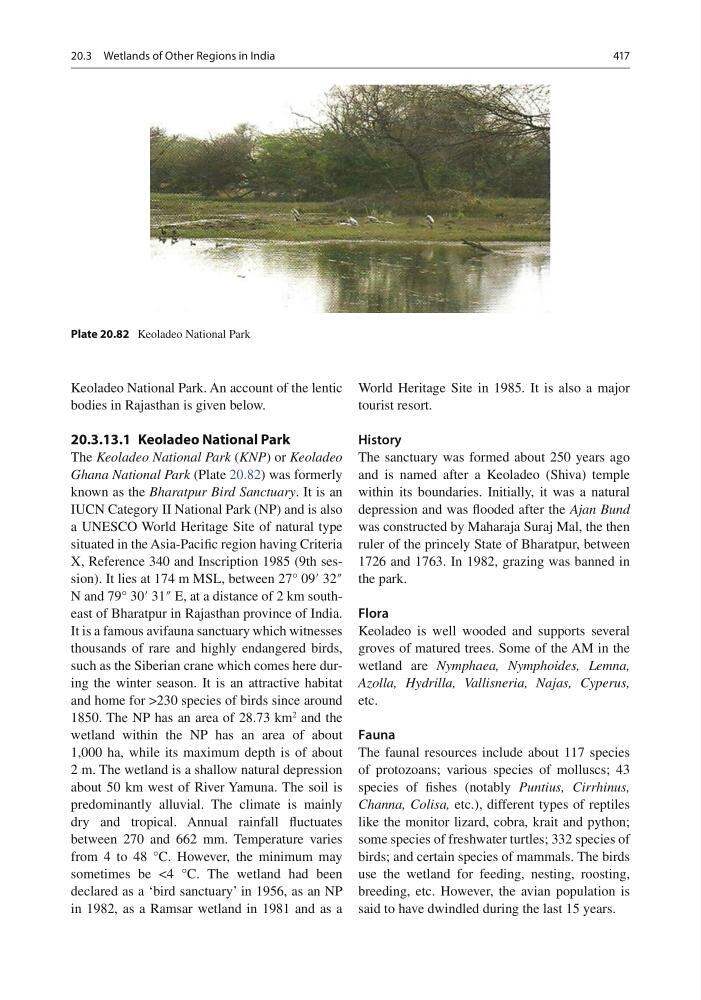
The Keoladeo National Park ( KNP ) or Keoladeo
Ghana National Park (Plate 20.82 ) was formerly
known as the Bharatpur Bird Sanctuary . It is an
IUCN Category II National Park (NP) and is also
a UNESCO World Heritage Site of natural type
situated in the Asia-Pacifi c region having Criteria
X, Reference 340 and Inscription 1985 (9th session). It lies at 174 m MSL, between 27° 09′ 32″
N and 79° 30′ 31″ E, at a distance of 2 km southeast of Bharatpur in Rajasthan province of India.
It is a famous avifauna sanctuary which witnesses
thousands of rare and highly endangered birds,
such as the Siberian crane which comes here during the winter season. It is an attractive habitat
and home for >230 species of birds since around
1850. The NP has an area of 28.73 km
2 and the
wetland within the NP has an area of about
1,000 ha, while its maximum depth is of about
2 m. The wetland is a shallow natural depression
about 50 km west of River Yamuna. The soil is
predominantly alluvial. The climate is mainly
dry and tropical. Annual rainfall fl uctuates
between 270 and 662 mm. Temperature varies
from 4 to 48 °C. However, the minimum may
sometimes be <4 °C. The wetland had been
declared as a ‘bird sanctuary’ in 1956, as an NP
in 1982, as a Ramsar wetland in 1981 and as a
World Heritage Site in 1985. It is also a major
tourist resort.
History
The sanctuary was formed about 250 years ago
and is named after a Keoladeo (Shiva) temple
within its boundaries. Initially, it was a natural
depression and was fl ooded after the Ajan Bund
was constructed by Maharaja Suraj Mal, the then
ruler of the princely State of Bharatpur, between
1726 and 1763. In 1982, grazing was banned in
the park.
Flora
Keoladeo is well wooded and supports several
groves of matured trees. Some of the AM in the
wetland are Nymphaea, Nymphoides, Lemna,
Azolla, Hydrilla, Vallisneria, Najas, Cyperus,
etc.
Fauna
The faunal resources include about 117 species
of protozoans; various species of molluscs; 43
species of fi shes (notably Puntius, Cirrhinus,
Channa, Colisa, etc.), different types of reptiles
like the monitor lizard, cobra, krait and python;
some species of freshwater turtles; 332 species of
birds; and certain species of mammals. The birds
use the wetland for feeding, nesting, roosting,
breeding, etc. However, the avian population is
said to have dwindled during the last 15 years.
Plate 20.82 Keoladeo National Park
20.3 Wetlands of Other Regions in India
Keoladeo National Park. An account of the lentic
bodies in Rajasthan is given below.
20.3.13.1 Keoladeo National Park
The Keoladeo National Park ( KNP ) or Keoladeo
Ghana National Park (Plate 20.82 ) was formerly
known as the Bharatpur Bird Sanctuary . It is an
IUCN Category II National Park (NP) and is also
a UNESCO World Heritage Site of natural type
situated in the Asia-Pacifi c region having Criteria
X, Reference 340 and Inscription 1985 (9th session). It lies at 174 m MSL, between 27° 09′ 32″
N and 79° 30′ 31″ E, at a distance of 2 km southeast of Bharatpur in Rajasthan province of India.
It is a famous avifauna sanctuary which witnesses
thousands of rare and highly endangered birds,
such as the Siberian crane which comes here during the winter season. It is an attractive habitat
and home for >230 species of birds since around
1850. The NP has an area of 28.73 km
2 and the
wetland within the NP has an area of about
1,000 ha, while its maximum depth is of about
2 m. The wetland is a shallow natural depression
about 50 km west of River Yamuna. The soil is
predominantly alluvial. The climate is mainly
dry and tropical. Annual rainfall fl uctuates
between 270 and 662 mm. Temperature varies
from 4 to 48 °C. However, the minimum may
sometimes be <4 °C. The wetland had been
declared as a ‘bird sanctuary’ in 1956, as an NP
in 1982, as a Ramsar wetland in 1981 and as a
World Heritage Site in 1985. It is also a major
tourist resort.
History
The sanctuary was formed about 250 years ago
and is named after a Keoladeo (Shiva) temple
within its boundaries. Initially, it was a natural
depression and was fl ooded after the Ajan Bund
was constructed by Maharaja Suraj Mal, the then
ruler of the princely State of Bharatpur, between
1726 and 1763. In 1982, grazing was banned in
the park.
Flora
Keoladeo is well wooded and supports several
groves of matured trees. Some of the AM in the
wetland are Nymphaea, Nymphoides, Lemna,
Azolla, Hydrilla, Vallisneria, Najas, Cyperus,
etc.
Fauna
The faunal resources include about 117 species
of protozoans; various species of molluscs; 43
species of fi shes (notably Puntius, Cirrhinus,
Channa, Colisa, etc.), different types of reptiles
like the monitor lizard, cobra, krait and python;
some species of freshwater turtles; 332 species of
birds; and certain species of mammals. The birds
use the wetland for feeding, nesting, roosting,
breeding, etc. However, the avian population is
said to have dwindled during the last 15 years.
Plate 20.82 Keoladeo National Park
20.3 Wetlands of Other Regions in India