

402
20.3.10.2 Upper Lake (Bhopal)
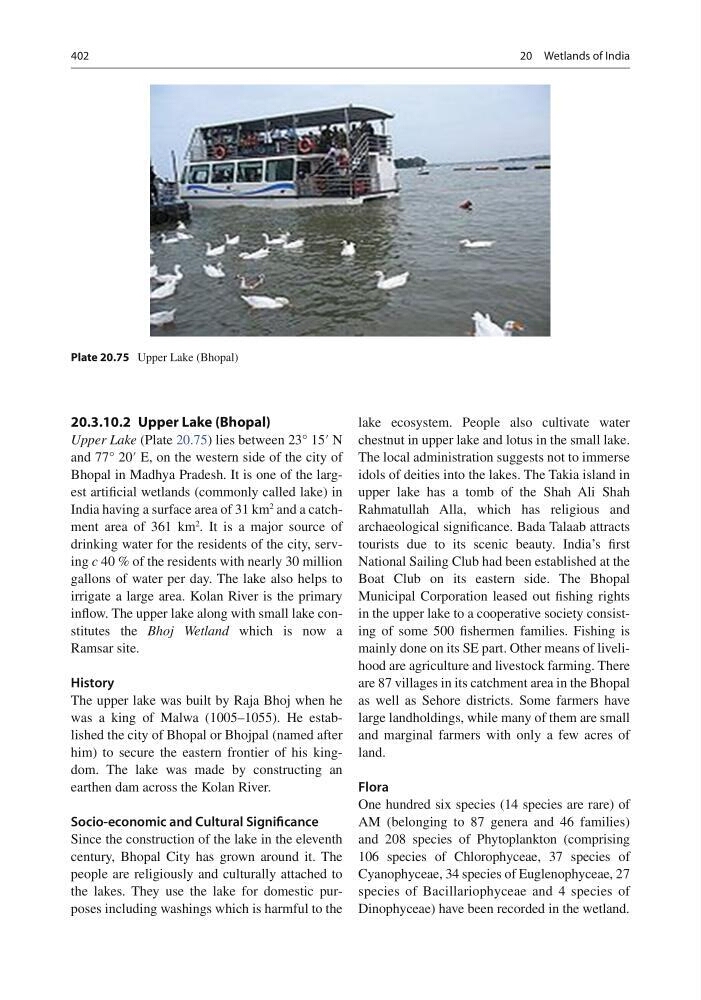
Upper Lake (Plate 20.75 ) lies between 23° 15′ N
and 77° 20′ E, on the western side of the city of
Bhopal in Madhya Pradesh. It is one of the largest artifi cial wetlands (commonly called lake) in
India having a surface area of 31 km
2 and a catchment area of 361 km
2 . It is a major source of
drinking water for the residents of the city, serving c 40 % of the residents with nearly 30 million
gallons of water per day. The lake also helps to
irrigate a large area. Kolan River is the primary
infl ow. The upper lake along with small lake constitutes the Bhoj Wetland which is now a
Ramsar site.
History
The upper lake was built by Raja Bhoj when he
was a king of Malwa (1005–1055). He established the city of Bhopal or Bhojpal (named after
him) to secure the eastern frontier of his kingdom. The lake was made by constructing an
earthen dam across the Kolan River.
Socio-economic and Cultural Signifi cance
Since the construction of the lake in the eleventh
century, Bhopal City has grown around it. The
people are religiously and culturally attached to
the lakes. They use the lake for domestic purposes including washings which is harmful to the
lake ecosystem. People also cultivate water
chestnut in upper lake and lotus in the small lake.
The local administration suggests not to immerse
idols of deities into the lakes. The Takia island in
upper lake has a tomb of the Shah Ali Shah
Rahmatullah Alla, which has religious and
archaeological signifi cance. Bada Talaab attracts
tourists due to its scenic beauty. India’s fi rst
National Sailing Club had been established at the
Boat Club on its eastern side. The Bhopal
Municipal Corporation leased out fi shing rights
in the upper lake to a cooperative society consisting of some 500 fi shermen families. Fishing is
mainly done on its SE part. Other means of livelihood are agriculture and livestock farming. There
are 87 villages in its catchment area in the Bhopal
as well as Sehore districts. Some farmers have
large landholdings, while many of them are small
and marginal farmers with only a few acres of
land.
Flora
One hundred six species (14 species are rare) of
AM (belonging to 87 genera and 46 families)
and 208 species of Phytoplankton (comprising
106 species of Chlorophyceae, 37 species of
Cyanophyceae, 34 species of Euglenophyceae, 27
species of Bacillariophyceae and 4 species of
Dinophyceae) have been recorded in the wetland.
Plate 20.75 Upper Lake (Bhopal)
20 Wetlands of India
20.3.10.2 Upper Lake (Bhopal)
Upper Lake (Plate 20.75 ) lies between 23° 15′ N
and 77° 20′ E, on the western side of the city of
Bhopal in Madhya Pradesh. It is one of the largest artifi cial wetlands (commonly called lake) in
India having a surface area of 31 km
2 and a catchment area of 361 km
2 . It is a major source of
drinking water for the residents of the city, serving c 40 % of the residents with nearly 30 million
gallons of water per day. The lake also helps to
irrigate a large area. Kolan River is the primary
infl ow. The upper lake along with small lake constitutes the Bhoj Wetland which is now a
Ramsar site.
History
The upper lake was built by Raja Bhoj when he
was a king of Malwa (1005–1055). He established the city of Bhopal or Bhojpal (named after
him) to secure the eastern frontier of his kingdom. The lake was made by constructing an
earthen dam across the Kolan River.
Socio-economic and Cultural Signifi cance
Since the construction of the lake in the eleventh
century, Bhopal City has grown around it. The
people are religiously and culturally attached to
the lakes. They use the lake for domestic purposes including washings which is harmful to the
lake ecosystem. People also cultivate water
chestnut in upper lake and lotus in the small lake.
The local administration suggests not to immerse
idols of deities into the lakes. The Takia island in
upper lake has a tomb of the Shah Ali Shah
Rahmatullah Alla, which has religious and
archaeological signifi cance. Bada Talaab attracts
tourists due to its scenic beauty. India’s fi rst
National Sailing Club had been established at the
Boat Club on its eastern side. The Bhopal
Municipal Corporation leased out fi shing rights
in the upper lake to a cooperative society consisting of some 500 fi shermen families. Fishing is
mainly done on its SE part. Other means of livelihood are agriculture and livestock farming. There
are 87 villages in its catchment area in the Bhopal
as well as Sehore districts. Some farmers have
large landholdings, while many of them are small
and marginal farmers with only a few acres of
land.
Flora
One hundred six species (14 species are rare) of
AM (belonging to 87 genera and 46 families)
and 208 species of Phytoplankton (comprising
106 species of Chlorophyceae, 37 species of
Cyanophyceae, 34 species of Euglenophyceae, 27
species of Bacillariophyceae and 4 species of
Dinophyceae) have been recorded in the wetland.
Plate 20.75 Upper Lake (Bhopal)
20 Wetlands of India