

387
Research and Education
Bombay Natural History Society (BNHS) had its
fi eld station at Chari-Dhand in Banni grasslands
from January 1990 to 1995 for the study of
migration of birds. It now also organises Nature
Education Camps here.
Ecotourism Development
The district administration has chosen the ChariDhand wetland to create basic facilities for tourists.
20.3.5 Wetlands of Haryana
The province of Haryana does not have a large
number of wetlands, it being a comparatively dry
area. Sultanpur Jheels are signifi cant amongst
them.
20.3.5.1 Sultanpur Jheels
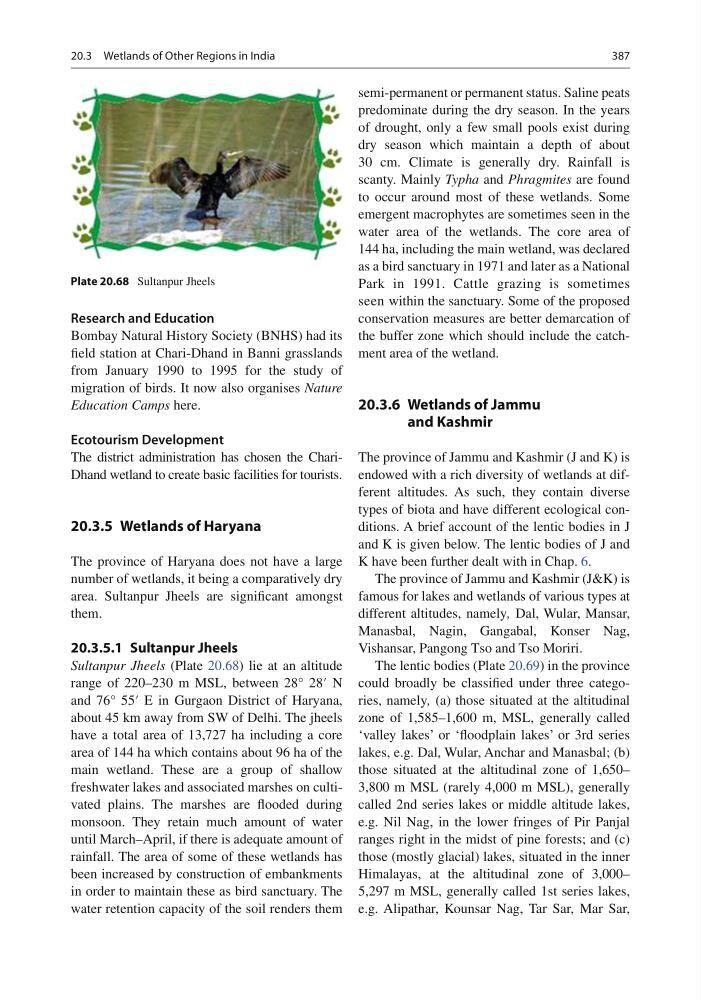
Sultanpur Jheels (Plate 20.68 ) lie at an altitude
range of 220–230 m MSL, between 28° 28′ N
and 76° 55′ E in Gurgaon District of Haryana,
about 45 km away from SW of Delhi. The jheels
have a total area of 13,727 ha including a core
area of 144 ha which contains about 96 ha of the
main wetland. These are a group of shallow
freshwater lakes and associated marshes on cultivated plains. The marshes are fl ooded during
monsoon. They retain much amount of water
until March–April, if there is adequate amount of
rainfall. The area of some of these wetlands has
been increased by construction of embankments
in order to maintain these as bird sanctuary. The
water retention capacity of the soil renders them
semi-permanent or permanent status. Saline peats
predominate during the dry season. In the years
of drought, only a few small pools exist during
dry season which maintain a depth of about
30 cm. Climate is generally dry. Rainfall is
scanty. Mainly Typha and Phragmites are found
to occur around most of these wetlands. Some
emergent macrophytes are sometimes seen in the
water area of the wetlands. The core area of
144 ha, including the main wetland, was declared
as a bird sanctuary in 1971 and later as a National
Park in 1991. Cattle grazing is sometimes
seen within the sanctuary. Some of the proposed
conservation measures are better demarcation of
the buffer zone which should include the catchment area of the wetland.
20.3.6 Wetlands of Jammu
and Kashmir
The province of Jammu and Kashmir (J and K) is
endowed with a rich diversity of wetlands at different altitudes. As such, they contain diverse
types of biota and have different ecological conditions. A brief account of the lentic bodies in J
and K is given below. The lentic bodies of J and
K have been further dealt with in Chap. 6 .
The province of Jammu and Kashmir (J&K) is
famous for lakes and wetlands of various types at
different altitudes, namely , Dal, Wular, Mansar,
Manasbal, Nagin, Gangabal, Konser Nag,
Vishansar, Pangong Tso and Tso Moriri.
The lentic bodies (Plate 20.69 ) in the province
could broadly be classifi ed under three categories, namely , (a) those situated at the altitudinal
zone of 1,585–1,600 m, MSL, generally called
‘valley lakes’ or ‘fl oodplain lakes’ or 3rd series
lakes, e.g. Dal, Wular, Anchar and Manasbal; (b)
those situated at the altitudinal zone of 1,650–
3,800 m MSL (rarely 4,000 m MSL), generally
called 2nd series lakes or middle altitude lakes,
e.g. Nil Nag, in the lower fringes of Pir Panjal
ranges right in the midst of pine forests; and (c)
those (mostly glacial) lakes, situated in the inner
Himalayas, at the altitudinal zone of 3,000–
5,297 m MSL, generally called 1st series lakes,
e.g. Alipathar, Kounsar Nag, Tar Sar, Mar Sar,
Plate 20.68 Sultanpur Jheels
20.3 Wetlands of Other Regions in India
Research and Education
Bombay Natural History Society (BNHS) had its
fi eld station at Chari-Dhand in Banni grasslands
from January 1990 to 1995 for the study of
migration of birds. It now also organises Nature
Education Camps here.
Ecotourism Development
The district administration has chosen the ChariDhand wetland to create basic facilities for tourists.
20.3.5 Wetlands of Haryana
The province of Haryana does not have a large
number of wetlands, it being a comparatively dry
area. Sultanpur Jheels are signifi cant amongst
them.
20.3.5.1 Sultanpur Jheels
Sultanpur Jheels (Plate 20.68 ) lie at an altitude
range of 220–230 m MSL, between 28° 28′ N
and 76° 55′ E in Gurgaon District of Haryana,
about 45 km away from SW of Delhi. The jheels
have a total area of 13,727 ha including a core
area of 144 ha which contains about 96 ha of the
main wetland. These are a group of shallow
freshwater lakes and associated marshes on cultivated plains. The marshes are fl ooded during
monsoon. They retain much amount of water
until March–April, if there is adequate amount of
rainfall. The area of some of these wetlands has
been increased by construction of embankments
in order to maintain these as bird sanctuary. The
water retention capacity of the soil renders them
semi-permanent or permanent status. Saline peats
predominate during the dry season. In the years
of drought, only a few small pools exist during
dry season which maintain a depth of about
30 cm. Climate is generally dry. Rainfall is
scanty. Mainly Typha and Phragmites are found
to occur around most of these wetlands. Some
emergent macrophytes are sometimes seen in the
water area of the wetlands. The core area of
144 ha, including the main wetland, was declared
as a bird sanctuary in 1971 and later as a National
Park in 1991. Cattle grazing is sometimes
seen within the sanctuary. Some of the proposed
conservation measures are better demarcation of
the buffer zone which should include the catchment area of the wetland.
20.3.6 Wetlands of Jammu
and Kashmir
The province of Jammu and Kashmir (J and K) is
endowed with a rich diversity of wetlands at different altitudes. As such, they contain diverse
types of biota and have different ecological conditions. A brief account of the lentic bodies in J
and K is given below. The lentic bodies of J and
K have been further dealt with in Chap. 6 .
The province of Jammu and Kashmir (J&K) is
famous for lakes and wetlands of various types at
different altitudes, namely , Dal, Wular, Mansar,
Manasbal, Nagin, Gangabal, Konser Nag,
Vishansar, Pangong Tso and Tso Moriri.
The lentic bodies (Plate 20.69 ) in the province
could broadly be classifi ed under three categories, namely , (a) those situated at the altitudinal
zone of 1,585–1,600 m, MSL, generally called
‘valley lakes’ or ‘fl oodplain lakes’ or 3rd series
lakes, e.g. Dal, Wular, Anchar and Manasbal; (b)
those situated at the altitudinal zone of 1,650–
3,800 m MSL (rarely 4,000 m MSL), generally
called 2nd series lakes or middle altitude lakes,
e.g. Nil Nag, in the lower fringes of Pir Panjal
ranges right in the midst of pine forests; and (c)
those (mostly glacial) lakes, situated in the inner
Himalayas, at the altitudinal zone of 3,000–
5,297 m MSL, generally called 1st series lakes,
e.g. Alipathar, Kounsar Nag, Tar Sar, Mar Sar,
Plate 20.68 Sultanpur Jheels
20.3 Wetlands of Other Regions in India