

372
‘fl oating lake’ in the world due to the presence
of fl oating phumdis on it. The Keibul Lamjao
National Park , covering an area of 40 km
2
, is situated in the southeastern region of this lake and is
the largest of all the phumdis in the lake. It is the
only natural refuge of the critically endangered
‘brow- antlered deer’ of Manipur, locally called
the Sangai ( Cervus eldi eldi ). It is one of the three
subspecies of the Eld’s Deer . The area was
declared a National Park (NP) only to preserve
and conserve this species of Eld’s Deer.
Topography, Geography, Geology,
Hydrology and Climate
Manipur province is drained by two river systems, namely , the Barak River and the Manipur
River. Drainage pattern is sub-dendritic, subparallel and sub-radial, which is dictated by the
structure and lithology of the area.
A catchment area of 980 km
2 drains into the
lake at the Ithai barrage outlet of the lake. Out of
this, 430 km
2 is under paddy cultivation, 150 km
2
under habitation and 400 km
2 under forest cover.
There is, perhaps, no development in the 70.3 km
2
protected ‘core zone’ of the lake. The remaining
area is the ‘buffer zone’. The Loktak Lake is neotectonic in origin. It has been infl uenced by
fl uvio- lacustrial process. The upper sediments
are about 20,000 years old.
Manipur River is the main inlet of Loktak. Its
average run-off is said to be 5.192 km
3 from a
total catchment area of 697 km
2 at the Ithai barrage. There are also other minor inlets. However,
Ungamel channel (Ithai barrage) is its only outlet now. Further, other inlets of Loktak are the
rivers Iril, Thoubal, Sekmai, Khuga, Nambul,
Nambol, Thongjarok, Awang Khujairok, Awang
Kharok, Ningthoukhong, Potsangbam, Oinam,
Keinou and the Irulok. Some of these deposit a
lot of silt into the lake. An 8-m high rocky barrier, called the Sugnu Hump, restricts the discharging capacity of the lake. A channel
connects Loktak Lake to Keibul Lamjao
National Park to the southeast.
Manipur valley has a tropical monsoon climate with an average annual rainfall of 1,183 mm.
Temperature ranges from 0 to 35 °C. February
and March are usually very dry.
Loktak Multipurpose Project
The Loktak Lake forms the headwaters of the
Loktak Multipurpose Hydel Power Project
situated on the Manipur River or Imphal River.
This provides regulated water storage for
power generation. It was built in 1983 for generation of 105 MW of hydel power and for lift
irrigation to 23,000 ha of land in the Manipur
valley.
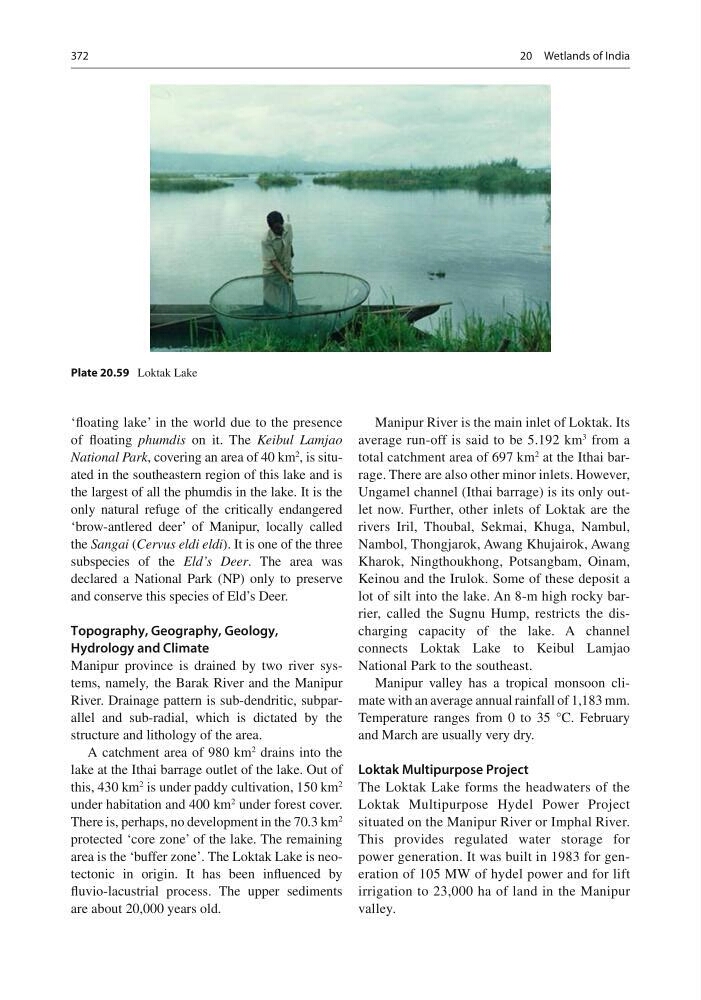
Plate 20.59 Loktak Lake
20 Wetlands of India
‘fl oating lake’ in the world due to the presence
of fl oating phumdis on it. The Keibul Lamjao
National Park , covering an area of 40 km
2
, is situated in the southeastern region of this lake and is
the largest of all the phumdis in the lake. It is the
only natural refuge of the critically endangered
‘brow- antlered deer’ of Manipur, locally called
the Sangai ( Cervus eldi eldi ). It is one of the three
subspecies of the Eld’s Deer . The area was
declared a National Park (NP) only to preserve
and conserve this species of Eld’s Deer.
Topography, Geography, Geology,
Hydrology and Climate
Manipur province is drained by two river systems, namely , the Barak River and the Manipur
River. Drainage pattern is sub-dendritic, subparallel and sub-radial, which is dictated by the
structure and lithology of the area.
A catchment area of 980 km
2 drains into the
lake at the Ithai barrage outlet of the lake. Out of
this, 430 km
2 is under paddy cultivation, 150 km
2
under habitation and 400 km
2 under forest cover.
There is, perhaps, no development in the 70.3 km
2
protected ‘core zone’ of the lake. The remaining
area is the ‘buffer zone’. The Loktak Lake is neotectonic in origin. It has been infl uenced by
fl uvio- lacustrial process. The upper sediments
are about 20,000 years old.
Manipur River is the main inlet of Loktak. Its
average run-off is said to be 5.192 km
3 from a
total catchment area of 697 km
2 at the Ithai barrage. There are also other minor inlets. However,
Ungamel channel (Ithai barrage) is its only outlet now. Further, other inlets of Loktak are the
rivers Iril, Thoubal, Sekmai, Khuga, Nambul,
Nambol, Thongjarok, Awang Khujairok, Awang
Kharok, Ningthoukhong, Potsangbam, Oinam,
Keinou and the Irulok. Some of these deposit a
lot of silt into the lake. An 8-m high rocky barrier, called the Sugnu Hump, restricts the discharging capacity of the lake. A channel
connects Loktak Lake to Keibul Lamjao
National Park to the southeast.
Manipur valley has a tropical monsoon climate with an average annual rainfall of 1,183 mm.
Temperature ranges from 0 to 35 °C. February
and March are usually very dry.
Loktak Multipurpose Project
The Loktak Lake forms the headwaters of the
Loktak Multipurpose Hydel Power Project
situated on the Manipur River or Imphal River.
This provides regulated water storage for
power generation. It was built in 1983 for generation of 105 MW of hydel power and for lift
irrigation to 23,000 ha of land in the Manipur
valley.
Plate 20.59 Loktak Lake
20 Wetlands of India