

316
Aquatic Macrophytes (AM)
Alternanthera sessilis, Azolla pinnata, Cynodon
dactylon, Eichhornia crassipes, Hygrorhiza aristata, Ipomoea aquatica, Jussiaea repens, Oryza
sativa, Salvinia cucullata, Trapa bispinosa,
Polygonum fl accidum, Pistia sp.
The Beel is a victim of eutrophication.
Plankton
Nostoc sp ., Microcystis aeruginosa , Euglena sp .,
Pinnularia sp. , Navicula sp., Arcella sp .,
Centropyxis sp ., Brachionus sp ., Keratella sp .,
Lecane sp . , Trichocerca sp . , Filinia sp ., Daphnia
sp ., Ceriodaphnia sp ., Bosmina sp ., Bosminopsis
sp ., Chydorus sp ., Cyclops sp . and Diaptomus sp.
Fish Diversity
Fourteen species of fi shes belonging to 12 genera, 6 families and 3 orders have been recorded in
Sat Beel (Kar 1998 ):
Amblypharyngodon mola, Cyprinus carpio
carpio, Labeo calbasu, Puntius chola, Puntius
ticto, Lepidocephalichthys guntea, Mystus
bleekeri, Mystus vittatus, Sperata seenghala,
Ompok bimaculatus, Wallago attu, Clupisoma
garua,, Channa punctatus and Macrognathus
pancalus.
Fish Yield (FY)
Weed fi shes are quite abundant because the wetland is a victim of eutrophication. Channa spp.
revealed good yield (30 %) followed by other
fi shes, namely , Puntius spp. (20 %), A. mola
(15 %) and Mystus spp. (20 %). The big size
fi shes account for approximately 15 % of the fi sh
yield.
Malini Beel
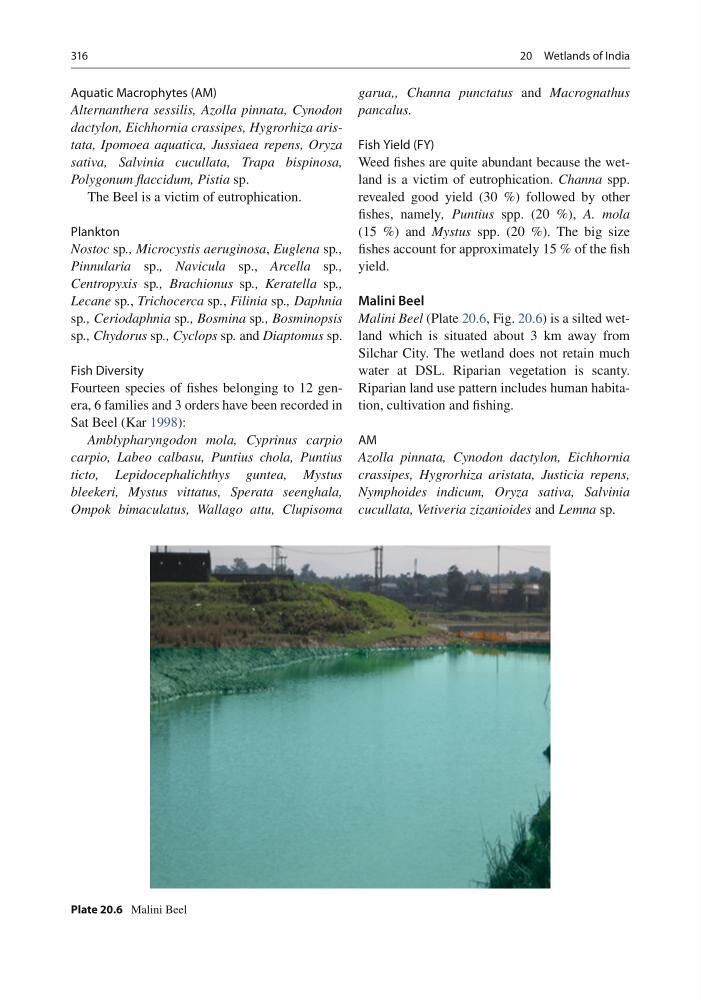
Malini Beel (Plate 20.6 , Fig. 20.6 ) is a silted wetland which is situated about 3 km away from
Silchar City. The wetland does not retain much
water at DSL. Riparian vegetation is scanty.
Riparian land use pattern includes human habitation, cultivation and fi shing.
AM
Azolla pinnata, Cynodon dactylon, Eichhornia
crassipes, Hygrorhiza aristata, Justicia repens,
Nymphoides indicum, Oryza sativa, Salvinia
cucullata, Vetiveria zizanioides and Lemna sp.
Plate 20.6 Malini Beel
20 Wetlands of India
Aquatic Macrophytes (AM)
Alternanthera sessilis, Azolla pinnata, Cynodon
dactylon, Eichhornia crassipes, Hygrorhiza aristata, Ipomoea aquatica, Jussiaea repens, Oryza
sativa, Salvinia cucullata, Trapa bispinosa,
Polygonum fl accidum, Pistia sp.
The Beel is a victim of eutrophication.
Plankton
Nostoc sp ., Microcystis aeruginosa , Euglena sp .,
Pinnularia sp. , Navicula sp., Arcella sp .,
Centropyxis sp ., Brachionus sp ., Keratella sp .,
Lecane sp . , Trichocerca sp . , Filinia sp ., Daphnia
sp ., Ceriodaphnia sp ., Bosmina sp ., Bosminopsis
sp ., Chydorus sp ., Cyclops sp . and Diaptomus sp.
Fish Diversity
Fourteen species of fi shes belonging to 12 genera, 6 families and 3 orders have been recorded in
Sat Beel (Kar 1998 ):
Amblypharyngodon mola, Cyprinus carpio
carpio, Labeo calbasu, Puntius chola, Puntius
ticto, Lepidocephalichthys guntea, Mystus
bleekeri, Mystus vittatus, Sperata seenghala,
Ompok bimaculatus, Wallago attu, Clupisoma
garua,, Channa punctatus and Macrognathus
pancalus.
Fish Yield (FY)
Weed fi shes are quite abundant because the wetland is a victim of eutrophication. Channa spp.
revealed good yield (30 %) followed by other
fi shes, namely , Puntius spp. (20 %), A. mola
(15 %) and Mystus spp. (20 %). The big size
fi shes account for approximately 15 % of the fi sh
yield.
Malini Beel
Malini Beel (Plate 20.6 , Fig. 20.6 ) is a silted wetland which is situated about 3 km away from
Silchar City. The wetland does not retain much
water at DSL. Riparian vegetation is scanty.
Riparian land use pattern includes human habitation, cultivation and fi shing.
AM
Azolla pinnata, Cynodon dactylon, Eichhornia
crassipes, Hygrorhiza aristata, Justicia repens,
Nymphoides indicum, Oryza sativa, Salvinia
cucullata, Vetiveria zizanioides and Lemna sp.
Plate 20.6 Malini Beel
20 Wetlands of India