

305
Aquatic Macrophytes (AM)
Twenty-three species of AM have been recorded
in this wetland. These could be classifi ed as
follows:
5 free fl oating, 4 rooted fl oating, 2 submerged
and 12 emergent. Of these, 6 AM species could
be found throughout the year. These are Azolla
pinnata, Eichhornia crassipes, Salvinia cucullata, Trapa bispinosa, Justicia repens and
Cynodon dactylon.
J. repens showed fl owering during March–
May, while Nymphaea nouchali bloomed during June–August followed by Nymphoides
cristatum and N. indicum which exhibited profuse fl owering during September–October.
Ipomoea aquatica depicted signifi cant growth
of population during July–August. Hydrilla
verticillata and Vallisneria spiralis , amongst
the submerged varieties, and Alternanthera sessilis, Cyperus platystylis, Echinochloa stagnina,
Eleocharis acutangula, Enhydra fl uctuans,
Scirpus eriophorum and Sagittaria trifolia ,
amongst the emergent varieties, succeeded at a
lesser water level during the dry season. The
fl oating varieties, namely, A. pinnata, E.
crassipes and S. cucullata , were recorded
throughout the year and found to be associated
with each other. Further, amongst the submerged varieties, H. verticillata and V. spiralis
were found to be associated.
Signifi cant phyto-social association was also
observed amongst Nymphaea sp. and Nymphoides
sp. and amongst Eleocharis acutangula, Scirpus
eriophorum and Echinochloa stagnina.
Fish Diversity
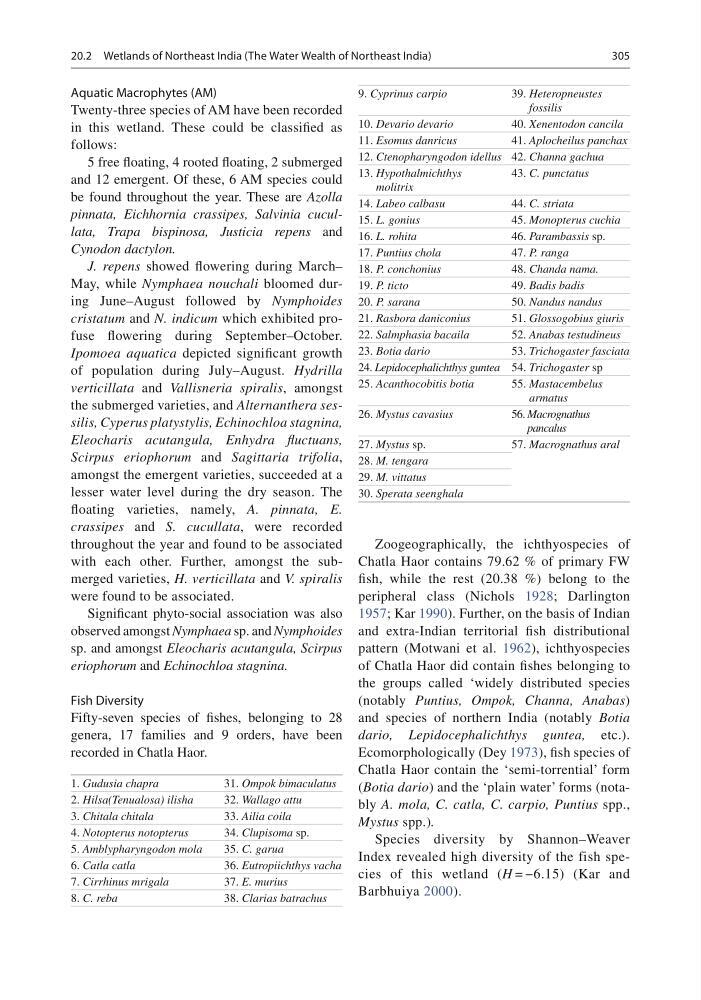
Fifty-seven species of fi shes, belonging to 28
genera, 17 families and 9 orders, have been
recorded in Chatla Haor.
1. Gudusia chapra
31. Ompok bimaculatus
2. Hilsa(Tenualosa) ilisha
32. Wallago attu
3. Chitala chitala
33. Ailia coila
4. Notopterus notopterus
34. Clupisoma sp.
5. Amblypharyngodon mola
35. C. garua
6. Catla catla
36. Eutropiichthys vacha
7. Cirrhinus mrigala
37. E. murius
8. C. reba
38. Clarias batrachus
9. Cyprinus carpio
39. Heteropneustes
fossilis
10. Devario devario
40. Xenentodon cancila
11. Esomus danricus
41. Aplocheilus panchax
12. Ctenopharyngodon idellus 42. Channa gachua
13. Hypothalmichthys
molitrix
43. C. punctatus
14. Labeo calbasu
44. C. striata
15. L. gonius
45. Monopterus cuchia
16. L. rohita
46. Parambassis sp.
17. Puntius chola
47. P. ranga
18. P. conchonius
48. Chanda nama.
19. P. ticto
49. Badis badis
20. P. sarana
50. Nandus nandus
21. Rasbora daniconius
51. Glossogobius giuris
22. Salmphasia bacaila
52. Anabas testudineus
23. Botia dario
53. Trichogaster fasciata
24. Lepidocephalichthys guntea 54. Trichogaster sp
25. Acanthocobitis botia
55. Mastacembelus
armatus
26. Mystus cavasius
56. Macrognathus
pancalus
27. Mystus sp.
57. Macrognathus aral
28. M. tengara
29. M. vittatus
30. Sperata seenghala
Zoogeographically, the ichthyospecies of
Chatla Haor contains 79.62 % of primary FW
fi sh, while the rest (20.38 %) belong to the
peripheral class (Nichols 1928 ; Darlington
1957 ; Kar 1990 ). Further, on the basis of Indian
and extra-Indian territorial fi sh distributional
pattern (Motwani et al. 1962 ), ichthyospecies
of Chatla Haor did contain fi shes belonging to
the groups called ‘widely distributed species
(notably Puntius, Ompok, Channa, Anabas )
and species of northern India (notably Botia
dario, Lepidocephalichthys guntea, etc.).
Ecomorphologically (Dey 1973 ), fi sh species of
Chatla Haor contain the ‘semi- torrential’ form
( Botia dario ) and the ‘plain water’ forms (notably A. mola, C. catla, C. carpio, Puntius spp.,
Mystus spp.) .
Species diversity by Shannon–Weaver
Index revealed high diversity of the fish species of this wetland ( H = −6.15) (Kar and
Barbhuiya 2000 ).
20.2 Wetlands of Northeast India (The Water Wealth of Northeast India)
Aquatic Macrophytes (AM)
Twenty-three species of AM have been recorded
in this wetland. These could be classifi ed as
follows:
5 free fl oating, 4 rooted fl oating, 2 submerged
and 12 emergent. Of these, 6 AM species could
be found throughout the year. These are Azolla
pinnata, Eichhornia crassipes, Salvinia cucullata, Trapa bispinosa, Justicia repens and
Cynodon dactylon.
J. repens showed fl owering during March–
May, while Nymphaea nouchali bloomed during June–August followed by Nymphoides
cristatum and N. indicum which exhibited profuse fl owering during September–October.
Ipomoea aquatica depicted signifi cant growth
of population during July–August. Hydrilla
verticillata and Vallisneria spiralis , amongst
the submerged varieties, and Alternanthera sessilis, Cyperus platystylis, Echinochloa stagnina,
Eleocharis acutangula, Enhydra fl uctuans,
Scirpus eriophorum and Sagittaria trifolia ,
amongst the emergent varieties, succeeded at a
lesser water level during the dry season. The
fl oating varieties, namely, A. pinnata, E.
crassipes and S. cucullata , were recorded
throughout the year and found to be associated
with each other. Further, amongst the submerged varieties, H. verticillata and V. spiralis
were found to be associated.
Signifi cant phyto-social association was also
observed amongst Nymphaea sp. and Nymphoides
sp. and amongst Eleocharis acutangula, Scirpus
eriophorum and Echinochloa stagnina.
Fish Diversity
Fifty-seven species of fi shes, belonging to 28
genera, 17 families and 9 orders, have been
recorded in Chatla Haor.
1. Gudusia chapra
31. Ompok bimaculatus
2. Hilsa(Tenualosa) ilisha
32. Wallago attu
3. Chitala chitala
33. Ailia coila
4. Notopterus notopterus
34. Clupisoma sp.
5. Amblypharyngodon mola
35. C. garua
6. Catla catla
36. Eutropiichthys vacha
7. Cirrhinus mrigala
37. E. murius
8. C. reba
38. Clarias batrachus
9. Cyprinus carpio
39. Heteropneustes
fossilis
10. Devario devario
40. Xenentodon cancila
11. Esomus danricus
41. Aplocheilus panchax
12. Ctenopharyngodon idellus 42. Channa gachua
13. Hypothalmichthys
molitrix
43. C. punctatus
14. Labeo calbasu
44. C. striata
15. L. gonius
45. Monopterus cuchia
16. L. rohita
46. Parambassis sp.
17. Puntius chola
47. P. ranga
18. P. conchonius
48. Chanda nama.
19. P. ticto
49. Badis badis
20. P. sarana
50. Nandus nandus
21. Rasbora daniconius
51. Glossogobius giuris
22. Salmphasia bacaila
52. Anabas testudineus
23. Botia dario
53. Trichogaster fasciata
24. Lepidocephalichthys guntea 54. Trichogaster sp
25. Acanthocobitis botia
55. Mastacembelus
armatus
26. Mystus cavasius
56. Macrognathus
pancalus
27. Mystus sp.
57. Macrognathus aral
28. M. tengara
29. M. vittatus
30. Sperata seenghala
Zoogeographically, the ichthyospecies of
Chatla Haor contains 79.62 % of primary FW
fi sh, while the rest (20.38 %) belong to the
peripheral class (Nichols 1928 ; Darlington
1957 ; Kar 1990 ). Further, on the basis of Indian
and extra-Indian territorial fi sh distributional
pattern (Motwani et al. 1962 ), ichthyospecies
of Chatla Haor did contain fi shes belonging to
the groups called ‘widely distributed species
(notably Puntius, Ompok, Channa, Anabas )
and species of northern India (notably Botia
dario, Lepidocephalichthys guntea, etc.).
Ecomorphologically (Dey 1973 ), fi sh species of
Chatla Haor contain the ‘semi- torrential’ form
( Botia dario ) and the ‘plain water’ forms (notably A. mola, C. catla, C. carpio, Puntius spp.,
Mystus spp.) .
Species diversity by Shannon–Weaver
Index revealed high diversity of the fish species of this wetland ( H = −6.15) (Kar and
Barbhuiya 2000 ).
20.2 Wetlands of Northeast India (The Water Wealth of Northeast India)