

113
Fisheries management of Gobind Sagar
Reservoir had included a programme of stocking
and harvesting. The inadvertent introduction of
silver carp had helped to build up the stocks of
food fi sh in this reservoir. The Fisheries
Department had been assisting, since 1974, in
organising about 1,000 fi shermen families into
cooperatives. Further management measures had
included the enforcement of mesh size regulation and imposition of a closed season during the
breeding season of some commercially important fi sh species. The capture and marketing of
fi sh is, possibly, still managed by the fi shery
cooperative societies. Several welfare schemes,
such as provision of subsidies for purchase of
fi shing equipment and personal accident insurance scheme, have helped in the emancipation of
the fi shermen communities.
Pong Reservoir
Pong Reservoir (also called Pong Lake ) is a shallow reservoir on the Beas River in HP with low
organic production. This reservoir (Plate 6.32 )
has a length, breadth (in its widest part), area
(FSL) and average depth of 42 km, 19 km,
24,529 ha and 35.7 m, respectively. The Beas and
its tributaries are snowmelt or glacier fed. Water
quality usually shows the temperature of surface
water 22.2–25.1 °C, the incoming river water
6–26 °C, Secchi disc transparency 0.12–4.8 m,
pH 7.0–8.4, TA 53–81 mg l
−1
, TH 19–68 mg l
−1 ,
specifi c conductivity 173–190 μmhos/cm, silicates 3.0–5.0 mg l
−1 and chlorides 6.0–7.0 mg l
−1
(Sehgal 1989a; Sugunan 1995). This lentic body
is said to be a haven for resident and migratory
birds situated in District Nurpur of HP.
The fi sh fauna was originally dominated by
catfi shes, minor carps and a few large-sized
fi shes. Systematic stocking of common carp and
IMC (after the fi rst introduction of the former in
1974 and the latter in 1976–1977) had led to the
alteration of the catch structure of the reservoir;
and carps, eventually, accounted for 61.8 % of
the total landings (1987–1988). Today, the
important fi sh species in order of abundance are
Labeo rohita , Sperata seenghala , Labeo calbasu ,
Tor putitora , Cirrhinus mrigala , Wallago attu ,
Cyprinus carpio , Labeo dero , Catla catla and
Channa spp. (Sugunan 1995). Mahseer stocks
declined from 101.5 t in 1982–1983 to 54 t in
1989–1990, whereas anglers used to (almost regularly) fi sh out 60–70 t of golden mahseer from
this reservoir annually. Further, in 1989–1990,
the fi sh yield was 20.4 kg ha
−1 , and the maximum
of 33.2 kg ha
−1 was recorded in 1987–1988.
The construction of the Gobind Sagar and
Pong reservoirs have created a perennial source
of fi sh supply for the people of HP and adjoining
states, but certain valuable migratory species
have been adversely affected. The golden mahseer ( Tor putitora ) is no longer able to migrate
into Kangra Valley due to the presence of the dam
at Pong. Nevertheless, the mahseer had established self-reproducing stocks within the new
limits. The impact of damming on schizothoracines had, possibly, been more serious.
Nonetheless, the gradual but continuous
increase in fi sh catches from the Gobind Sagar
and Pong reservoirs had led to a stable commercial fi shery, which generally provided employment to >4,000 fi shermen, traders, retailers, etc.
(Kumar 1997). During 1996–1997, >1,400 t of
fi sh were landed from both the reservoirs, out of
which about 400 t came from Pong. Gobind
Sagar is known for its rich landings. Similarly,
Pong is reputed for excellent quality of fi sh. As
Such, Pong fi sh fetch the highest unit price. Pong
is also a favourite place for anglers, who fi sh out
about 60–70 t of golden mahseers annually. Both
the reservoirs are judiciously managed at state
level by the Reservoirs Fisheries Development
Committee, which is now trying to focus on the
improvement of the socio-economic status of the
fi sherfolk, their social safety, such as insurance,
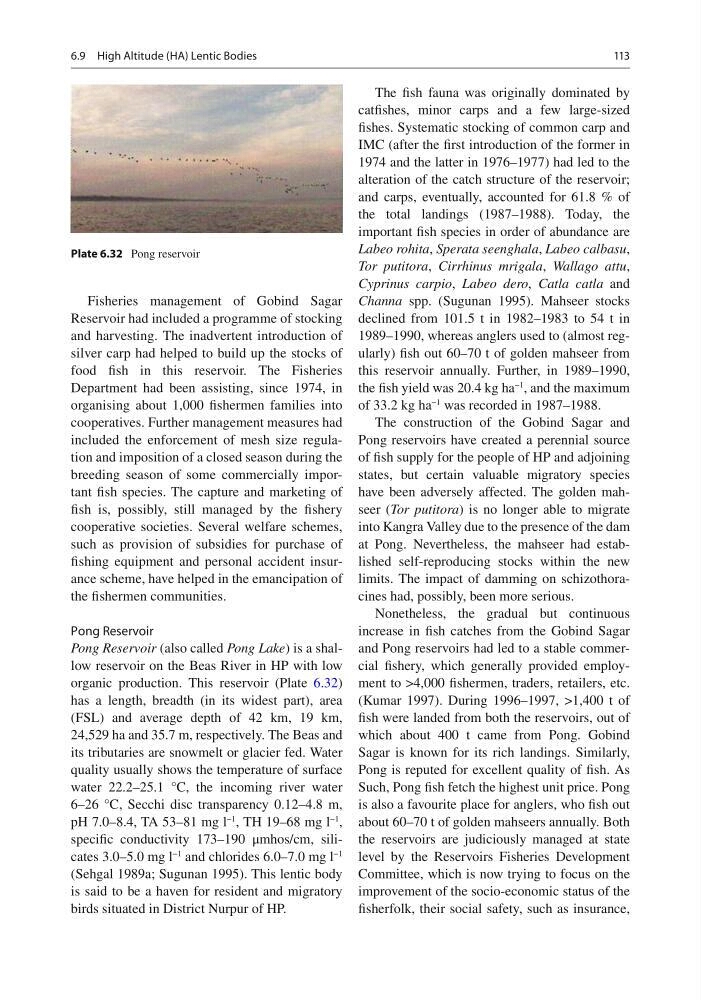
Plate 6.32 Pong reservoir
6.9 High Altitude (HA) Lentic Bodies
Fisheries management of Gobind Sagar
Reservoir had included a programme of stocking
and harvesting. The inadvertent introduction of
silver carp had helped to build up the stocks of
food fi sh in this reservoir. The Fisheries
Department had been assisting, since 1974, in
organising about 1,000 fi shermen families into
cooperatives. Further management measures had
included the enforcement of mesh size regulation and imposition of a closed season during the
breeding season of some commercially important fi sh species. The capture and marketing of
fi sh is, possibly, still managed by the fi shery
cooperative societies. Several welfare schemes,
such as provision of subsidies for purchase of
fi shing equipment and personal accident insurance scheme, have helped in the emancipation of
the fi shermen communities.
Pong Reservoir
Pong Reservoir (also called Pong Lake ) is a shallow reservoir on the Beas River in HP with low
organic production. This reservoir (Plate 6.32 )
has a length, breadth (in its widest part), area
(FSL) and average depth of 42 km, 19 km,
24,529 ha and 35.7 m, respectively. The Beas and
its tributaries are snowmelt or glacier fed. Water
quality usually shows the temperature of surface
water 22.2–25.1 °C, the incoming river water
6–26 °C, Secchi disc transparency 0.12–4.8 m,
pH 7.0–8.4, TA 53–81 mg l
−1
, TH 19–68 mg l
−1 ,
specifi c conductivity 173–190 μmhos/cm, silicates 3.0–5.0 mg l
−1 and chlorides 6.0–7.0 mg l
−1
(Sehgal 1989a; Sugunan 1995). This lentic body
is said to be a haven for resident and migratory
birds situated in District Nurpur of HP.
The fi sh fauna was originally dominated by
catfi shes, minor carps and a few large-sized
fi shes. Systematic stocking of common carp and
IMC (after the fi rst introduction of the former in
1974 and the latter in 1976–1977) had led to the
alteration of the catch structure of the reservoir;
and carps, eventually, accounted for 61.8 % of
the total landings (1987–1988). Today, the
important fi sh species in order of abundance are
Labeo rohita , Sperata seenghala , Labeo calbasu ,
Tor putitora , Cirrhinus mrigala , Wallago attu ,
Cyprinus carpio , Labeo dero , Catla catla and
Channa spp. (Sugunan 1995). Mahseer stocks
declined from 101.5 t in 1982–1983 to 54 t in
1989–1990, whereas anglers used to (almost regularly) fi sh out 60–70 t of golden mahseer from
this reservoir annually. Further, in 1989–1990,
the fi sh yield was 20.4 kg ha
−1 , and the maximum
of 33.2 kg ha
−1 was recorded in 1987–1988.
The construction of the Gobind Sagar and
Pong reservoirs have created a perennial source
of fi sh supply for the people of HP and adjoining
states, but certain valuable migratory species
have been adversely affected. The golden mahseer ( Tor putitora ) is no longer able to migrate
into Kangra Valley due to the presence of the dam
at Pong. Nevertheless, the mahseer had established self-reproducing stocks within the new
limits. The impact of damming on schizothoracines had, possibly, been more serious.
Nonetheless, the gradual but continuous
increase in fi sh catches from the Gobind Sagar
and Pong reservoirs had led to a stable commercial fi shery, which generally provided employment to >4,000 fi shermen, traders, retailers, etc.
(Kumar 1997). During 1996–1997, >1,400 t of
fi sh were landed from both the reservoirs, out of
which about 400 t came from Pong. Gobind
Sagar is known for its rich landings. Similarly,
Pong is reputed for excellent quality of fi sh. As
Such, Pong fi sh fetch the highest unit price. Pong
is also a favourite place for anglers, who fi sh out
about 60–70 t of golden mahseers annually. Both
the reservoirs are judiciously managed at state
level by the Reservoirs Fisheries Development
Committee, which is now trying to focus on the
improvement of the socio-economic status of the
fi sherfolk, their social safety, such as insurance,
Plate 6.32 Pong reservoir
6.9 High Altitude (HA) Lentic Bodies