

112
Mahakali Lake
It is an HA lake, lying at 4,080 m MSL, between
Sano and Gudial in Chamba District of HP.
Lama Dal
Lama Dal , lying at 3,960 m MSL, between 32°
20′ 47″ N and 76° 18′ 4″ E, is an HA lake located
in district Chamba (45 km from Chamba main
town) of HP.
Further, Kareri Lake is situated just 3 km (air
distance) southwest.
Chander Naun
Chander Naun , lying at 4,260 m MSL, is an HA
lake located at Rohru tehsil in Shimla District of
HP. It is surrounded by snow for a long time and
is the source of the river Pabbar.
Reservoirs
The Gobind Sagar (560 m MSL) and Pong
(436 m MSL) are the two potential reservoirs of
the Himalayan foothills in HP, which supply
large quantity of fi shes to the Himalayan States.
Fish landings from Gobind Sagar account for
58–60 % of the total fi sh production in HP.
Gobind Sagar Reservoir
This reservoir was constructed in 1963 by
impounding the River Sutlej at Bhakra. The Sutlej
usually receives cool, snowmelt water during
spring and water from monsoon rains during July–
September. The Sutlej joins the River Beas and
enters Pakistan downstream of the reservoir. In
1978, the Beas–Sutlej Link (BSL) was completed,
diverting Beas water to Gobind Sagar in order to
augment the power generation and irrigation
capacity of the reservoir (Sugunan 1995). A peculiar ecosystem with unique pattern of thermal and
oxygen regime and dissolved chemical components is usually formed due to the happy blending
of cool Beas water with comparatively warmer
Sutlej water. This, in turn, had an impact on the life
and production of aquatic biota.
The Gobind Sagar reservoir has a length,
breadth, area (FSL) and area (DSL) of 168 km,
6 km, 15,867 ha and 5,063 ha, respectively. The
annual water fl uctuation varies from 41 to 61 m,
and the maximum amplitude is 70 m. The water
temperature usually ranged from 17 to 27 °C
before the completion of BSL; while it had never
exceeded 18 °C after the BSL was connected,
mainly because of the infl uence of cool Beas
water. There was a concomitant rise in DO level
(Sugunan 1995).
Before the construction of the dam, the upper
reaches of the River Sutlej used to contain 30
species of fi shes, of which Tor putitora , Labeo
dero , L. dyocheilus , Schizothorax and Sperata
seenghala were quite abundant. In 1961–1962,
Gobind Sagar was stocked with IMC followed by
a regular stocking with common carp. Later,
Jhingran and Sehgal (1978) and Rao and Natrajan
(1979) reported 51 species, subspecies and varieties of fi sh (e.g . Tor putitora , Catla , catla , Labeo
rohita , L. calbasu , Sperata seenghala ) from
Gobind Sagar. Notably, the emergence of silver
carp in the reservoir in 1979 marked the beginning of a radical change in the catch structure,
with this fi sh establishing an overriding dominance over all other species (Sugunan 1995).
After their introduction, common carp and
silver carp gradually increased their proportion in
the total catch. Gobind Sagar is, possibly, the
only Indian reservoir where silver carp has produced a self-sustaining stock. However, the major
disadvantages of the fi sh are its poor self-life and
low market preference. Nevertheless, the total
annual catch from Gobind Sagar had continued to
increase, with 1,016 t achieved in 1996–1997,
much of it being silver carp (Kumar 1997).
However, there had been a moderate increase in
the quantity of captured mahseer since 1974.
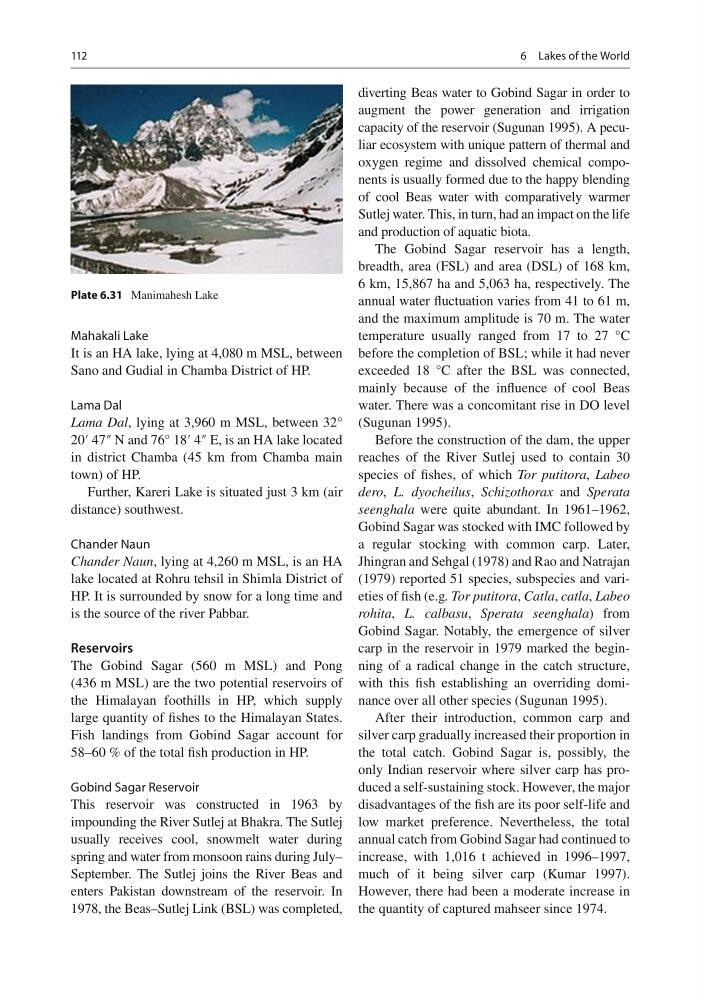
Plate 6.31 Manimahesh Lake
6 Lakes of the World
Mahakali Lake
It is an HA lake, lying at 4,080 m MSL, between
Sano and Gudial in Chamba District of HP.
Lama Dal
Lama Dal , lying at 3,960 m MSL, between 32°
20′ 47″ N and 76° 18′ 4″ E, is an HA lake located
in district Chamba (45 km from Chamba main
town) of HP.
Further, Kareri Lake is situated just 3 km (air
distance) southwest.
Chander Naun
Chander Naun , lying at 4,260 m MSL, is an HA
lake located at Rohru tehsil in Shimla District of
HP. It is surrounded by snow for a long time and
is the source of the river Pabbar.
Reservoirs
The Gobind Sagar (560 m MSL) and Pong
(436 m MSL) are the two potential reservoirs of
the Himalayan foothills in HP, which supply
large quantity of fi shes to the Himalayan States.
Fish landings from Gobind Sagar account for
58–60 % of the total fi sh production in HP.
Gobind Sagar Reservoir
This reservoir was constructed in 1963 by
impounding the River Sutlej at Bhakra. The Sutlej
usually receives cool, snowmelt water during
spring and water from monsoon rains during July–
September. The Sutlej joins the River Beas and
enters Pakistan downstream of the reservoir. In
1978, the Beas–Sutlej Link (BSL) was completed,
diverting Beas water to Gobind Sagar in order to
augment the power generation and irrigation
capacity of the reservoir (Sugunan 1995). A peculiar ecosystem with unique pattern of thermal and
oxygen regime and dissolved chemical components is usually formed due to the happy blending
of cool Beas water with comparatively warmer
Sutlej water. This, in turn, had an impact on the life
and production of aquatic biota.
The Gobind Sagar reservoir has a length,
breadth, area (FSL) and area (DSL) of 168 km,
6 km, 15,867 ha and 5,063 ha, respectively. The
annual water fl uctuation varies from 41 to 61 m,
and the maximum amplitude is 70 m. The water
temperature usually ranged from 17 to 27 °C
before the completion of BSL; while it had never
exceeded 18 °C after the BSL was connected,
mainly because of the infl uence of cool Beas
water. There was a concomitant rise in DO level
(Sugunan 1995).
Before the construction of the dam, the upper
reaches of the River Sutlej used to contain 30
species of fi shes, of which Tor putitora , Labeo
dero , L. dyocheilus , Schizothorax and Sperata
seenghala were quite abundant. In 1961–1962,
Gobind Sagar was stocked with IMC followed by
a regular stocking with common carp. Later,
Jhingran and Sehgal (1978) and Rao and Natrajan
(1979) reported 51 species, subspecies and varieties of fi sh (e.g . Tor putitora , Catla , catla , Labeo
rohita , L. calbasu , Sperata seenghala ) from
Gobind Sagar. Notably, the emergence of silver
carp in the reservoir in 1979 marked the beginning of a radical change in the catch structure,
with this fi sh establishing an overriding dominance over all other species (Sugunan 1995).
After their introduction, common carp and
silver carp gradually increased their proportion in
the total catch. Gobind Sagar is, possibly, the
only Indian reservoir where silver carp has produced a self-sustaining stock. However, the major
disadvantages of the fi sh are its poor self-life and
low market preference. Nevertheless, the total
annual catch from Gobind Sagar had continued to
increase, with 1,016 t achieved in 1996–1997,
much of it being silver carp (Kumar 1997).
However, there had been a moderate increase in
the quantity of captured mahseer since 1974.
Plate 6.31 Manimahesh Lake
6 Lakes of the World