

102
Khangchendzonga Biosphere Reserve (Buffer
Zone IV). The lake has a maximum length,
breadth, depth, average depth and area of 547 m,
352 m, 9 m, 7.2 m and 15.08 ha (7.11 ha of clear
water area + 7.97 ha of aqua-vegetation area or
marshy land), respectively. The lake has two
perennial and fi ve seasonal inlets and one major
perennial outlet. Average annual rainfall is
1,183 mm. Temperature ranges from 15 to
28 °C. The lake has moderate turbidity and some
AM on the periphery. An aquifer is expected to
be opening at the lake bottom. The bog has an
area of 70.1 m
2 with a peat of 2–5 m depth
(approx.). The lake is a habitat for TransHimalayan migratory birds during winter. The
lake provides recreational tourism besides pilgrimage. The lake is surrounded with marginal
vegetation forming ‘kettle hole bog’ dominated
by species of Sphagnum and Acorus. Other
important vegetations recorded around the lake
area are Symplocos thaefolia and Eurya acuminata . The holistic view of degradation and
decrease in longevity of the lake takes into
account various factors, like growth of population, fragmentation of families, land use/cover
change, livestock grazing, timber and fi rewood
extraction and growth of tourism and pilgrimage. Assessment of these factors may help in
management. Further, the lake is enveloped in a
dense forest cover of temperate vegetation and
bamboo. Various ethnic religio-cultural aspects
and sacred beliefs had been associated with it.
In addition, a great diversity of invertebrate and
vertebrate fauna is associated with this lake.
The real name of this lake is Sho Dzo Sho . The
origin of this lake has been narrated in the sacred
scriptures of the Sikkimese. Buddhism is said to
have started after the Nepali invasion of the medieval kingdom in the 1780s. The Nepali army is
said to have destroyed the palace of the Namgyal
Dynasty. However, the lake, of late, has been
having much anthropogenic impact mainly
through tourism which threatens its conservation.
Nevertheless, it may be possible to conserve the
natural and cultural heritage of the lake and also
that of the Himalayan region as a whole, by promoting traditional sacred beliefs, preserving its
folklores and, possibly, linking ecotourism with
socio-economic development of the local populace. Notably, there are ‘Lepcha’ settlements
around the lake. Further, the lake is a wintering
ground for the Trans-Himalayan migratory birds.
The important Bumchu festival attracts large
number of tourists. The large gathering of visitors
generally results in some negative impacts on the
serenity of the lake especially in the form of
noise, littering, garbage, vehicular pollution,
resource extraction and the offerings made in the
lake water. There is said to be a net deposition of
around 3 million gram (Mg) of garbage annually
in the lake watershed as contributed by tourism
and pilgrimage (Jain et al. 2004a).
Deforestation from the lake watershed for timber and fi rewood has certainly led to squeezing of
certain canopy species, such as Quercus and
Castanopsis . Likewise, livestock grazing had
defi nite pressure on the regeneration of tree species. Annual woody biomass removal was 26 %
and the fodder 47 % of the productivity from the
watershed forest. Reduction of canopy species,
trampling by grazing livestock and conversion of
forest areas to agricultural land have led to exposure of soil leading to nutrient loss from the
watershed. The disturbed forest showed 5.65
times higher soil loss compared to undisturbed
forest. In a study, a net annual deposition of
141 Mg of sediment in the lake and bog was
recorded. The highest soil loss was from the agriculture land followed by bare land. Total soil loss
from the Khecheopalri lake watershed was
502 Mg km
−2 year
−1 with the soil deposit of
141 Mg km
−2 year
−1
. Nevertheless, it was, possibly,
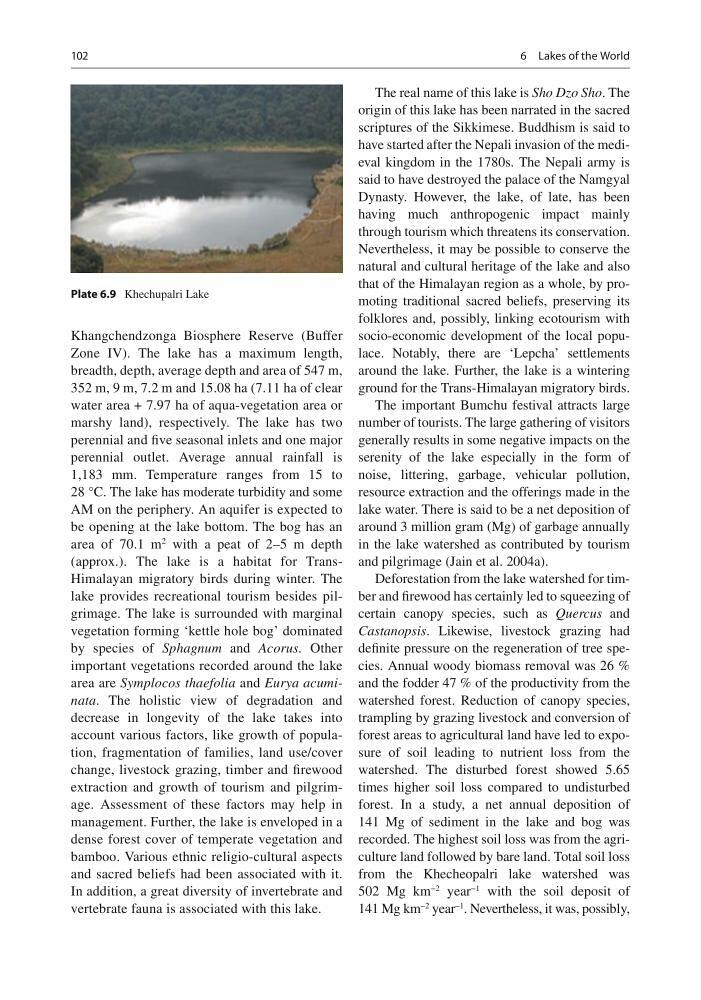
Plate 6.9 Khechupalri Lake
6 Lakes of the World
Khangchendzonga Biosphere Reserve (Buffer
Zone IV). The lake has a maximum length,
breadth, depth, average depth and area of 547 m,
352 m, 9 m, 7.2 m and 15.08 ha (7.11 ha of clear
water area + 7.97 ha of aqua-vegetation area or
marshy land), respectively. The lake has two
perennial and fi ve seasonal inlets and one major
perennial outlet. Average annual rainfall is
1,183 mm. Temperature ranges from 15 to
28 °C. The lake has moderate turbidity and some
AM on the periphery. An aquifer is expected to
be opening at the lake bottom. The bog has an
area of 70.1 m
2 with a peat of 2–5 m depth
(approx.). The lake is a habitat for TransHimalayan migratory birds during winter. The
lake provides recreational tourism besides pilgrimage. The lake is surrounded with marginal
vegetation forming ‘kettle hole bog’ dominated
by species of Sphagnum and Acorus. Other
important vegetations recorded around the lake
area are Symplocos thaefolia and Eurya acuminata . The holistic view of degradation and
decrease in longevity of the lake takes into
account various factors, like growth of population, fragmentation of families, land use/cover
change, livestock grazing, timber and fi rewood
extraction and growth of tourism and pilgrimage. Assessment of these factors may help in
management. Further, the lake is enveloped in a
dense forest cover of temperate vegetation and
bamboo. Various ethnic religio-cultural aspects
and sacred beliefs had been associated with it.
In addition, a great diversity of invertebrate and
vertebrate fauna is associated with this lake.
The real name of this lake is Sho Dzo Sho . The
origin of this lake has been narrated in the sacred
scriptures of the Sikkimese. Buddhism is said to
have started after the Nepali invasion of the medieval kingdom in the 1780s. The Nepali army is
said to have destroyed the palace of the Namgyal
Dynasty. However, the lake, of late, has been
having much anthropogenic impact mainly
through tourism which threatens its conservation.
Nevertheless, it may be possible to conserve the
natural and cultural heritage of the lake and also
that of the Himalayan region as a whole, by promoting traditional sacred beliefs, preserving its
folklores and, possibly, linking ecotourism with
socio-economic development of the local populace. Notably, there are ‘Lepcha’ settlements
around the lake. Further, the lake is a wintering
ground for the Trans-Himalayan migratory birds.
The important Bumchu festival attracts large
number of tourists. The large gathering of visitors
generally results in some negative impacts on the
serenity of the lake especially in the form of
noise, littering, garbage, vehicular pollution,
resource extraction and the offerings made in the
lake water. There is said to be a net deposition of
around 3 million gram (Mg) of garbage annually
in the lake watershed as contributed by tourism
and pilgrimage (Jain et al. 2004a).
Deforestation from the lake watershed for timber and fi rewood has certainly led to squeezing of
certain canopy species, such as Quercus and
Castanopsis . Likewise, livestock grazing had
defi nite pressure on the regeneration of tree species. Annual woody biomass removal was 26 %
and the fodder 47 % of the productivity from the
watershed forest. Reduction of canopy species,
trampling by grazing livestock and conversion of
forest areas to agricultural land have led to exposure of soil leading to nutrient loss from the
watershed. The disturbed forest showed 5.65
times higher soil loss compared to undisturbed
forest. In a study, a net annual deposition of
141 Mg of sediment in the lake and bog was
recorded. The highest soil loss was from the agriculture land followed by bare land. Total soil loss
from the Khecheopalri lake watershed was
502 Mg km
−2 year
−1 with the soil deposit of
141 Mg km
−2 year
−1
. Nevertheless, it was, possibly,
Plate 6.9 Khechupalri Lake
6 Lakes of the World