

25
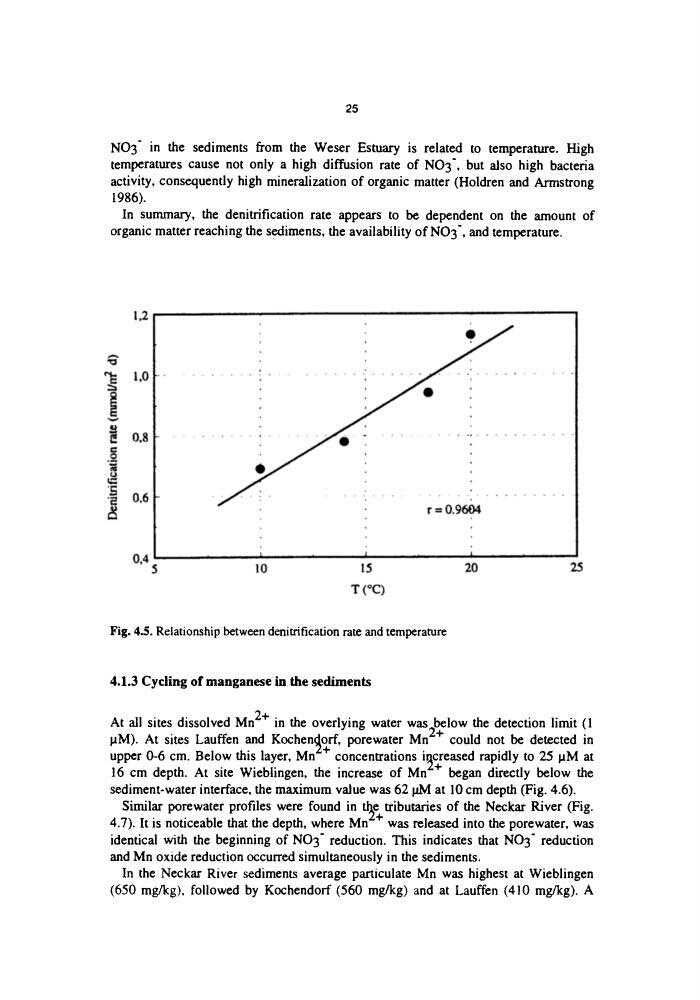
NO3" in the sediments from the Weser Estuary is related to temperature. High
temperatures cause not only a high diffusion rate of NO3", but also high bacteria
activity, consequently high mineralization of organic matter (Holdren and Armstrong
1986).
In summary, the denitrification rate appears to be dependent on the amount of
organic matter reaching the sediments, the availability of NO3", and temperature.
1,2
"(3
~ 0,8
e~
.o
"2 0.6
0,4 5
25
....
ii
r = 0.9604
i
i
i
i
i
10
15
20
T (~
Fig. 4.5. Relationship between denitrification rate and temperature
4.1.3 Cycling of manganese in the sediments
9
.
2+ .
.
.
.
At all sites dtssolved Mn
m the overlying water was below the detectaon hmit (1
2+
laM). At sites Lauffen and Kocben~orf, porewater Mn
could not be detected in
upper 0-6 cm. Below this layer, Mn z+ concentrations iqcreased rapidly to 25 )aM at
16 cm depth. At site Wieblingen, the increase of Mn "+ began directly below the
sediment-water interface, the maximum value was 62 gM at 10 cm depth (Fig. 4.6).
Similar porewater profiles were found in tll,e tributaries of the Neckar River (Fig.
L +
4.7). It is noticeable that the depth, where Mn
was released into the porewater, was
identical with the beginning of NO3" reduction. This indicates that NO3" reduction
and Mn oxide reduction occurred simultaneously in the sediments.
In the Neckar River sediments average particulate Mn was highest at Wieblingen
(650 mg/kg), followed by Kochendorf (560 mg/kg) and at Lauffen (410 mg/kg). A
NO3" in the sediments from the Weser Estuary is related to temperature. High
temperatures cause not only a high diffusion rate of NO3", but also high bacteria
activity, consequently high mineralization of organic matter (Holdren and Armstrong
1986).
In summary, the denitrification rate appears to be dependent on the amount of
organic matter reaching the sediments, the availability of NO3", and temperature.
1,2
"(3
~ 0,8
e~
.o
"2 0.6
0,4 5
25
....
ii
r = 0.9604
i
i
i
i
i
10
15
20
T (~
Fig. 4.5. Relationship between denitrification rate and temperature
4.1.3 Cycling of manganese in the sediments
9
.
2+ .
.
.
.
At all sites dtssolved Mn
m the overlying water was below the detectaon hmit (1
2+
laM). At sites Lauffen and Kocben~orf, porewater Mn
could not be detected in
upper 0-6 cm. Below this layer, Mn z+ concentrations iqcreased rapidly to 25 )aM at
16 cm depth. At site Wieblingen, the increase of Mn "+ began directly below the
sediment-water interface, the maximum value was 62 gM at 10 cm depth (Fig. 4.6).
Similar porewater profiles were found in tll,e tributaries of the Neckar River (Fig.
L +
4.7). It is noticeable that the depth, where Mn
was released into the porewater, was
identical with the beginning of NO3" reduction. This indicates that NO3" reduction
and Mn oxide reduction occurred simultaneously in the sediments.
In the Neckar River sediments average particulate Mn was highest at Wieblingen
(650 mg/kg), followed by Kochendorf (560 mg/kg) and at Lauffen (410 mg/kg). A