

12
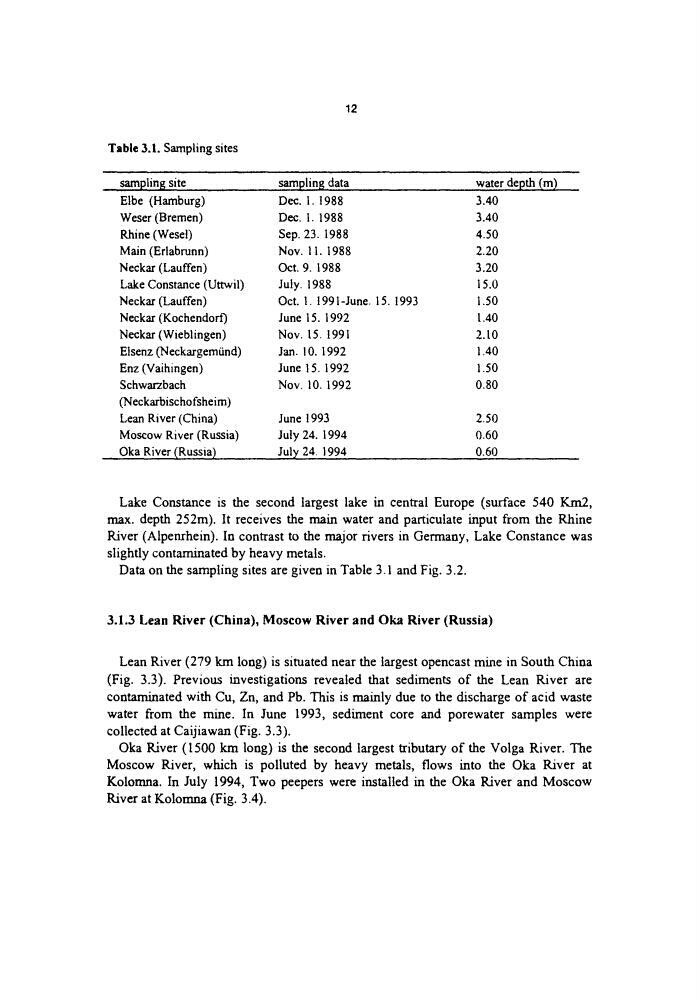
Table 3.1. Sampling sites
.... samEling site
sampling.data
water depth f.m)
Elbe (Hamburg)
Dec. I. 1988
3.40
Weser (Bremen)
Dee. 1. 1988
3.40
Rhine (Wesel)
Sep. 23. 1988
4.50
Main (Erlabrunn)
Nov. 1 I. 1988
2.20
Neckar (Lauffen)
Oct. 9. 1988
3.20
Lake Constance (Uttwil)
July. 1988
15.0
Neckar (Lauffen)
Oct. 1. 199t-June. 15. 1993
1.50
Neckar (Kochendorf)
June 15. 1992
1.40
Neckar (Wieblingen)
Nov. 15. 1991
2.10
Elsenz (Neckargemtind)
Jan. I 0. 1992
1.40
Enz (Vaihingen)
June 15. 1992
1.50
Schwarzbach
Nov. 10. 1992
0.80
(Neckarbischofsheim)
Lean River (China)
June 1993
2.50
Moscow River (Russia)
July 24. 1994
0.60
Oka River (Ru~ia)
July 24. 1994
0.60
Lake Constance is the second largest lake in central Europe (surface 540 Kin2,
max. depth 252m). It receives the main water and particulate input from the Rhine
River (Alpenrhein). In contrast to the major rivers in Germany, Lake Constance was
slightly contaminated by heavy metals.
Data on the sampling sites are given in Table 3.1 and Fig. 3.2.
3.1.3 Lean River (China), Moscow River and Oka River (Russia)
Lean River (279 krn long) is situated near the largest opencast mine in South China
(Fig. 3.3). Previous investigations revealed that sediments of the Lean River are
contaminated with Cu, Zn, and Pb. This is mainly due to the discharge of acid waste
water from the mine. In June 1993, sediment core and porewater samples were
collected at Caijiawan (Fig. 3.3).
Oka River (1500 km long) is the second largest tributary of the Volga River. The
Moscow River, which is polluted by heavy metals, flows into the Oka River at
Kolomna. In July 1994, Two peepers were installed in the Oka River and Moscow
River at Kolomna (Fig. 3.4).
Table 3.1. Sampling sites
.... samEling site
sampling.data
water depth f.m)
Elbe (Hamburg)
Dec. I. 1988
3.40
Weser (Bremen)
Dee. 1. 1988
3.40
Rhine (Wesel)
Sep. 23. 1988
4.50
Main (Erlabrunn)
Nov. 1 I. 1988
2.20
Neckar (Lauffen)
Oct. 9. 1988
3.20
Lake Constance (Uttwil)
July. 1988
15.0
Neckar (Lauffen)
Oct. 1. 199t-June. 15. 1993
1.50
Neckar (Kochendorf)
June 15. 1992
1.40
Neckar (Wieblingen)
Nov. 15. 1991
2.10
Elsenz (Neckargemtind)
Jan. I 0. 1992
1.40
Enz (Vaihingen)
June 15. 1992
1.50
Schwarzbach
Nov. 10. 1992
0.80
(Neckarbischofsheim)
Lean River (China)
June 1993
2.50
Moscow River (Russia)
July 24. 1994
0.60
Oka River (Ru~ia)
July 24. 1994
0.60
Lake Constance is the second largest lake in central Europe (surface 540 Kin2,
max. depth 252m). It receives the main water and particulate input from the Rhine
River (Alpenrhein). In contrast to the major rivers in Germany, Lake Constance was
slightly contaminated by heavy metals.
Data on the sampling sites are given in Table 3.1 and Fig. 3.2.
3.1.3 Lean River (China), Moscow River and Oka River (Russia)
Lean River (279 krn long) is situated near the largest opencast mine in South China
(Fig. 3.3). Previous investigations revealed that sediments of the Lean River are
contaminated with Cu, Zn, and Pb. This is mainly due to the discharge of acid waste
water from the mine. In June 1993, sediment core and porewater samples were
collected at Caijiawan (Fig. 3.3).
Oka River (1500 km long) is the second largest tributary of the Volga River. The
Moscow River, which is polluted by heavy metals, flows into the Oka River at
Kolomna. In July 1994, Two peepers were installed in the Oka River and Moscow
River at Kolomna (Fig. 3.4).