

99
oxides in the Oka River sediments. As products of the decomposition of organic
matter, PO43" and NH4" were released into the porewater. The maxtmum values of
NH4+ were 3.0 mM and 2.2 mM in the sediments of Moscow River and Oka River,
respectively. These values are lower compared to the Neckar River sediments (4 - 15
raM). This is in good agreement with the low organic carbon content (2.5%) in the
sediments of the Moscow River and Oka River.
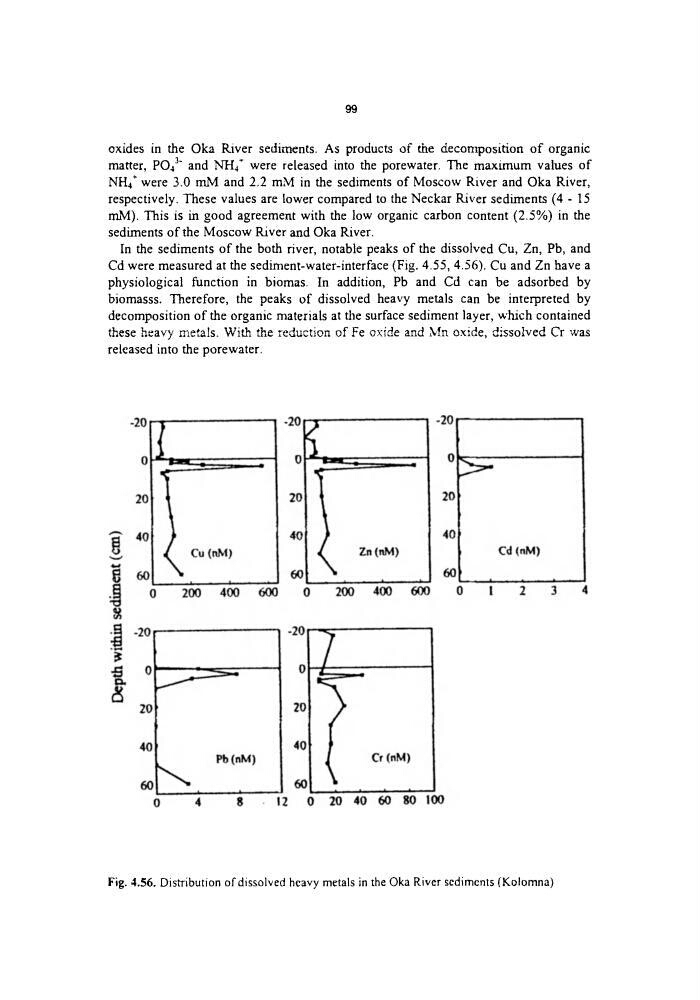
In the sediments of the both river, notable peaks of the dissolved Cu, Zn, Pb, and
Cd were measured at the sediment-water-interface (Fig. 4.55, 4.56). Cu and Zn have a
physiological function in biomas. In addition, Pb and Cd can be adsorbed by
biomasss. Therefore, the peaks of dissolved heavy metals can be interpreted by
decomposition of the organic materials at the surface sediment layer, which contained
these heavy metals. With the reduction of Fe oxide and Mn oxide, clissoIved Cr was
released into the porewater.
-20
20
" 4O
v
o
-20
-20
0
20
40
Cu (riM)
Zn (riM)
z~o 4~o ~
o 200 400
2O
40
Pb (nM)
12
-20
0
2O
-2~ ~==_.
o
4O
6O
0
Cr (nM)
204'o ~'io ioo
4C
Cd (nM)
6C
0
1
Fig. 4.56. Distribution of dissolved heavy metals in the Oka River sediments (Kolomna)
oxides in the Oka River sediments. As products of the decomposition of organic
matter, PO43" and NH4" were released into the porewater. The maxtmum values of
NH4+ were 3.0 mM and 2.2 mM in the sediments of Moscow River and Oka River,
respectively. These values are lower compared to the Neckar River sediments (4 - 15
raM). This is in good agreement with the low organic carbon content (2.5%) in the
sediments of the Moscow River and Oka River.
In the sediments of the both river, notable peaks of the dissolved Cu, Zn, Pb, and
Cd were measured at the sediment-water-interface (Fig. 4.55, 4.56). Cu and Zn have a
physiological function in biomas. In addition, Pb and Cd can be adsorbed by
biomasss. Therefore, the peaks of dissolved heavy metals can be interpreted by
decomposition of the organic materials at the surface sediment layer, which contained
these heavy metals. With the reduction of Fe oxide and Mn oxide, clissoIved Cr was
released into the porewater.
-20
20
" 4O
v
o
-20
-20
0
20
40
Cu (riM)
Zn (riM)
z~o 4~o ~
o 200 400
2O
40
Pb (nM)
12
-20
0
2O
-2~ ~==_.
o
4O
6O
0
Cr (nM)
204'o ~'io ioo
4C
Cd (nM)
6C
0
1
Fig. 4.56. Distribution of dissolved heavy metals in the Oka River sediments (Kolomna)