

98
The Oka River mainly drains area agricultural area. However, the Moscow River,
one of the tributaries of the Oka River, flows through the most important industrial
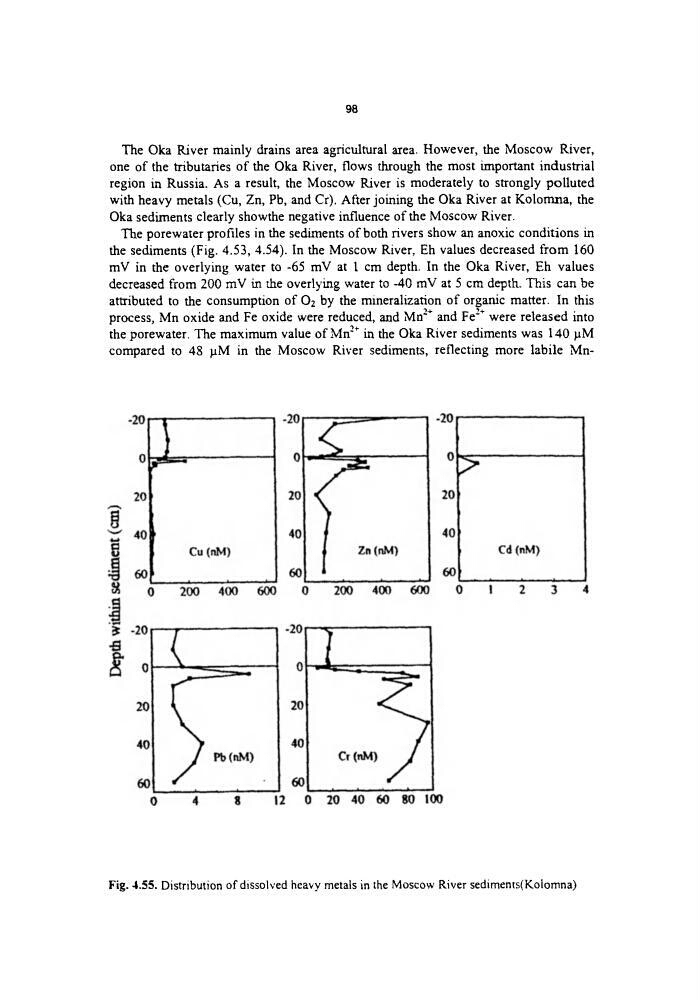
region in Russia. As a result, the Moscow River is moderately to strongly polluted
with heavy metals (Cu, Zn, Pb, and Cr). After joining the Oka River at Kolorrma, the
Oka sediments clearly showthe negative influence of the Moscow River.
The porewater profiles in the sediments of both rivers show an anoxic conditions in
the sediments (Fig. 4.53, 4.54). In the Moscow River, Eh values decreased from 160
mV in the overlying water to -65 mV at l cm depth. In the Oka River, Eh values
decreased from 200 mV in the overlying water to -40 mV at 5 cm depth. This can be
attributed to the consumption of O2 by the mineralization of organic matter. In this
process, Mn oxide and Fe oxide were reduced, and Mn 2+ and Fe z+ were released into
the porewater. The maximum value of Mn 2§ in the Oka River sediments was 140 pM
compared to 48 ~tM in the Moscow River sediments, reflecting more labile Mn-20
2o
"-" 40
8
0
200 400 60o
60o 0
4
Cu (~Vl)
-21 L
2O
:I
o
I
Zn (riM)
200 400
-20 "~.
0
40
i
i
201 ~
?I .....
12 0 20 40 60 80 I00
-2O
o2,
20
40
6O
Cd (nM)
Fig. 4.55. Distribution &dissolved heavy metals in the Moscow River sediments(Kolomna)
The Oka River mainly drains area agricultural area. However, the Moscow River,
one of the tributaries of the Oka River, flows through the most important industrial
region in Russia. As a result, the Moscow River is moderately to strongly polluted
with heavy metals (Cu, Zn, Pb, and Cr). After joining the Oka River at Kolorrma, the
Oka sediments clearly showthe negative influence of the Moscow River.
The porewater profiles in the sediments of both rivers show an anoxic conditions in
the sediments (Fig. 4.53, 4.54). In the Moscow River, Eh values decreased from 160
mV in the overlying water to -65 mV at l cm depth. In the Oka River, Eh values
decreased from 200 mV in the overlying water to -40 mV at 5 cm depth. This can be
attributed to the consumption of O2 by the mineralization of organic matter. In this
process, Mn oxide and Fe oxide were reduced, and Mn 2+ and Fe z+ were released into
the porewater. The maximum value of Mn 2§ in the Oka River sediments was 140 pM
compared to 48 ~tM in the Moscow River sediments, reflecting more labile Mn-20
2o
"-" 40
8
0
200 400 60o
60o 0
4
Cu (~Vl)
-21 L
2O
:I
o
I
Zn (riM)
200 400
-20 "~.
0
40
i
i
201 ~
?I .....
12 0 20 40 60 80 I00
-2O
o2,
20
40
6O
Cd (nM)
Fig. 4.55. Distribution &dissolved heavy metals in the Moscow River sediments(Kolomna)