

75
also limit the ability of aquatic and riparian organisms to reproduce and disperse
(Pringle et al. 2000). Smaller peak flows reduce the ability of the river to transport
sediment that enters downstream from the dam, which can lead to a condition of
excess sediment and channel aggradation (Salant et al. 2006; Ta et al. 2008).
Finally, lower peak flows can limit lateral connectivity by eliminating processes
such as overbank flooding (Walker and Thomas 1993; Renshaw et al. 2014). Abrupt
fluctuations in flow associated with hydropower generation can strand and kill
aquatic organisms such as juvenile fish along the channel margins (Stanford and
Hauer 1992).
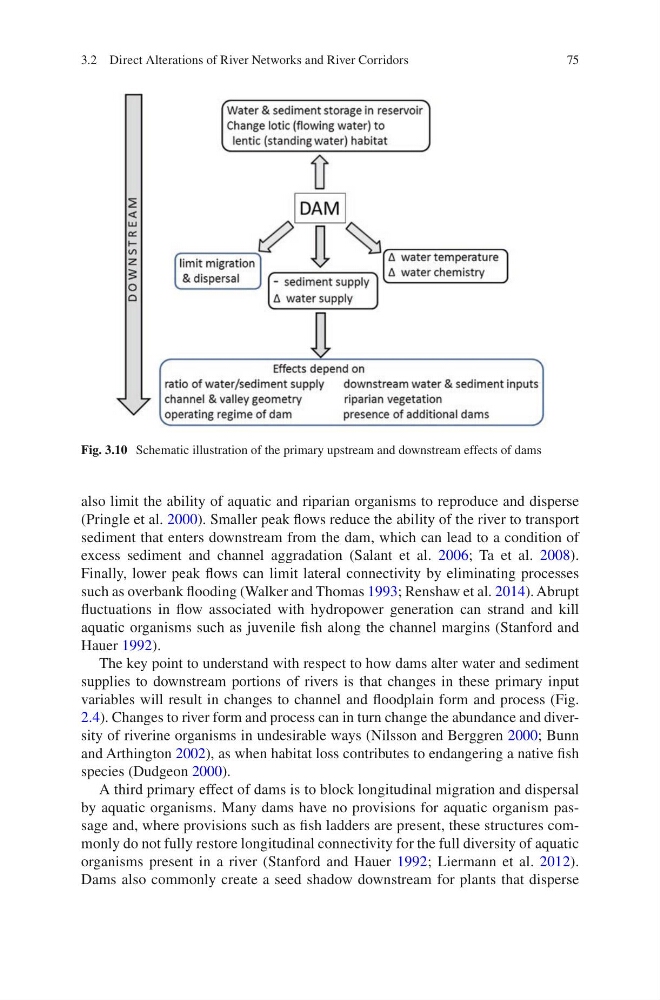
The key point to understand with respect to how dams alter water and sediment
supplies to downstream portions of rivers is that changes in these primary input
variables will result in changes to channel and floodplain form and process (Fig.
2.4). Changes to river form and process can in turn change the abundance and diversity of riverine organisms in undesirable ways (Nilsson and Berggren 2000; Bunn
and Arthington 2002), as when habitat loss contributes to endangering a native fish
species (Dudgeon 2000).
A third primary effect of dams is to block longitudinal migration and dispersal
by aquatic organisms. Many dams have no provisions for aquatic organism passage and, where provisions such as fish ladders are present, these structures commonly do not fully restore longitudinal connectivity for the full diversity of aquatic
organisms present in a river (Stanford and Hauer 1992; Liermann et al. 2012).
Dams also commonly create a seed shadow downstream for plants that disperse
Fig. 3.10 Schematic illustration of the primary upstream and downstream effects of dams
3.2 Direct Alterations of River Networks and River Corridors
also limit the ability of aquatic and riparian organisms to reproduce and disperse
(Pringle et al. 2000). Smaller peak flows reduce the ability of the river to transport
sediment that enters downstream from the dam, which can lead to a condition of
excess sediment and channel aggradation (Salant et al. 2006; Ta et al. 2008).
Finally, lower peak flows can limit lateral connectivity by eliminating processes
such as overbank flooding (Walker and Thomas 1993; Renshaw et al. 2014). Abrupt
fluctuations in flow associated with hydropower generation can strand and kill
aquatic organisms such as juvenile fish along the channel margins (Stanford and
Hauer 1992).
The key point to understand with respect to how dams alter water and sediment
supplies to downstream portions of rivers is that changes in these primary input
variables will result in changes to channel and floodplain form and process (Fig.
2.4). Changes to river form and process can in turn change the abundance and diversity of riverine organisms in undesirable ways (Nilsson and Berggren 2000; Bunn
and Arthington 2002), as when habitat loss contributes to endangering a native fish
species (Dudgeon 2000).
A third primary effect of dams is to block longitudinal migration and dispersal
by aquatic organisms. Many dams have no provisions for aquatic organism passage and, where provisions such as fish ladders are present, these structures commonly do not fully restore longitudinal connectivity for the full diversity of aquatic
organisms present in a river (Stanford and Hauer 1992; Liermann et al. 2012).
Dams also commonly create a seed shadow downstream for plants that disperse
Fig. 3.10 Schematic illustration of the primary upstream and downstream effects of dams
3.2 Direct Alterations of River Networks and River Corridors