

40
ral range of variability for connectivity, which in some river networks may mean
that sources of disconnectivity are vital to river health.
Natural forms of disconnectivity are rarely permanent or complete, however, and
are better conceptualized as creating temporary limits to connectivity. A tributary
alluvial fan that stores sediment transported by a tributary channel to the main river
corridor, for example, eventually releases that sediment for transport down the main
stem river, although a period of centuries to millennia may pass before the main
stem remobilizes the tributary sediment (Meyer et al. 1992). The tributary fan may
also slow the passage of water that infiltrates from the tributary channel and moves
into the main stem river corridor over a period of weeks to a few years, helping to
sustain base flows and riparian water tables in the main river corridor (Woods et al.
2006). A waterfall that limits upstream migration of fish or amphibians may persist
for thousands of years, allowing geographic speciation in isolated populations of
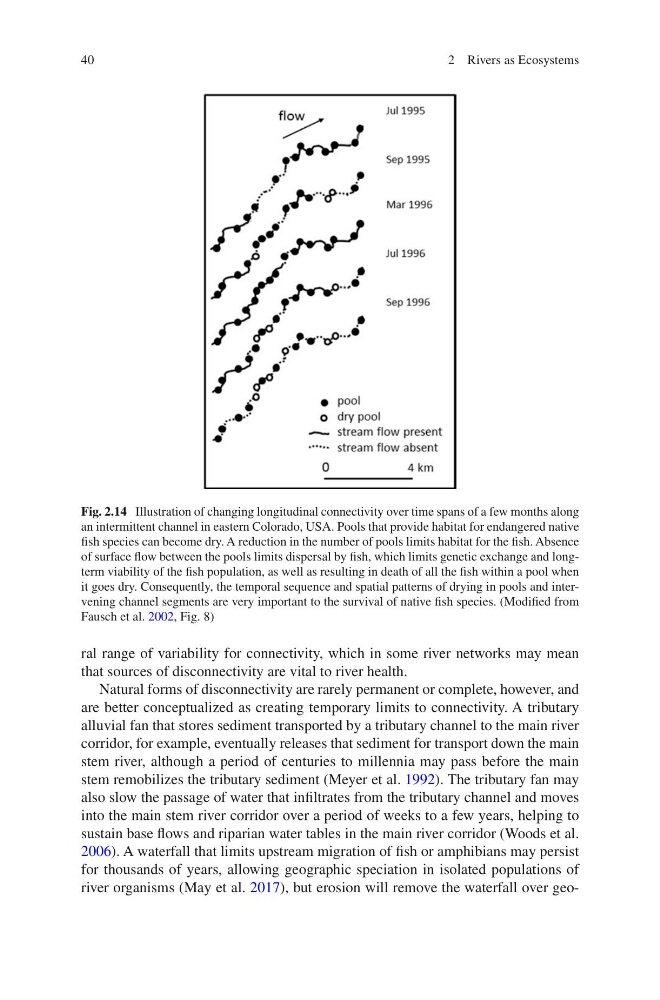
river organisms (May et al. 2017), but erosion will remove the waterfall over geoFig. 2.14 Illustration of changing longitudinal connectivity over time spans of a few months along
an intermittent channel in eastern Colorado, USA. Pools that provide habitat for endangered native
fish species can become dry. A reduction in the number of pools limits habitat for the fish. Absence
of surface flow between the pools limits dispersal by fish, which limits genetic exchange and longterm viability of the fish population, as well as resulting in death of all the fish within a pool when
it goes dry. Consequently, the temporal sequence and spatial patterns of drying in pools and intervening channel segments are very important to the survival of native fish species. (Modified from
Fausch et al. 2002, Fig. 8)
2 Rivers as Ecosystems
ral range of variability for connectivity, which in some river networks may mean
that sources of disconnectivity are vital to river health.
Natural forms of disconnectivity are rarely permanent or complete, however, and
are better conceptualized as creating temporary limits to connectivity. A tributary
alluvial fan that stores sediment transported by a tributary channel to the main river
corridor, for example, eventually releases that sediment for transport down the main
stem river, although a period of centuries to millennia may pass before the main
stem remobilizes the tributary sediment (Meyer et al. 1992). The tributary fan may
also slow the passage of water that infiltrates from the tributary channel and moves
into the main stem river corridor over a period of weeks to a few years, helping to
sustain base flows and riparian water tables in the main river corridor (Woods et al.
2006). A waterfall that limits upstream migration of fish or amphibians may persist
for thousands of years, allowing geographic speciation in isolated populations of
river organisms (May et al. 2017), but erosion will remove the waterfall over geoFig. 2.14 Illustration of changing longitudinal connectivity over time spans of a few months along
an intermittent channel in eastern Colorado, USA. Pools that provide habitat for endangered native
fish species can become dry. A reduction in the number of pools limits habitat for the fish. Absence
of surface flow between the pools limits dispersal by fish, which limits genetic exchange and longterm viability of the fish population, as well as resulting in death of all the fish within a pool when
it goes dry. Consequently, the temporal sequence and spatial patterns of drying in pools and intervening channel segments are very important to the survival of native fish species. (Modified from
Fausch et al. 2002, Fig. 8)
2 Rivers as Ecosystems