

38
transport between components of a system that may not be physically contiguous
(e.g., wind carries silt and clay eroded from the Gobi Desert across the Pacific
Ocean and deposits the material on a channel in western North America).
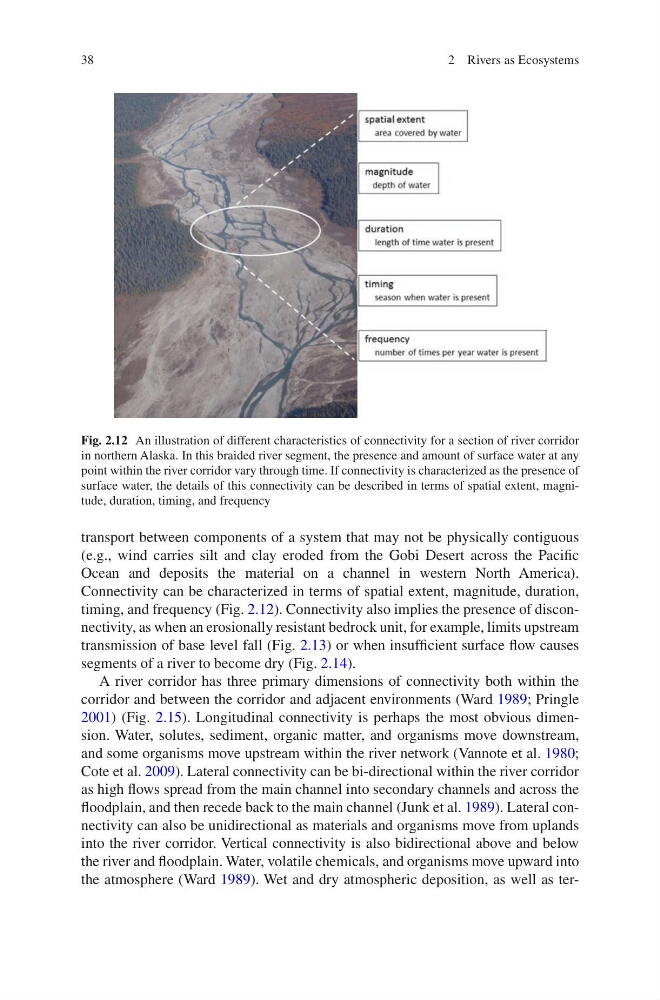
Connectivity can be characterized in terms of spatial extent, magnitude, duration,
timing, and frequency (Fig. 2.12). Connectivity also implies the presence of disconnectivity, as when an erosionally resistant bedrock unit, for example, limits upstream
transmission of base level fall (Fig. 2.13) or when insufficient surface flow causes
segments of a river to become dry (Fig. 2.14).
A river corridor has three primary dimensions of connectivity both within the
corridor and between the corridor and adjacent environments (Ward 1989; Pringle
2001) (Fig. 2.15). Longitudinal connectivity is perhaps the most obvious dimension. Water, solutes, sediment, organic matter, and organisms move downstream,
and some organisms move upstream within the river network (Vannote et al. 1980;
Cote et al. 2009). Lateral connectivity can be bi-directional within the river corridor
as high flows spread from the main channel into secondary channels and across the
floodplain, and then recede back to the main channel (Junk et al. 1989). Lateral connectivity can also be unidirectional as materials and organisms move from uplands
into the river corridor. Vertical connectivity is also bidirectional above and below
the river and floodplain. Water, volatile chemicals, and organisms move upward into
the atmosphere (Ward 1989). Wet and dry atmospheric deposition, as well as terFig. 2.12 An illustration of different characteristics of connectivity for a section of river corridor
in northern Alaska. In this braided river segment, the presence and amount of surface water at any
point within the river corridor vary through time. If connectivity is characterized as the presence of
surface water, the details of this connectivity can be described in terms of spatial extent, magnitude, duration, timing, and frequency
2 Rivers as Ecosystems
transport between components of a system that may not be physically contiguous
(e.g., wind carries silt and clay eroded from the Gobi Desert across the Pacific
Ocean and deposits the material on a channel in western North America).
Connectivity can be characterized in terms of spatial extent, magnitude, duration,
timing, and frequency (Fig. 2.12). Connectivity also implies the presence of disconnectivity, as when an erosionally resistant bedrock unit, for example, limits upstream
transmission of base level fall (Fig. 2.13) or when insufficient surface flow causes
segments of a river to become dry (Fig. 2.14).
A river corridor has three primary dimensions of connectivity both within the
corridor and between the corridor and adjacent environments (Ward 1989; Pringle
2001) (Fig. 2.15). Longitudinal connectivity is perhaps the most obvious dimension. Water, solutes, sediment, organic matter, and organisms move downstream,
and some organisms move upstream within the river network (Vannote et al. 1980;
Cote et al. 2009). Lateral connectivity can be bi-directional within the river corridor
as high flows spread from the main channel into secondary channels and across the
floodplain, and then recede back to the main channel (Junk et al. 1989). Lateral connectivity can also be unidirectional as materials and organisms move from uplands
into the river corridor. Vertical connectivity is also bidirectional above and below
the river and floodplain. Water, volatile chemicals, and organisms move upward into
the atmosphere (Ward 1989). Wet and dry atmospheric deposition, as well as terFig. 2.12 An illustration of different characteristics of connectivity for a section of river corridor
in northern Alaska. In this braided river segment, the presence and amount of surface water at any
point within the river corridor vary through time. If connectivity is characterized as the presence of
surface water, the details of this connectivity can be described in terms of spatial extent, magnitude, duration, timing, and frequency
2 Rivers as Ecosystems