

33
long-term stability (Schröder et al. 2005). This has led to the related concept of
alternate states, which can be stable or transient over varying time scales (Suding
et al. 2004).
A well-known example of alternate states in river corridors is that of beaver
meadows versus elk grasslands. Beaver meadows are the valley-bottom mosaic of
beaver dams and ponds in varying stages of active maintenance or abandonment by
beaver. Beaver meadows commonly include anabranching channels, ponds and
marshes, and willow (Salix spp.) carrs (Polvi and Wohl 2012). An elk grassland has
a drier valley bottom dominated by grasses rather than woody riparian vegetation,
and typically has a single, incised channel with limited or no floodplain wetlands. A
beaver meadow can become an elk grassland if the number of elk grazing in the
riparian zone becomes large enough to suppress woody riparian species so that food
supplies become insufficient to support beaver (Wolf et al. 2007). Reintroduction of
elk predators such as wolves in river corridors where the predators were previously
hunted to extinction can reduce elk herbivory on riparian vegetation. This allows
beaver to recolonize the river corridor, which can return to the wetter, more spatially
heterogeneous conditions of a beaver meadow (Ripple and Beschta 2004; Beschta
and Ripple 2012).
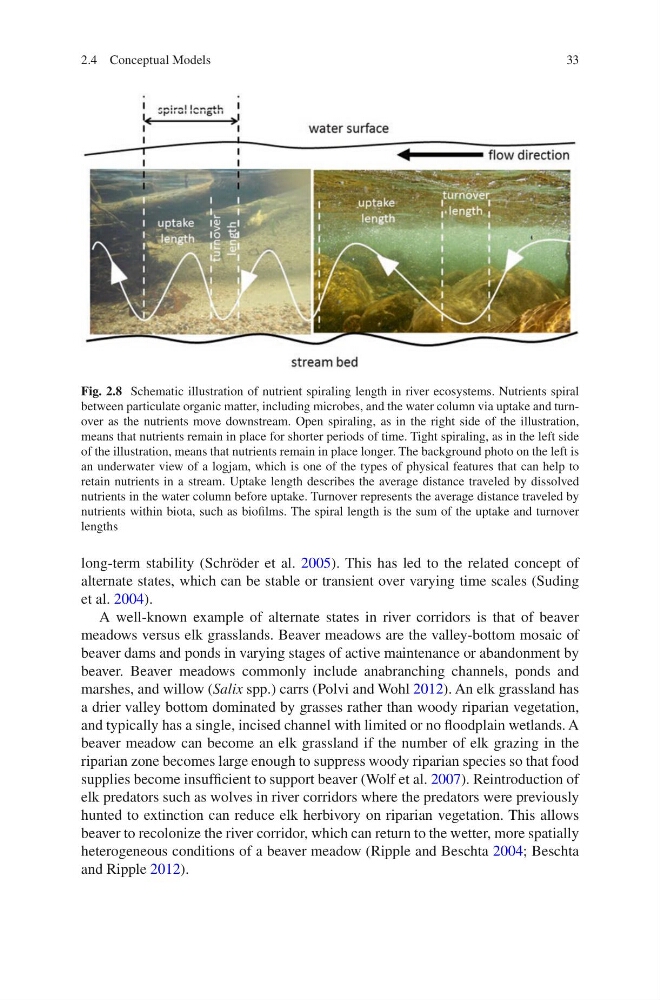
Fig. 2.8 Schematic illustration of nutrient spiraling length in river ecosystems. Nutrients spiral
between particulate organic matter, including microbes, and the water column via uptake and turnover as the nutrients move downstream. Open spiraling, as in the right side of the illustration,
means that nutrients remain in place for shorter periods of time. Tight spiraling, as in the left side
of the illustration, means that nutrients remain in place longer. The background photo on the left is
an underwater view of a logjam, which is one of the types of physical features that can help to
retain nutrients in a stream. Uptake length describes the average distance traveled by dissolved
nutrients in the water column before uptake. Turnover represents the average distance traveled by
nutrients within biota, such as biofilms. The spiral length is the sum of the uptake and turnover
lengths
2.4 Conceptual Models
long-term stability (Schröder et al. 2005). This has led to the related concept of
alternate states, which can be stable or transient over varying time scales (Suding
et al. 2004).
A well-known example of alternate states in river corridors is that of beaver
meadows versus elk grasslands. Beaver meadows are the valley-bottom mosaic of
beaver dams and ponds in varying stages of active maintenance or abandonment by
beaver. Beaver meadows commonly include anabranching channels, ponds and
marshes, and willow (Salix spp.) carrs (Polvi and Wohl 2012). An elk grassland has
a drier valley bottom dominated by grasses rather than woody riparian vegetation,
and typically has a single, incised channel with limited or no floodplain wetlands. A
beaver meadow can become an elk grassland if the number of elk grazing in the
riparian zone becomes large enough to suppress woody riparian species so that food
supplies become insufficient to support beaver (Wolf et al. 2007). Reintroduction of
elk predators such as wolves in river corridors where the predators were previously
hunted to extinction can reduce elk herbivory on riparian vegetation. This allows
beaver to recolonize the river corridor, which can return to the wetter, more spatially
heterogeneous conditions of a beaver meadow (Ripple and Beschta 2004; Beschta
and Ripple 2012).
Fig. 2.8 Schematic illustration of nutrient spiraling length in river ecosystems. Nutrients spiral
between particulate organic matter, including microbes, and the water column via uptake and turnover as the nutrients move downstream. Open spiraling, as in the right side of the illustration,
means that nutrients remain in place for shorter periods of time. Tight spiraling, as in the left side
of the illustration, means that nutrients remain in place longer. The background photo on the left is
an underwater view of a logjam, which is one of the types of physical features that can help to
retain nutrients in a stream. Uptake length describes the average distance traveled by dissolved
nutrients in the water column before uptake. Turnover represents the average distance traveled by
nutrients within biota, such as biofilms. The spiral length is the sum of the uptake and turnover
lengths
2.4 Conceptual Models