

74
H. Rubin et al.
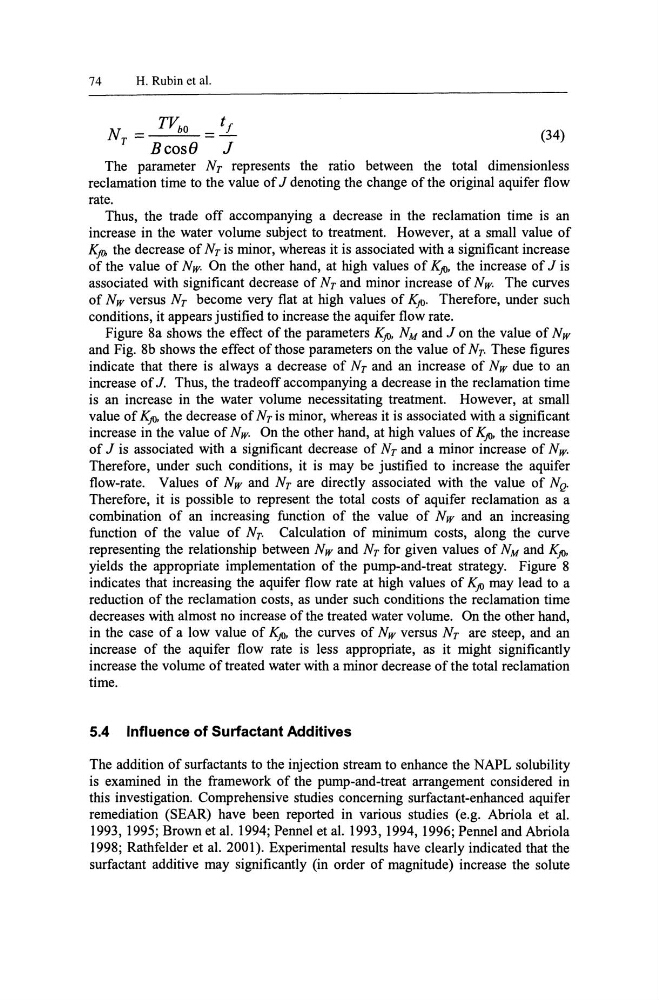
TV bO
t f
NT =
= -
Bcos8
J
(34)
The parameter NT represents the ratio between the total dimensionless
reclamation time to the value of J denoting the change of the original aquifer flow
rate.
Thus, the trade off accompanying a decrease in the reclamation time is an
increase in the water volume subject to treatment. However, at a small value of
K./fJ, the decrease of NT is minor, whereas it is associated with a significant increase
of the value of Nw. On the other hand, at high values of KjO, the increase of J is
associated with significant decrease of NT and minor increase of Nw. The curves
of Nw versus NT become very flat at high values of KjO. Therefore, under such
conditions, it appears justified to increase the aquifer flow rate.
Figure 8a shows the effect of the parameters KjO' NM and J on the value of Nw
and Fig. 8b shows the effect of those parameters on the value of NT' These figures
indicate that there is always a decrease of NT and an increase of Nw due to an
increase of J. Thus, the tradeoff accompanying a decrease in the reclamation time
is an increase in the water volume necessitating treatment. However, at small
value of KjO, the decrease of NT is minor, whereas it is associated with a significant
increase in the value of Nw. On the other hand, at high values of KjO, the increase
of J is associated with a significant decrease of NT and a minor increase of Nw.
Therefore, under such conditions, it is may be justified to increase the aquifer
flow-rate. Values of Nw and NT are directly associated with the value of N Q .
Therefore, it is possible to represent the total costs of aquifer reclamation as a
combination of an increasing function of the value of Nw and an increasing
function of the value of NT' Calculation of minimum costs, along the curve
representing the relationship between Nw and NT for given values of NM and KjO,
yields the appropriate implementation of the pump-and-treat strategy. Figure 8
indicates that increasing the aquifer flow rate at high values of KjO may lead to a
reduction of the reclamation costs, as under such conditions the reclamation time
decreases with almost no increase of the treated water volume. On the other hand,
in the case of a low value of KjO, the curves of Nw versus NT are steep, and an
increase of the aquifer flow rate is less appropriate, as it might significantly
increase the volume of treated water with a minor decrease of the total reclamation
time.
5.4 Influence of Surfactant Additives
The addition of surfactants to the injection stream to enhance the NAPL solubility
is examined in the framework of the pump-and-treat arrangement considered in
this investigation. Comprehensive studies concerning surfactant-enhanced aquifer
remediation (SEAR) have been reported in various studies (e.g. Abriola et al.
1993, 1995; Brown et al. 1994; Pennel et al. 1993,1994,1996; Pennel and Abriola
1998; Rathfelder et al. 2001). Experimental results have clearly indicated that the
surfactant additive may significantly (in order of magnitude) increase the solute
H. Rubin et al.
TV bO
t f
NT =
= -
Bcos8
J
(34)
The parameter NT represents the ratio between the total dimensionless
reclamation time to the value of J denoting the change of the original aquifer flow
rate.
Thus, the trade off accompanying a decrease in the reclamation time is an
increase in the water volume subject to treatment. However, at a small value of
K./fJ, the decrease of NT is minor, whereas it is associated with a significant increase
of the value of Nw. On the other hand, at high values of KjO, the increase of J is
associated with significant decrease of NT and minor increase of Nw. The curves
of Nw versus NT become very flat at high values of KjO. Therefore, under such
conditions, it appears justified to increase the aquifer flow rate.
Figure 8a shows the effect of the parameters KjO' NM and J on the value of Nw
and Fig. 8b shows the effect of those parameters on the value of NT' These figures
indicate that there is always a decrease of NT and an increase of Nw due to an
increase of J. Thus, the tradeoff accompanying a decrease in the reclamation time
is an increase in the water volume necessitating treatment. However, at small
value of KjO, the decrease of NT is minor, whereas it is associated with a significant
increase in the value of Nw. On the other hand, at high values of KjO, the increase
of J is associated with a significant decrease of NT and a minor increase of Nw.
Therefore, under such conditions, it is may be justified to increase the aquifer
flow-rate. Values of Nw and NT are directly associated with the value of N Q .
Therefore, it is possible to represent the total costs of aquifer reclamation as a
combination of an increasing function of the value of Nw and an increasing
function of the value of NT' Calculation of minimum costs, along the curve
representing the relationship between Nw and NT for given values of NM and KjO,
yields the appropriate implementation of the pump-and-treat strategy. Figure 8
indicates that increasing the aquifer flow rate at high values of KjO may lead to a
reduction of the reclamation costs, as under such conditions the reclamation time
decreases with almost no increase of the treated water volume. On the other hand,
in the case of a low value of KjO, the curves of Nw versus NT are steep, and an
increase of the aquifer flow rate is less appropriate, as it might significantly
increase the volume of treated water with a minor decrease of the total reclamation
time.
5.4 Influence of Surfactant Additives
The addition of surfactants to the injection stream to enhance the NAPL solubility
is examined in the framework of the pump-and-treat arrangement considered in
this investigation. Comprehensive studies concerning surfactant-enhanced aquifer
remediation (SEAR) have been reported in various studies (e.g. Abriola et al.
1993, 1995; Brown et al. 1994; Pennel et al. 1993,1994,1996; Pennel and Abriola
1998; Rathfelder et al. 2001). Experimental results have clearly indicated that the
surfactant additive may significantly (in order of magnitude) increase the solute