

The Effect of Fractures on the Reclamation ofNAPL
73
of an identical value of the hydraulic gradient Jh• A constant hydraulic gradient
indicates differences to the total aquifer discharge and the mass transfer
coefficient k J for the varying conditions considered above. For increasing values
of Jh, the total flow rate is subject to an increase, the value of KJO decreases, and
the characteristic time scale, given in Eq. (5) decreases. It is appropriate to
calculate the ratio between the value of the total aquifer discharge, Qt with given
values of NM and Jh to the value of QbO, which is identical for all examples of the
preceding section and is associated with a representative value of Jh = JhO•
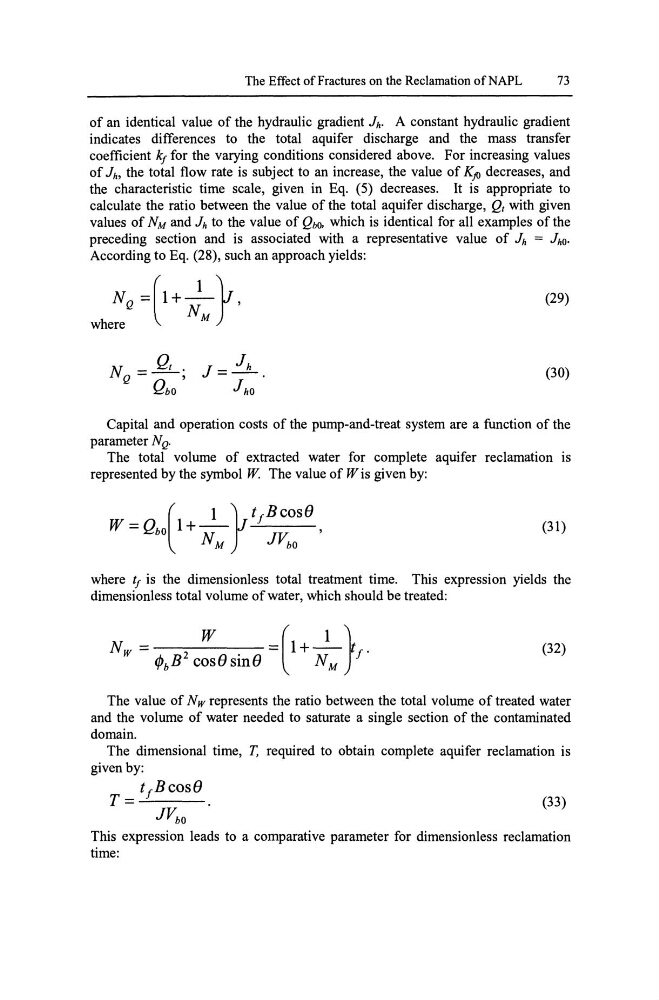
According to Eq. (28), such an approach yields:
N Q = (1 + ; MIT,
where
J
N = Qt.
Q
Q '
bO
(29)
(30)
Capital and operation costs of the pump-and-treat system are a function of the
parameter N Q.
The total volume of extracted water for complete aquifer reclamation is
represented by the symbol W. The value of W is given by:
W -QbO 1+,
_
(
1 ytJBCose
NM
JVbO
(31)
where t J is the dimensionless total treatment time. This expression yields the
dimensionless total volume of water, which should be treated:
(32)
The value of Nw represents the ratio between the total volume of treated water
and the volume of water needed to saturate a single section of the contaminated
domain.
The dimensional time, T, required to obtain complete aquifer reclamation is
given by:
t fBcose
T =
(33)
JV bO
This expression leads to a comparative parameter for dimensionless reclamation
time:
73
of an identical value of the hydraulic gradient Jh• A constant hydraulic gradient
indicates differences to the total aquifer discharge and the mass transfer
coefficient k J for the varying conditions considered above. For increasing values
of Jh, the total flow rate is subject to an increase, the value of KJO decreases, and
the characteristic time scale, given in Eq. (5) decreases. It is appropriate to
calculate the ratio between the value of the total aquifer discharge, Qt with given
values of NM and Jh to the value of QbO, which is identical for all examples of the
preceding section and is associated with a representative value of Jh = JhO•
According to Eq. (28), such an approach yields:
N Q = (1 + ; MIT,
where
J
N = Qt.
Q
Q '
bO
(29)
(30)
Capital and operation costs of the pump-and-treat system are a function of the
parameter N Q.
The total volume of extracted water for complete aquifer reclamation is
represented by the symbol W. The value of W is given by:
W -QbO 1+,
_
(
1 ytJBCose
NM
JVbO
(31)
where t J is the dimensionless total treatment time. This expression yields the
dimensionless total volume of water, which should be treated:
(32)
The value of Nw represents the ratio between the total volume of treated water
and the volume of water needed to saturate a single section of the contaminated
domain.
The dimensional time, T, required to obtain complete aquifer reclamation is
given by:
t fBcose
T =
(33)
JV bO
This expression leads to a comparative parameter for dimensionless reclamation
time: