

Spatial Modeling of Nitrogen Leaching
41
where CN03 is the concentration of N03-N at the end of a day, PO is soil porosity,
and bl is a fraction of the storage PO occupied by percolating water. Eq. (6) is a
finite difference approximation for the exponential equation
C'N03 = CN03 exp[-QT / (bl) (PO)] .
(7)
Thus, VN03 can be computed for any volume, QT, by integrating Eq. (7)
VN03 = WN03 {I - exp[ -QT / (bl) (PO)]} .
(8)
The average concentration during the percolation of QT (1 day, since EPIC is a
daily time-step model) is
CN03 = VN03 / QT.
(9)
Amounts of N03-N contained in runoff, lateral flow, and percolation are
estimated as products of the volume of water and the concentration from Eq. (9).
The calculation sequence is:
1. Soil layer 1. Leaching is estimated first by substituting 0 for QT in Eq. (8)
and solving for VN03. Then VN03 is removed from WN03 1 and placed into
WN03 2. Next, runoff and lateral flow losses are estimated simultaneously by
substituting Q + QR, for QT in Eq. (8) and the resulting VN03 into Eq. (9).
Individual losses are estimated for runoff (QCN03) and lateral flow (QR 1cN03)'
Finally, these losses are removed from WN03 1•
2. Soil layers 2-M. Leaching and lateral flow losses are estimated
simultaneously by substituting QR + 0 for QT in Eq. (8) and the reSUlting VN03
into Eq. (9). Individual losses are calculated as in 1. (QRCN03) and (OCN03),
subtracted from WN03 and added to WN03+1• The process is repeated layer by
layer to the bottom of the soil profile.
2.2.5 Crop Growth Model
A single model is used in EPIC for simulating all the crops considered (sugar beet,
onion, winter wheat, potatoes, carrot, canola, com, durum wheat, summer barley,
pasture, winter barley, sunflower, pea, etc.). Of course, each crop has unique
values for the model parameters. EPIC is capable of simulating growth for both
annual and perennial crops. Annual crops grow from planting date to harvest date
or until the accumulated heat units equal the potential heat units for the crop.
Perennial crops maintain their root systems throughout the year, although they
may become dormant after frost. They start growing when the average daily air
temperature exceeds their base temperature.
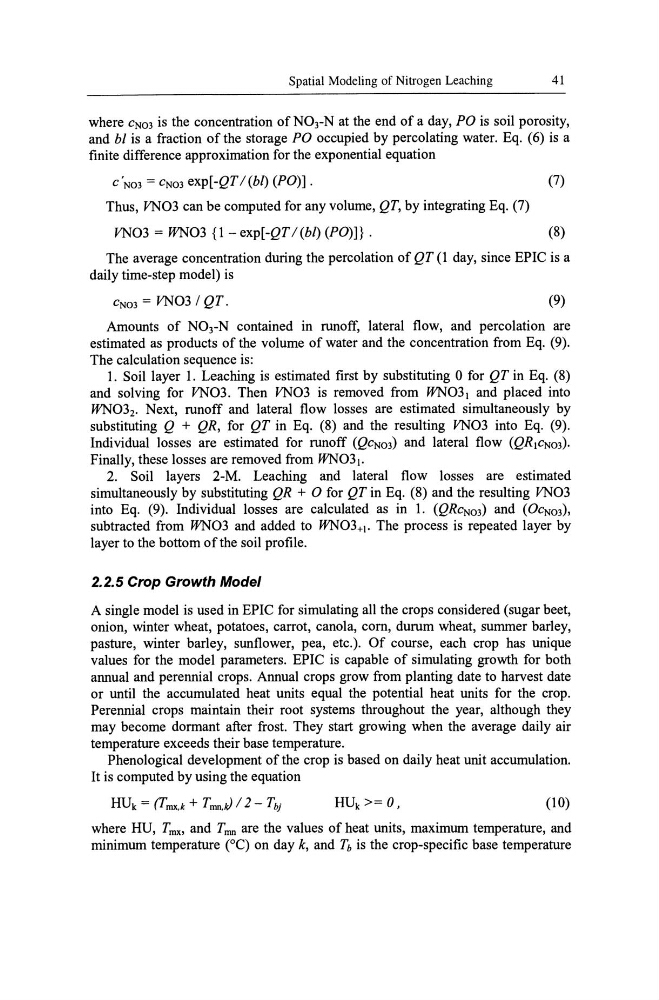
Phenological development of the crop is based on daily heat unit accumulation.
It is computed by using the equation
RUk >= 0,
(10)
where RU, Trnx' and T mn are the values of heat units, maximum temperature, and
minimum temperature (0C) on day k, and Tb is the crop-specific base temperature
41
where CN03 is the concentration of N03-N at the end of a day, PO is soil porosity,
and bl is a fraction of the storage PO occupied by percolating water. Eq. (6) is a
finite difference approximation for the exponential equation
C'N03 = CN03 exp[-QT / (bl) (PO)] .
(7)
Thus, VN03 can be computed for any volume, QT, by integrating Eq. (7)
VN03 = WN03 {I - exp[ -QT / (bl) (PO)]} .
(8)
The average concentration during the percolation of QT (1 day, since EPIC is a
daily time-step model) is
CN03 = VN03 / QT.
(9)
Amounts of N03-N contained in runoff, lateral flow, and percolation are
estimated as products of the volume of water and the concentration from Eq. (9).
The calculation sequence is:
1. Soil layer 1. Leaching is estimated first by substituting 0 for QT in Eq. (8)
and solving for VN03. Then VN03 is removed from WN03 1 and placed into
WN03 2. Next, runoff and lateral flow losses are estimated simultaneously by
substituting Q + QR, for QT in Eq. (8) and the resulting VN03 into Eq. (9).
Individual losses are estimated for runoff (QCN03) and lateral flow (QR 1cN03)'
Finally, these losses are removed from WN03 1•
2. Soil layers 2-M. Leaching and lateral flow losses are estimated
simultaneously by substituting QR + 0 for QT in Eq. (8) and the reSUlting VN03
into Eq. (9). Individual losses are calculated as in 1. (QRCN03) and (OCN03),
subtracted from WN03 and added to WN03+1• The process is repeated layer by
layer to the bottom of the soil profile.
2.2.5 Crop Growth Model
A single model is used in EPIC for simulating all the crops considered (sugar beet,
onion, winter wheat, potatoes, carrot, canola, com, durum wheat, summer barley,
pasture, winter barley, sunflower, pea, etc.). Of course, each crop has unique
values for the model parameters. EPIC is capable of simulating growth for both
annual and perennial crops. Annual crops grow from planting date to harvest date
or until the accumulated heat units equal the potential heat units for the crop.
Perennial crops maintain their root systems throughout the year, although they
may become dormant after frost. They start growing when the average daily air
temperature exceeds their base temperature.
Phenological development of the crop is based on daily heat unit accumulation.
It is computed by using the equation
RUk >= 0,
(10)
where RU, Trnx' and T mn are the values of heat units, maximum temperature, and
minimum temperature (0C) on day k, and Tb is the crop-specific base temperature