

40
P. Cepuder and V. aus-der-Schmitten
2.2.2 Evapotranspiration
The model offers four options for estimating potential evaporation: Hargreaves
and Samani (1985), Penman (1948), Priestley - Taylor (1972), and Penman -
Monteith (Monteith 1965). The Penman and Penman - Monteith methods require
solar radiation, air temperature, wind speed, and relative humidity as input. If
wind speed, relative humidity, and solar radiation data are not available, the
Hargreaves or Priestley - Taylor methods provide options that give realistic results
in most cases.
The model computes evaporation from soils and plants separately, as described
by Ritchie (1972). Potential soil water evaporation is estimated as a function of
potential evaporation and leaf area index (LAI, area of plant leaves relative to the
soil surface area). Actual soil water evaporation is estimated by using exponential
functions of soil depth and water content. Plant water evaporation is simulated as a
linear function of potential evaporation and leaf area index.
2.2.3 Weather
The weather variables necessary for driving the EPIC model are precipitation, air
temperature, and solar radiation. If the Penman methods are used to estimate
potential evaporation, wind speed and relative humidity are also required. If daily
precipitation, air temperature, and solar radiation data are available, they can be
input directly into EPIC. Rainfall and temperature data are available for many
areas, but solar radiation, relative humidity, and wind data are scarce. Even
rainfall and temperature data are generally not adequate for the long-term EPIC
simulation. Thus, EPIC provides options for simulating various combinations of
the five weather variables.
2.2.4 Nitrogen
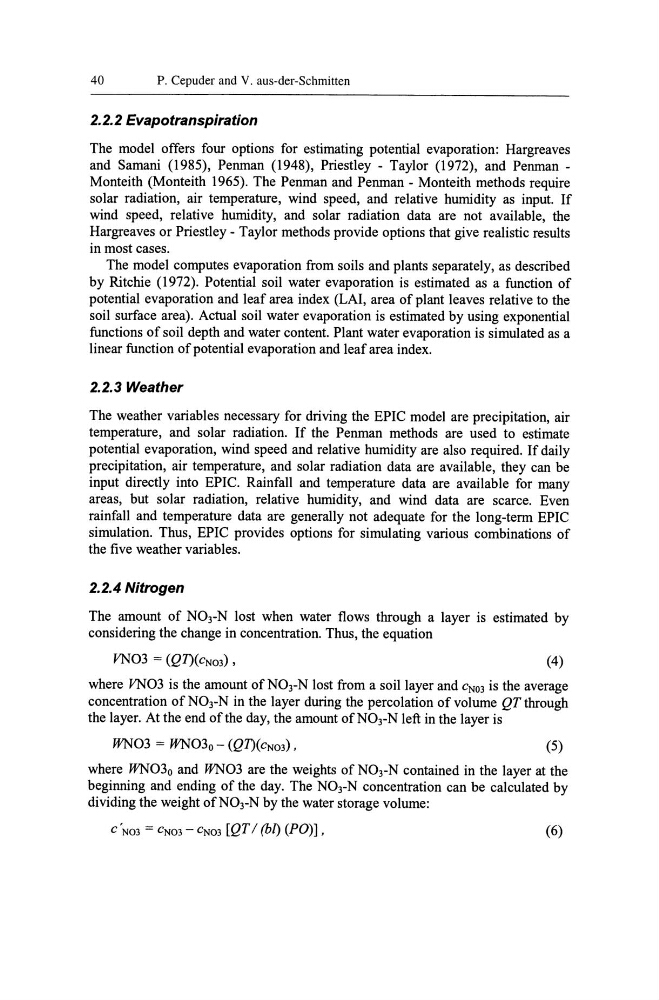
The amount of N03-N lost when water flows through a layer is estimated by
considering the change in concentration. Thus, the equation
VN03 = (Q1)(CNOl)'
(4)
where VN03 is the amount ofN03-N lost from a soil layer and CN03 is the average
concentration of N03-N in the layer during the percolation of volume QTthrough
the layer. At the end of the day, the amount of N03-N left in the layer is
WN03 = WN03 0 - (Q1)(CNOl) ,
(5)
where WN030 and WN03 are the weights of N03-N contained in the layer at the
beginning and ending of the day. The N03-N concentration can be calculated by
dividing the weight ofN03-N by the water storage volume:
C 'N03 = CN03 - CNOl [QT / (hI) (PO)] ,
(6)
P. Cepuder and V. aus-der-Schmitten
2.2.2 Evapotranspiration
The model offers four options for estimating potential evaporation: Hargreaves
and Samani (1985), Penman (1948), Priestley - Taylor (1972), and Penman -
Monteith (Monteith 1965). The Penman and Penman - Monteith methods require
solar radiation, air temperature, wind speed, and relative humidity as input. If
wind speed, relative humidity, and solar radiation data are not available, the
Hargreaves or Priestley - Taylor methods provide options that give realistic results
in most cases.
The model computes evaporation from soils and plants separately, as described
by Ritchie (1972). Potential soil water evaporation is estimated as a function of
potential evaporation and leaf area index (LAI, area of plant leaves relative to the
soil surface area). Actual soil water evaporation is estimated by using exponential
functions of soil depth and water content. Plant water evaporation is simulated as a
linear function of potential evaporation and leaf area index.
2.2.3 Weather
The weather variables necessary for driving the EPIC model are precipitation, air
temperature, and solar radiation. If the Penman methods are used to estimate
potential evaporation, wind speed and relative humidity are also required. If daily
precipitation, air temperature, and solar radiation data are available, they can be
input directly into EPIC. Rainfall and temperature data are available for many
areas, but solar radiation, relative humidity, and wind data are scarce. Even
rainfall and temperature data are generally not adequate for the long-term EPIC
simulation. Thus, EPIC provides options for simulating various combinations of
the five weather variables.
2.2.4 Nitrogen
The amount of N03-N lost when water flows through a layer is estimated by
considering the change in concentration. Thus, the equation
VN03 = (Q1)(CNOl)'
(4)
where VN03 is the amount ofN03-N lost from a soil layer and CN03 is the average
concentration of N03-N in the layer during the percolation of volume QTthrough
the layer. At the end of the day, the amount of N03-N left in the layer is
WN03 = WN03 0 - (Q1)(CNOl) ,
(5)
where WN030 and WN03 are the weights of N03-N contained in the layer at the
beginning and ending of the day. The N03-N concentration can be calculated by
dividing the weight ofN03-N by the water storage volume:
C 'N03 = CN03 - CNOl [QT / (hI) (PO)] ,
(6)