

Chemical Pre-Treatment of Sewage - A Cost-Benefit Method
381
During the cost analyses of chemical upgrading, aluminum-sulfate was
evaluated as the most effective coagulant in pollutant removal, according to the
laboratory tests. Aluminum-sulfate was also found to be the cheapest coagulant
(167 HUF/kg Me 3 +; 1 USD = 300 HUF), however its application can be limited if
sewage sludge is utilized in agriculture.
Table 1. Costs of different upgrading possibilities
Operational cost (million
HUFyear· l )
Construction cost
(million HUF)
Annualized construction
cost (i=12%; n=20 year)
(million HUF)
Total annual cost
(million HUF year· l )
Alternative 1
construction of new
aeration tank
61.3
143.5
19.2
80.5
Alternative 2
Alternative 3
chemical
chemical
pretreatment
pretreatment + new
+ utilizing old aeration tank
basin
55.6
56.1
55.0
86.0
7.4
11.5
63.0
67.6
Providing an appropriate effluent water quality at Nl WWTP, the removal of
organic matter, ammonium and phosphorus has to be increased. To reach this
purpose, three main alternatives were found: (l) constructing a new aeration tank,
(2) applying chemical pretreatment and utilizing one of the old basins (presently
out of use) as an activated sludge tank, (3) applying chemical pretreatment and
constructing a new (smaller) aeration tank.
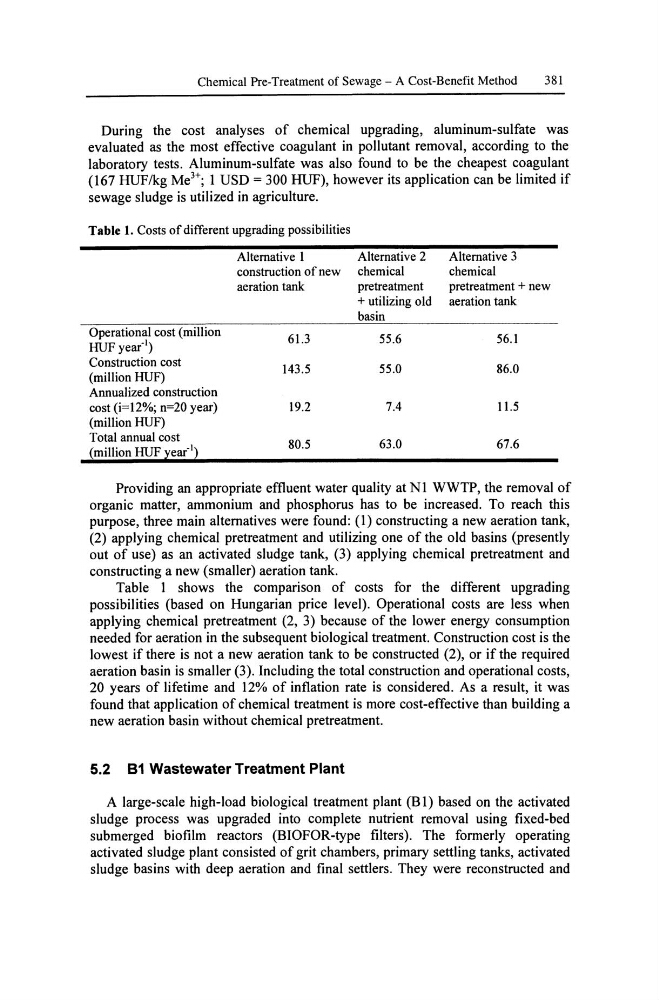
Table 1 shows the comparison of costs for the different upgrading
possibilities (based on Hungarian price level). Operational costs are less when
applying chemical pretreatment (2, 3) because of the lower energy consumption
needed for aeration in the subsequent biological treatment. Construction cost is the
lowest if there is not a new aeration tank to be constructed (2), or if the required
aeration basin is smaller (3). Including the total construction and operational costs,
20 years of lifetime and 12% of inflation rate is considered. As a result, it was
found that application of chemical treatment is more cost-effective than building a
new aeration basin without chemical pretreatment.
5.2 81 Wastewater Treatment Plant
A large-scale high-load biological treatment plant (Bl) based on the activated
sludge process was upgraded into complete nutrient removal using fixed-bed
submerged biofilm reactors (BIOFOR-type filters). The formerly operating
activated sludge plant consisted of grit chambers, primary settling tanks, activated
sludge basins with deep aeration and final settlers. They were reconstructed and
381
During the cost analyses of chemical upgrading, aluminum-sulfate was
evaluated as the most effective coagulant in pollutant removal, according to the
laboratory tests. Aluminum-sulfate was also found to be the cheapest coagulant
(167 HUF/kg Me 3 +; 1 USD = 300 HUF), however its application can be limited if
sewage sludge is utilized in agriculture.
Table 1. Costs of different upgrading possibilities
Operational cost (million
HUFyear· l )
Construction cost
(million HUF)
Annualized construction
cost (i=12%; n=20 year)
(million HUF)
Total annual cost
(million HUF year· l )
Alternative 1
construction of new
aeration tank
61.3
143.5
19.2
80.5
Alternative 2
Alternative 3
chemical
chemical
pretreatment
pretreatment + new
+ utilizing old aeration tank
basin
55.6
56.1
55.0
86.0
7.4
11.5
63.0
67.6
Providing an appropriate effluent water quality at Nl WWTP, the removal of
organic matter, ammonium and phosphorus has to be increased. To reach this
purpose, three main alternatives were found: (l) constructing a new aeration tank,
(2) applying chemical pretreatment and utilizing one of the old basins (presently
out of use) as an activated sludge tank, (3) applying chemical pretreatment and
constructing a new (smaller) aeration tank.
Table 1 shows the comparison of costs for the different upgrading
possibilities (based on Hungarian price level). Operational costs are less when
applying chemical pretreatment (2, 3) because of the lower energy consumption
needed for aeration in the subsequent biological treatment. Construction cost is the
lowest if there is not a new aeration tank to be constructed (2), or if the required
aeration basin is smaller (3). Including the total construction and operational costs,
20 years of lifetime and 12% of inflation rate is considered. As a result, it was
found that application of chemical treatment is more cost-effective than building a
new aeration basin without chemical pretreatment.
5.2 81 Wastewater Treatment Plant
A large-scale high-load biological treatment plant (Bl) based on the activated
sludge process was upgraded into complete nutrient removal using fixed-bed
submerged biofilm reactors (BIOFOR-type filters). The formerly operating
activated sludge plant consisted of grit chambers, primary settling tanks, activated
sludge basins with deep aeration and final settlers. They were reconstructed and