

380
I. Licsko et al.
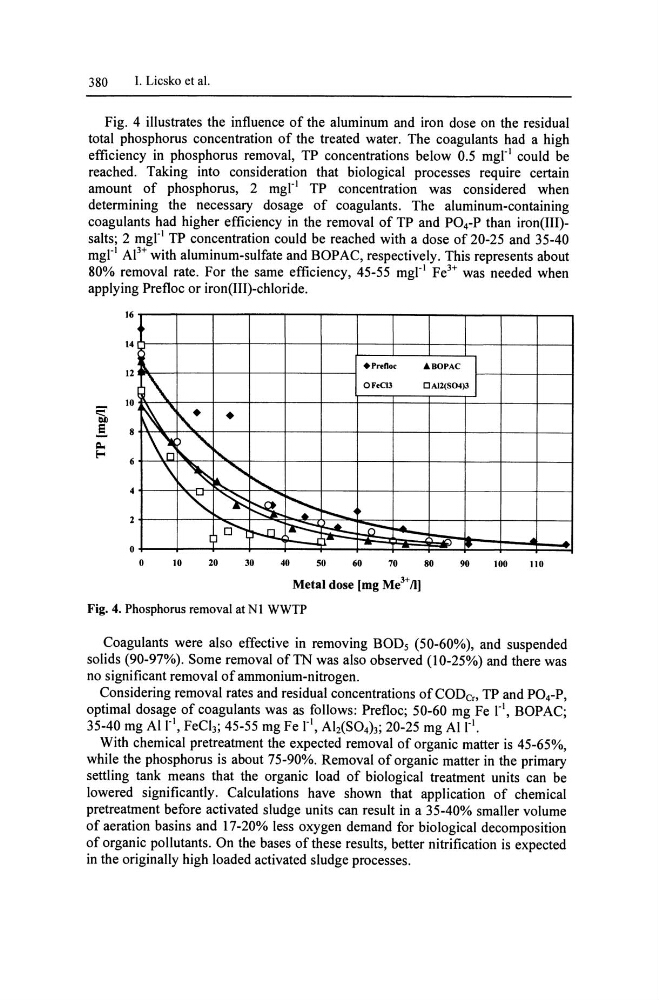
Fig. 4 illustrates the influence of the aluminum and iron dose on the residual
total phosphorus concentration of the treated water. The coagulants had a high
efficiency in phosphorus removal, TP concentrations below 0.5 mgr l could be
reached. Taking into consideration that biological processes require certain
amount of phosphorus, 2 mgr l TP concentration was considered when
determining the necessary dosage of coagulants. The aluminum-containing
coagulants had higher efficiency in the removal of TP and P04-P than iron(III)salts; 2 mgr l TP concentration could be reached with a dose of 20-25 and 35-40
mgr l AI3+ with aluminum-sulfate and BOPAC, respectively. This represents about
80% removal rate. For the same efficiency, 45-55 mgr l Fe3+ was needed when
applying Prefloc or iron(III)-chloride.
16
14
I
.Preflo.
4
!\.
OFeC13
~~ ,. •
\~ ,-' I'..
\ ~ ~" ~
~ ~ ~ ~ t---~i:j'-.., ~
I-..~
... ~ ......
l -
r---.,I; ;1'
12
10
8
6
2
o
o
10
20
39
40
50
60
70
Metal dose [mg Me 3 +II]
Fig. 4. Phosphorus removal at NI WWTP
I
I
• BOPAe
I
o All(S04)3 I
. .
80
90
100
110
Coagulants were also effective in removing BODs (50-60%), and suspended
solids (90-97%). Some removal of TN was also observed (10-25%) and there was
no significant removal of ammonium-nitrogen.
Considering removal rates and residual concentrations ofCODcn TP and P04-P,
optimal dosage of coagulants was as follows: Prefloc; 50-60 mg Fe rl, BOPAC;
35-40 mg Al r l , FeCh; 45-55 mg Fe r l , Ah(S04)3; 20-25 mg Al rl.
With chemical pretreatment the expected removal of organic matter is 45-65%,
while the phosphorus is about 75-90%. Removal of organic matter in the primary
settling tank means that the organic load of biological treatment units can be
lowered significantly. Calculations have shown that application of chemical
pretreatment before activated sludge units can result in a 35-40% smaller volume
of aeration basins and 17-20% less oxygen demand for biological decomposition
of organic pollutants. On the bases of these results, better nitrification is expected
in the originally high loaded activated sludge processes.
I. Licsko et al.
Fig. 4 illustrates the influence of the aluminum and iron dose on the residual
total phosphorus concentration of the treated water. The coagulants had a high
efficiency in phosphorus removal, TP concentrations below 0.5 mgr l could be
reached. Taking into consideration that biological processes require certain
amount of phosphorus, 2 mgr l TP concentration was considered when
determining the necessary dosage of coagulants. The aluminum-containing
coagulants had higher efficiency in the removal of TP and P04-P than iron(III)salts; 2 mgr l TP concentration could be reached with a dose of 20-25 and 35-40
mgr l AI3+ with aluminum-sulfate and BOPAC, respectively. This represents about
80% removal rate. For the same efficiency, 45-55 mgr l Fe3+ was needed when
applying Prefloc or iron(III)-chloride.
16
14
I
.Preflo.
4
!\.
OFeC13
~~ ,. •
\~ ,-' I'..
\ ~ ~" ~
~ ~ ~ ~ t---~i:j'-.., ~
I-..~
... ~ ......
l -
r---.,I; ;1'
12
10
8
6
2
o
o
10
20
39
40
50
60
70
Metal dose [mg Me 3 +II]
Fig. 4. Phosphorus removal at NI WWTP
I
I
• BOPAe
I
o All(S04)3 I
. .
80
90
100
110
Coagulants were also effective in removing BODs (50-60%), and suspended
solids (90-97%). Some removal of TN was also observed (10-25%) and there was
no significant removal of ammonium-nitrogen.
Considering removal rates and residual concentrations ofCODcn TP and P04-P,
optimal dosage of coagulants was as follows: Prefloc; 50-60 mg Fe rl, BOPAC;
35-40 mg Al r l , FeCh; 45-55 mg Fe r l , Ah(S04)3; 20-25 mg Al rl.
With chemical pretreatment the expected removal of organic matter is 45-65%,
while the phosphorus is about 75-90%. Removal of organic matter in the primary
settling tank means that the organic load of biological treatment units can be
lowered significantly. Calculations have shown that application of chemical
pretreatment before activated sludge units can result in a 35-40% smaller volume
of aeration basins and 17-20% less oxygen demand for biological decomposition
of organic pollutants. On the bases of these results, better nitrification is expected
in the originally high loaded activated sludge processes.