

352
R. Almon et al.
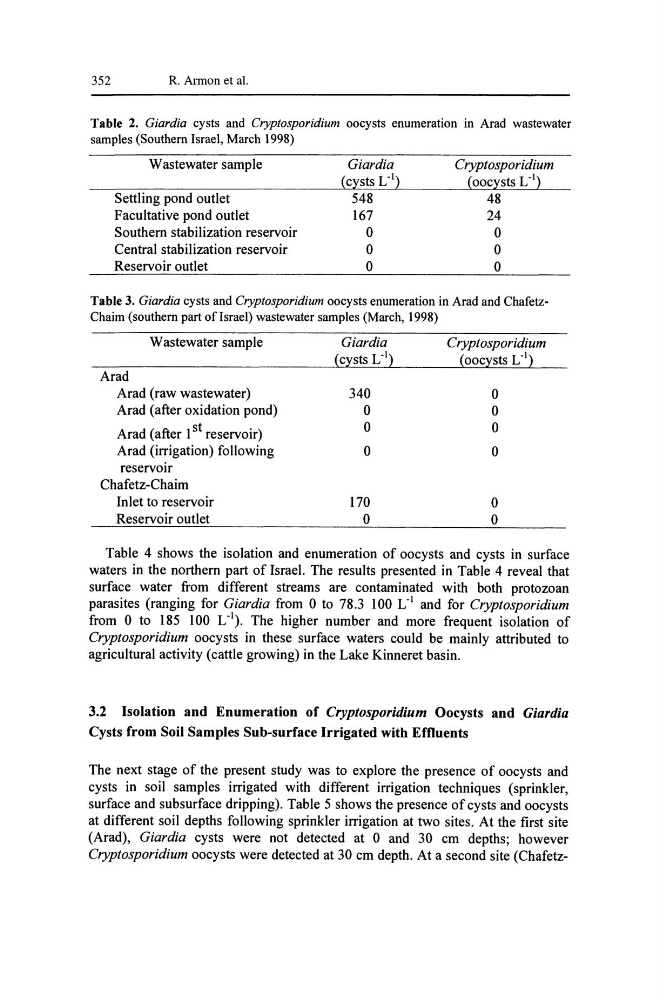
Table 2. Giardia cysts and Crypfosporidium oocysts enumeration in Arad wastewater
samples (Southern Israel, March 1998)
Wastewater sample
Settling pond outlet
Facultative pond outlet
Southern stabilization reservoir
Central stabilization reservoir
Reservoir outlet
Giardia
(cysts L- 1 )
548
167
o
o
o
Cryptosporidium
(oocysts L- 1 )
48
24
o
o
o
Table 3. Giardia cysts and Crypfosporidium oocysts enumeration in Arad and ChafetzChaim (southern part of Israel) wastewater samples (March, 1998)
Wastewater sample
Giardia
Cryptosporidium
(cysts L- 1 )
(oocysts L- 1 )
Arad
Arad (raw wastewater)
340
0
Arad (after oxidation pond)
0
0
Arad (after 1 st reservoir)
0
0
Arad (irrigation) following
0
0
reservoir
Chafetz-Chaim
Inlet to reservoir
170
0
Reservoir outlet
0
0
Table 4 shows the isolation and enumeration of oocysts and cysts in surface
waters in the northern part of Israel. The results presented in Table 4 reveal that
surface water from different streams are contaminated with both protozoan
parasites (ranging for Giardia from 0 to 78.3 100 L- 1 and for Cryptosporidium
from 0 to 185 100 L- 1 ). The higher number and more frequent isolation of
Cryptosporidium oocysts in these surface waters could be mainly attributed to
agricultural activity (cattle growing) in the Lake Kinneret basin.
3.2 Isolation and Enumeration of Cryptosporidium Oocysts and Giardia
Cysts from Soil Samples Sub-surface Irrigated with Effluents
The next stage of the present study was to explore the presence of oocysts and
cysts in soil samples irrigated with different irrigation techniques (sprinkler,
surface and subsurface dripping). Table 5 shows the presence of cysts and oocysts
at different soil depths following sprinkler irrigation at two sites. At the first site
(Arad), Giardia cysts were not detected at 0 and 30 cm depths; however
Cryptosporidium oocysts were detected at 30 cm depth. At a second site (Chafetz-
R. Almon et al.
Table 2. Giardia cysts and Crypfosporidium oocysts enumeration in Arad wastewater
samples (Southern Israel, March 1998)
Wastewater sample
Settling pond outlet
Facultative pond outlet
Southern stabilization reservoir
Central stabilization reservoir
Reservoir outlet
Giardia
(cysts L- 1 )
548
167
o
o
o
Cryptosporidium
(oocysts L- 1 )
48
24
o
o
o
Table 3. Giardia cysts and Crypfosporidium oocysts enumeration in Arad and ChafetzChaim (southern part of Israel) wastewater samples (March, 1998)
Wastewater sample
Giardia
Cryptosporidium
(cysts L- 1 )
(oocysts L- 1 )
Arad
Arad (raw wastewater)
340
0
Arad (after oxidation pond)
0
0
Arad (after 1 st reservoir)
0
0
Arad (irrigation) following
0
0
reservoir
Chafetz-Chaim
Inlet to reservoir
170
0
Reservoir outlet
0
0
Table 4 shows the isolation and enumeration of oocysts and cysts in surface
waters in the northern part of Israel. The results presented in Table 4 reveal that
surface water from different streams are contaminated with both protozoan
parasites (ranging for Giardia from 0 to 78.3 100 L- 1 and for Cryptosporidium
from 0 to 185 100 L- 1 ). The higher number and more frequent isolation of
Cryptosporidium oocysts in these surface waters could be mainly attributed to
agricultural activity (cattle growing) in the Lake Kinneret basin.
3.2 Isolation and Enumeration of Cryptosporidium Oocysts and Giardia
Cysts from Soil Samples Sub-surface Irrigated with Effluents
The next stage of the present study was to explore the presence of oocysts and
cysts in soil samples irrigated with different irrigation techniques (sprinkler,
surface and subsurface dripping). Table 5 shows the presence of cysts and oocysts
at different soil depths following sprinkler irrigation at two sites. At the first site
(Arad), Giardia cysts were not detected at 0 and 30 cm depths; however
Cryptosporidium oocysts were detected at 30 cm depth. At a second site (Chafetz-