

Isolation, Identification of the Water-borne Protozoan Parasites
351
3 Results
3.1 Isolation and Enumeration of Cryptosporidium Oocysts and
Giardia Cysts from Surface Water, Wastewater, and Effluent in
Israel
Wastewater and effluents from northern and southern sources in Israel were tested
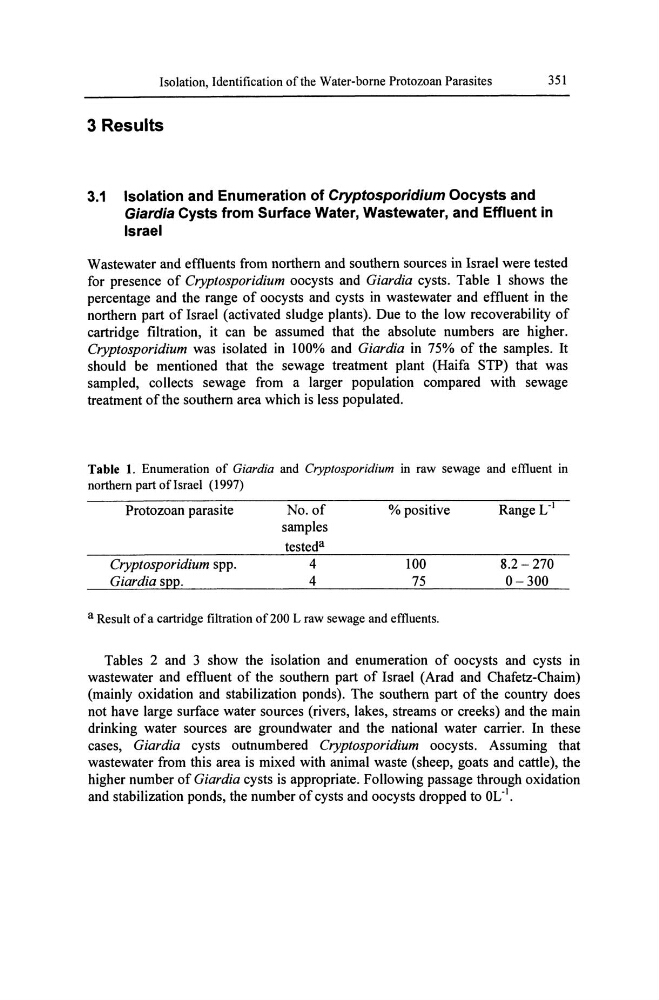
for presence of Cryplosporidium oocysts and Giardia cysts. Table 1 shows the
percentage and the range of oocysts and cysts in wastewater and effluent in the
northern part of Israel (activated sludge plants). Due to the low recoverability of
cartridge filtration, it can be assumed that the absolute numbers are higher.
Cryplosporidium was isolated in 100% and Giardia in 75% of the samples. It
should be mentioned that the sewage treatment plant (Haifa STP) that was
sampled, collects sewage from a larger population compared with sewage
treatment of the southern area which is less populated.
Table 1. Enumeration of Giardia and Cryptosporidium in raw sewage and effluent in
northern part ofIsrael (1997)
Protozoan parasite
No. of
% positive
Range L- 1
samples
tested a
Cryplosporidium spp.
4
100
8.2 - 270
Giardia spp.
4
75
0-300
a Result of a cartridge filtration of 200 L raw sewage and effluents.
Tables 2 and 3 show the isolation and enumeration of oocysts and cysts in
wastewater and effluent of the southern part of Israel (Arad and Chafetz-Chaim)
(mainly oxidation and stabilization ponds). The southern part of the country does
not have large surface water sources (rivers, lakes, streams or creeks) and the main
drinking water sources are groundwater and the national water carrier. In these
cases, Giardia cysts outnumbered Cryplosporidium oocysts. Assuming that
wastewater from this area is mixed with animal waste (sheep, goats and cattle), the
higher number of Giardia cysts is appropriate. Following passage through oxidation
and stabilization ponds, the number of cysts and oocysts dropped to OL- 1 •
351
3 Results
3.1 Isolation and Enumeration of Cryptosporidium Oocysts and
Giardia Cysts from Surface Water, Wastewater, and Effluent in
Israel
Wastewater and effluents from northern and southern sources in Israel were tested
for presence of Cryplosporidium oocysts and Giardia cysts. Table 1 shows the
percentage and the range of oocysts and cysts in wastewater and effluent in the
northern part of Israel (activated sludge plants). Due to the low recoverability of
cartridge filtration, it can be assumed that the absolute numbers are higher.
Cryplosporidium was isolated in 100% and Giardia in 75% of the samples. It
should be mentioned that the sewage treatment plant (Haifa STP) that was
sampled, collects sewage from a larger population compared with sewage
treatment of the southern area which is less populated.
Table 1. Enumeration of Giardia and Cryptosporidium in raw sewage and effluent in
northern part ofIsrael (1997)
Protozoan parasite
No. of
% positive
Range L- 1
samples
tested a
Cryplosporidium spp.
4
100
8.2 - 270
Giardia spp.
4
75
0-300
a Result of a cartridge filtration of 200 L raw sewage and effluents.
Tables 2 and 3 show the isolation and enumeration of oocysts and cysts in
wastewater and effluent of the southern part of Israel (Arad and Chafetz-Chaim)
(mainly oxidation and stabilization ponds). The southern part of the country does
not have large surface water sources (rivers, lakes, streams or creeks) and the main
drinking water sources are groundwater and the national water carrier. In these
cases, Giardia cysts outnumbered Cryplosporidium oocysts. Assuming that
wastewater from this area is mixed with animal waste (sheep, goats and cattle), the
higher number of Giardia cysts is appropriate. Following passage through oxidation
and stabilization ponds, the number of cysts and oocysts dropped to OL- 1 •