

316
F. Hell and J. Lahnsteiner
2 Principle of Electrodialysis
The principle of electrodialysis involves the removal of ionic components from
aqueous solutions through ion exchange membranes using the driving force of an
electric field. The water to be treated is pumped through a membrane stack, which
consists of alternately placed anionic and cationic selective membranes. Separated
by gasket frames and spacers, the membranes are fixed between two end plates,
which contain the electrodes producing the electric field. In order to transfer the
electric current and to remove gases produced by the electrode reactions, the
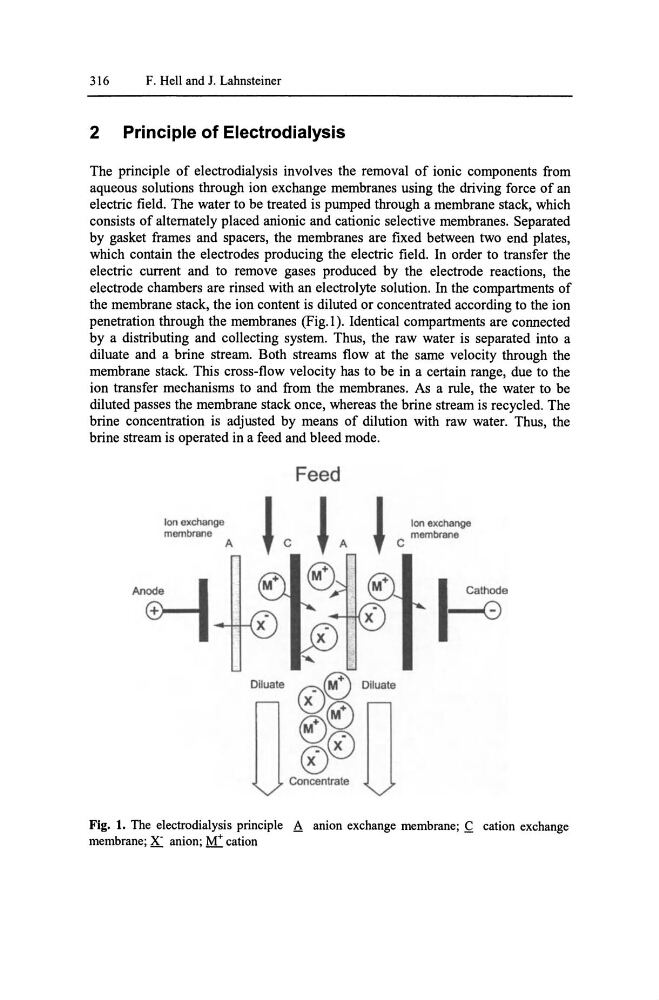
electrode chambers are rinsed with an electrolyte solution. In the compartments of
the membrane stack, the ion content is diluted or concentrated according to the ion
penetration through the membranes (Fig. I ). Identical compartments are connected
by a distributing and collecting system. Thus, the raw water is separated into a
diluate and a brine stream. Both streams flow at the same velocity through the
membrane stack. This cross-flow velocity has to be in a certain range, due to the
ion transfer mechanisms to and from the membranes. As a rule, the water to be
diluted passes the membrane stack once, whereas the brine stream is recycled. The
brine concentration is adjusted by means of dilution with raw water. Thus, the
brine stream is operated in a feed and bleed mode.
Ion exchange
membrane
A
Diluate
Feed
.......
~
0®
€)
(i)®
Concentrate
C
Diluate
Ion exchange
membrane
I
Cathode
--0
Fig. 1. The electrodialysis principle A anion exchange membrane; £ cation exchange
membrane; X- anion; M+ cation
F. Hell and J. Lahnsteiner
2 Principle of Electrodialysis
The principle of electrodialysis involves the removal of ionic components from
aqueous solutions through ion exchange membranes using the driving force of an
electric field. The water to be treated is pumped through a membrane stack, which
consists of alternately placed anionic and cationic selective membranes. Separated
by gasket frames and spacers, the membranes are fixed between two end plates,
which contain the electrodes producing the electric field. In order to transfer the
electric current and to remove gases produced by the electrode reactions, the
electrode chambers are rinsed with an electrolyte solution. In the compartments of
the membrane stack, the ion content is diluted or concentrated according to the ion
penetration through the membranes (Fig. I ). Identical compartments are connected
by a distributing and collecting system. Thus, the raw water is separated into a
diluate and a brine stream. Both streams flow at the same velocity through the
membrane stack. This cross-flow velocity has to be in a certain range, due to the
ion transfer mechanisms to and from the membranes. As a rule, the water to be
diluted passes the membrane stack once, whereas the brine stream is recycled. The
brine concentration is adjusted by means of dilution with raw water. Thus, the
brine stream is operated in a feed and bleed mode.
Ion exchange
membrane
A
Diluate
Feed
.......
~
0®
€)
(i)®
Concentrate
C
Diluate
Ion exchange
membrane
I
Cathode
--0
Fig. 1. The electrodialysis principle A anion exchange membrane; £ cation exchange
membrane; X- anion; M+ cation