

Turbidity Removal by Polyelectrolytes as Flocculant Aids
305
small dosages of the cationic polymers were needed for good clarification. The
optimal polymer dosages at these aluminium nitrate concentrations are
considerably lower than their optimal flocculant dose when used alone.
0.3
0.1
o.o+--...l~""~~~----'--r---~
o
1
Z
3
POLYMER DOSE mg/L
4
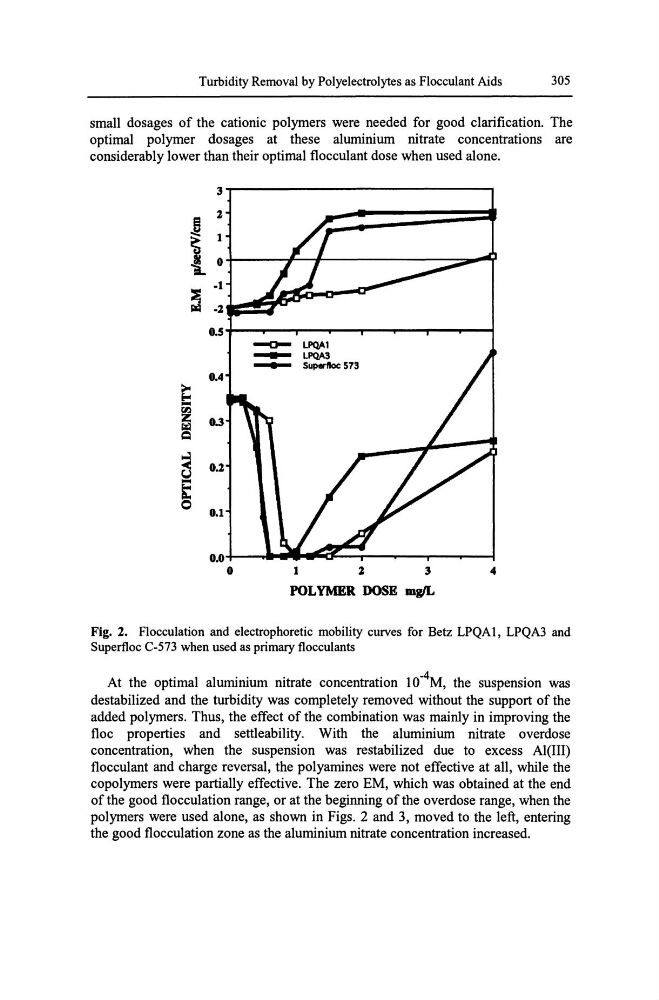
Fig. 2. Flocculation and electrophoretic mobility curves for Betz LPQAl, LPQA3 and
Superfloc C-573 when used as primary flocculants
At the optimal aluminium nitrate concentration lO-4M, the suspension was
destabilized and the turbidity was completely removed without the support of the
added polymers. Thus, the effect of the combination was mainly in improving the
floc properties and settleability. With the aluminium nitrate overdose
concentration, when the suspension was restabilized due to excess AI(III)
flocculant and charge reversal, the polyamines were not effective at all, while the
copolymers were partially effective. The zero EM, which was obtained at the end
of the good flocculation range, or at the beginning of the overdose range, when the
polymers were used alone, as shown in Figs. 2 and 3, moved to the left, entering
the good flocculation zone as the aluminium nitrate concentration increased.
305
small dosages of the cationic polymers were needed for good clarification. The
optimal polymer dosages at these aluminium nitrate concentrations are
considerably lower than their optimal flocculant dose when used alone.
0.3
0.1
o.o+--...l~""~~~----'--r---~
o
1
Z
3
POLYMER DOSE mg/L
4
Fig. 2. Flocculation and electrophoretic mobility curves for Betz LPQAl, LPQA3 and
Superfloc C-573 when used as primary flocculants
At the optimal aluminium nitrate concentration lO-4M, the suspension was
destabilized and the turbidity was completely removed without the support of the
added polymers. Thus, the effect of the combination was mainly in improving the
floc properties and settleability. With the aluminium nitrate overdose
concentration, when the suspension was restabilized due to excess AI(III)
flocculant and charge reversal, the polyamines were not effective at all, while the
copolymers were partially effective. The zero EM, which was obtained at the end
of the good flocculation range, or at the beginning of the overdose range, when the
polymers were used alone, as shown in Figs. 2 and 3, moved to the left, entering
the good flocculation zone as the aluminium nitrate concentration increased.