

304
N. Narkis et al.
to 8 mg £-1. The characteristics of the flocculation with cationic polymers and
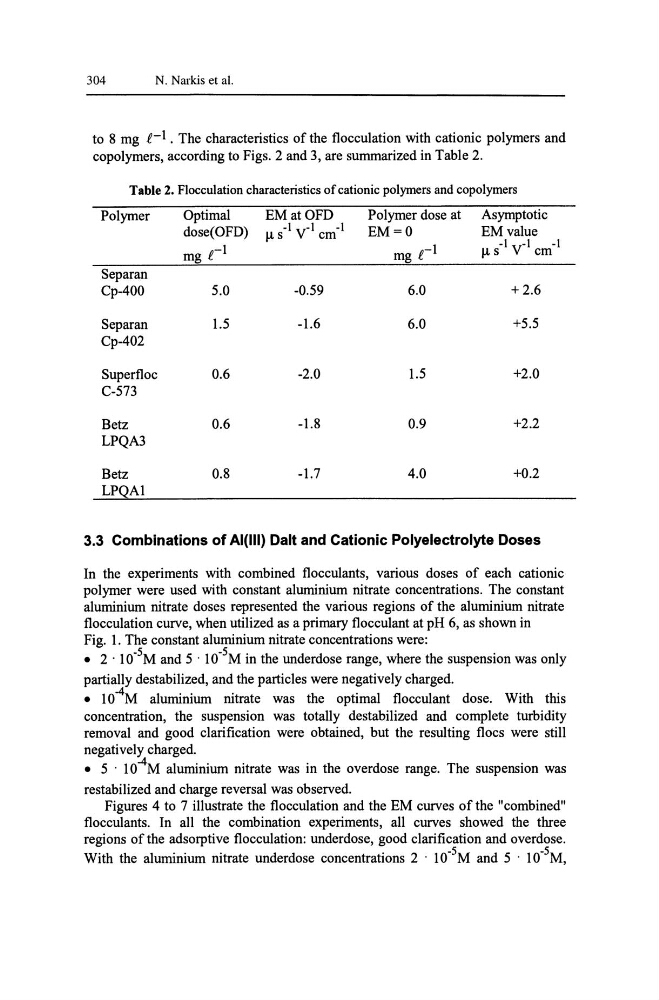
copolymers, according to Figs. 2 and 3, are summarized in Table 2.
Table 2. Flocculation characteristics of cationic polymers and copolymers
Polymer
Optimal
EMatOFD
Polymer dose at Asymptotic
dose(OFD)
-I -I
-I
EM=O
EM value
Ils V cm
mg rl
mg rl
-I V-I
-I
Il s
cm
Separan
Cp-400
5.0
-0.59
6.0
+ 2.6
Separan
1.5
-1.6
6.0
+5.5
Cp-402
Superfloc
0.6
-2.0
1.5
+2.0
C-573
Betz
0.6
-1.8
0.9
+2.2
LPQA3
Betz
0.8
-1.7
4.0
+0.2
LPQAI
3.3 Combinations of AI(III) Dalt and Cationic Polyelectrolyte Doses
In the experiments with combined flocculants, various doses of each cationic
polymer were used with constant aluminium nitrate concentrations. The constant
aluminium nitrate doses represented the various regions of the aluminium nitrate
flocculation curve, when utilized as a primary flocculant at pH 6, as shown in
Fig. 1. The constant aluminium nitrate concentrations were:
-5
-5
.
• 2' lO M and 5 . lO M m the underdose range, where the suspension was only
partially destabilized, and the particles were negatively charged.
• lO-4M aluminium nitrate was the optimal flocculant dose. With this
concentration, the suspension was totally destabilized and complete turbidity
removal and good clarification were obtained, but the reSUlting flocs were still
negatively charged.
• 5 . lO-4M aluminium nitrate was in the overdose range. The suspension was
restabilized and charge reversal was observed.
Figures 4 to 7 illustrate the flocculation and the EM curves of the "combined"
flocculants. In all the combination experiments, all curves showed the three
regions of the adsorptive flocculation: underdose, good clarification and overdose.
With the aluminium nitrate underdose concentrations 2 . lO-5M and 5 . lO-5M,
N. Narkis et al.
to 8 mg £-1. The characteristics of the flocculation with cationic polymers and
copolymers, according to Figs. 2 and 3, are summarized in Table 2.
Table 2. Flocculation characteristics of cationic polymers and copolymers
Polymer
Optimal
EMatOFD
Polymer dose at Asymptotic
dose(OFD)
-I -I
-I
EM=O
EM value
Ils V cm
mg rl
mg rl
-I V-I
-I
Il s
cm
Separan
Cp-400
5.0
-0.59
6.0
+ 2.6
Separan
1.5
-1.6
6.0
+5.5
Cp-402
Superfloc
0.6
-2.0
1.5
+2.0
C-573
Betz
0.6
-1.8
0.9
+2.2
LPQA3
Betz
0.8
-1.7
4.0
+0.2
LPQAI
3.3 Combinations of AI(III) Dalt and Cationic Polyelectrolyte Doses
In the experiments with combined flocculants, various doses of each cationic
polymer were used with constant aluminium nitrate concentrations. The constant
aluminium nitrate doses represented the various regions of the aluminium nitrate
flocculation curve, when utilized as a primary flocculant at pH 6, as shown in
Fig. 1. The constant aluminium nitrate concentrations were:
-5
-5
.
• 2' lO M and 5 . lO M m the underdose range, where the suspension was only
partially destabilized, and the particles were negatively charged.
• lO-4M aluminium nitrate was the optimal flocculant dose. With this
concentration, the suspension was totally destabilized and complete turbidity
removal and good clarification were obtained, but the reSUlting flocs were still
negatively charged.
• 5 . lO-4M aluminium nitrate was in the overdose range. The suspension was
restabilized and charge reversal was observed.
Figures 4 to 7 illustrate the flocculation and the EM curves of the "combined"
flocculants. In all the combination experiments, all curves showed the three
regions of the adsorptive flocculation: underdose, good clarification and overdose.
With the aluminium nitrate underdose concentrations 2 . lO-5M and 5 . lO-5M,