

Groundwater Management Strategies to Improve Surface Water
261
m 3 , the maximum volume of 3.2-3.9 million m 3 in summer was reached mainly by
groundwater inflow within 4 months.
A separate consideration of the water balances in the connected compartments
Obere Alte Donau (upper section) and Untere Alte Donau (lower section)
indicates a clear movement of water in the natural flow direction from upstream to
downstream (Fig. 8, left part).
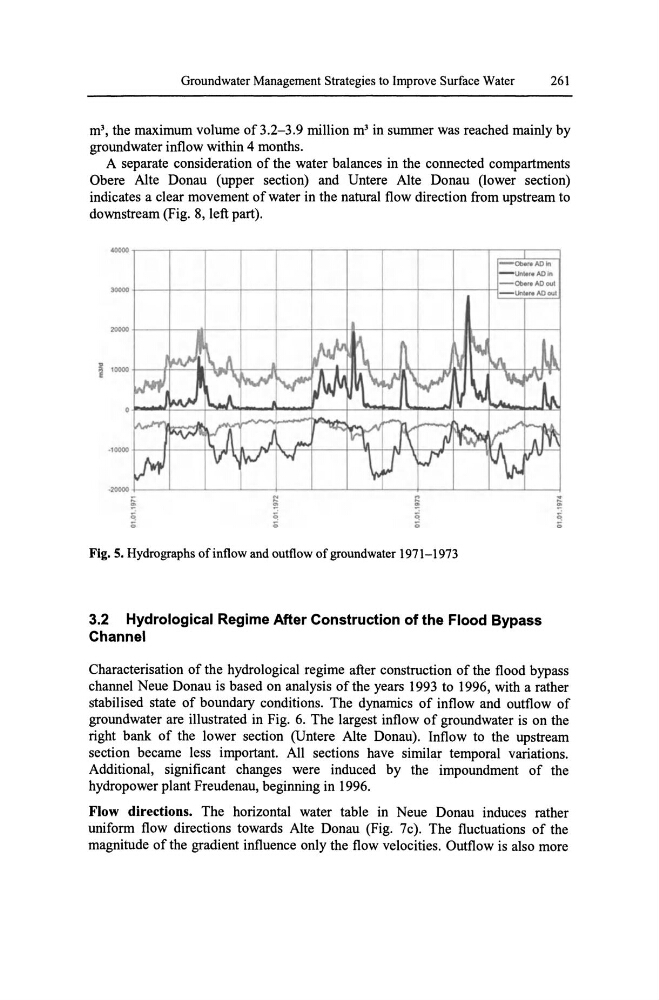
Fig. 5. Hydrographs of inflow and outflow of groundwater 1971-1973
3.2 Hydrological Regime After Construction of the Flood Bypass
Channel
Characterisation of the hydrological regime after construction of the flood bypass
channel Neue Donau is based on analysis of the years 1993 to 1996, with a rather
stabilised state of boundary conditions. The dynamics of inflow and outflow of
groundwater are illustrated in Fig. 6. The largest inflow of groundwater is on the
right bank of the lower section (Untere Alte Donau). Inflow to the upstream
section became less important. All sections have similar temporal variations.
Additional, significant changes were induced by the impoundment of the
hydropower plant Freudenau, beginning in 1996.
Flow directions. The horizontal water table in Neue Donau induces rather
uniform flow directions towards Alte Donau (Fig. 7c). The fluctuations of the
magnitude of the gradient influence only the flow velocities. Outflow is also more
261
m 3 , the maximum volume of 3.2-3.9 million m 3 in summer was reached mainly by
groundwater inflow within 4 months.
A separate consideration of the water balances in the connected compartments
Obere Alte Donau (upper section) and Untere Alte Donau (lower section)
indicates a clear movement of water in the natural flow direction from upstream to
downstream (Fig. 8, left part).
Fig. 5. Hydrographs of inflow and outflow of groundwater 1971-1973
3.2 Hydrological Regime After Construction of the Flood Bypass
Channel
Characterisation of the hydrological regime after construction of the flood bypass
channel Neue Donau is based on analysis of the years 1993 to 1996, with a rather
stabilised state of boundary conditions. The dynamics of inflow and outflow of
groundwater are illustrated in Fig. 6. The largest inflow of groundwater is on the
right bank of the lower section (Untere Alte Donau). Inflow to the upstream
section became less important. All sections have similar temporal variations.
Additional, significant changes were induced by the impoundment of the
hydropower plant Freudenau, beginning in 1996.
Flow directions. The horizontal water table in Neue Donau induces rather
uniform flow directions towards Alte Donau (Fig. 7c). The fluctuations of the
magnitude of the gradient influence only the flow velocities. Outflow is also more