

256
J. FUrst and H. P. Nachtnebel
importance of a lake's hydrological regime (Maitland and Morgan 1997), an
integrated view of the interaction between groundwater regime and surface water
regime has not been utilised to develop integrated management strategies. In this
study, we will identify and assess integrated groundwater and surface water
management alternatives to restore the Alte Donau in Vienna.
1.1 History of the Study Site Alte Donau
For decades, the citizens of Vienna have enjoyed the amenities of large, "almost
natural" surface waterbodies right in the centre of the metropolitan area for many
kinds of water-based recreation, including swimming, boating and fishing. The
most important waterbody with a long tradition as a public recreational resort, that
can be considered an important part of the cultural heritage, is the Alte Donau
(Old Danube). It is a shallow lake that originated from a cut-off branch of the
previously braided river system of the River Danube in Vienna (Goldschmid and
Grotzer 1993). Being separated from the surface flow system of the Danube,
renewal and exchange of water in the Alte Donau is now dominated by the
interaction of groundwater and surface water.
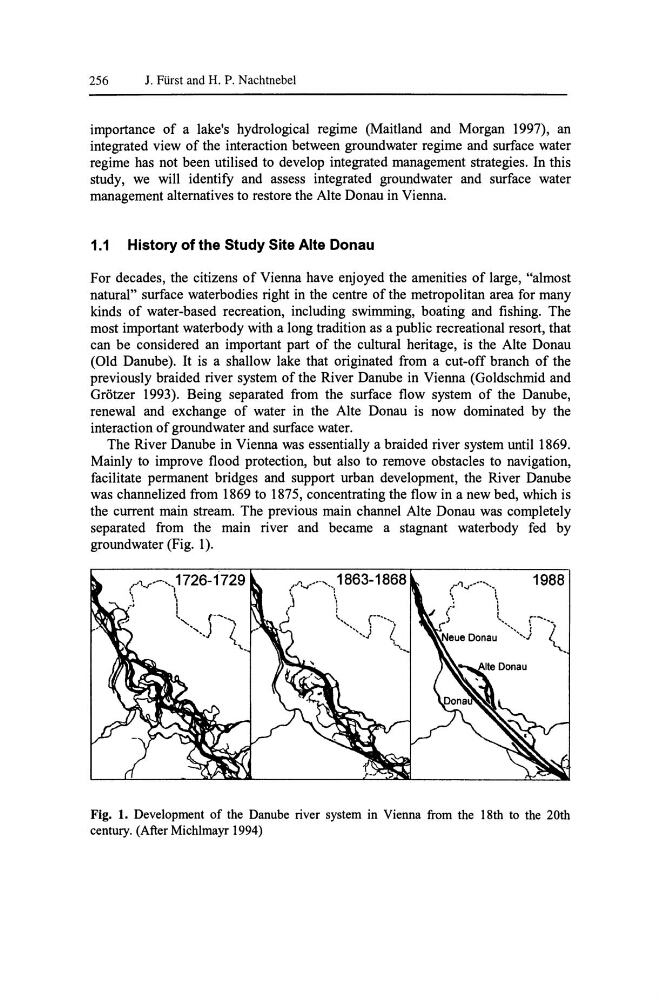
The River Danube in Vienna was essentially a braided river system until 1869.
Mainly to improve flood protection, but also to remove obstacles to navigation,
facilitate permanent bridges and support urban development, the River Danube
was channelized from 1869 to 1875, concentrating the flow in a new bed, which is
the current main stream. The previous main channel Alte Donau was completely
separated from the main river and became a stagnant waterbody fed by
groundwater (Fig. 1).
rv--·· .. 1726-1729
\
\
,_J
I
l
,--..
'- ) "
' "' ' <
"\.
/1 ..... ·· ..... 1863-1868
\
1
..l
i
j
'"
C·····
"' .. ) i
1988
Fig. 1. Development of the Danube river system in Vienna from the 18th to the 20th
century. (After Michlmayr 1994)
J. FUrst and H. P. Nachtnebel
importance of a lake's hydrological regime (Maitland and Morgan 1997), an
integrated view of the interaction between groundwater regime and surface water
regime has not been utilised to develop integrated management strategies. In this
study, we will identify and assess integrated groundwater and surface water
management alternatives to restore the Alte Donau in Vienna.
1.1 History of the Study Site Alte Donau
For decades, the citizens of Vienna have enjoyed the amenities of large, "almost
natural" surface waterbodies right in the centre of the metropolitan area for many
kinds of water-based recreation, including swimming, boating and fishing. The
most important waterbody with a long tradition as a public recreational resort, that
can be considered an important part of the cultural heritage, is the Alte Donau
(Old Danube). It is a shallow lake that originated from a cut-off branch of the
previously braided river system of the River Danube in Vienna (Goldschmid and
Grotzer 1993). Being separated from the surface flow system of the Danube,
renewal and exchange of water in the Alte Donau is now dominated by the
interaction of groundwater and surface water.
The River Danube in Vienna was essentially a braided river system until 1869.
Mainly to improve flood protection, but also to remove obstacles to navigation,
facilitate permanent bridges and support urban development, the River Danube
was channelized from 1869 to 1875, concentrating the flow in a new bed, which is
the current main stream. The previous main channel Alte Donau was completely
separated from the main river and became a stagnant waterbody fed by
groundwater (Fig. 1).
rv--·· .. 1726-1729
\
\
,_J
I
l
,--..
'- ) "
' "' ' <
"\.
/1 ..... ·· ..... 1863-1868
\
1
..l
i
j
'"
C·····
"' .. ) i
1988
Fig. 1. Development of the Danube river system in Vienna from the 18th to the 20th
century. (After Michlmayr 1994)