

Application of the Integrated Water Management Approach
221
6 Computational Structure of the Spree Model
The extremely complex situation of multiple water demands and different quality
influences, which make self-contradicting countermeasures necessary can best be
managed with the aid of a water - quality model, which has to include all named
aspects. Since the 1990s, environmental offices in Brandenburg and Saxony are
using the water - quantity model ArcGRM as a management tool for the River
Spree. This water - quantity model is used as the basis to develop an innovative
and holistic approach to create a decision - support system as an integrated combination of water quality and water quantity. The water - quality modules are coupled to ArcGRM.
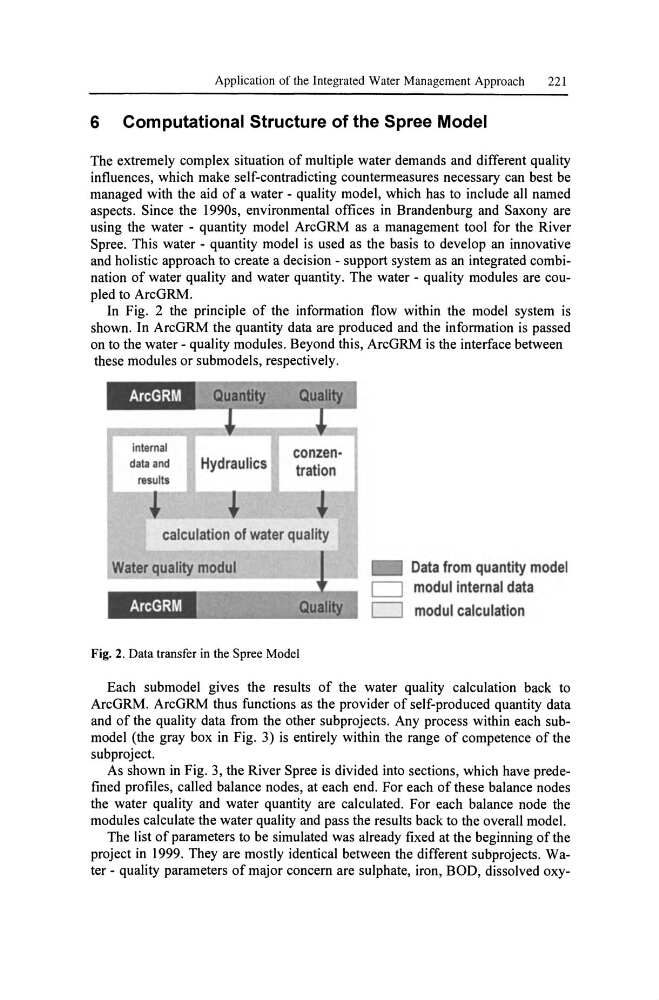
In Fig. 2 the principle of the information flow within the model system is
shown. In ArcGRM the quantity data are produced and the information is passed
on to the water - quality modules. Beyond this, ArcGRM is the interface between
these modules or submodels, respectively.
internal
data and
results
Hydraulics
conzentration
calculation of water quality
Water quality modul
Fig. 2. Data transfer in the Spree Model
Data from quantity model
D modul internal data
D modul calculation
Each submodel gives the results of the water quality calculation back to
ArcGRM. ArcGRM thus functions as the provider of self-produced quantity data
and of the quality data from the other subprojects. Any process within each submodel (the gray box in Fig. 3) is entirely within the range of competence of the
subproject.
As shown in Fig. 3, the River Spree is divided into sections, which have predefined profiles, called balance nodes, at each end. For each of these balance nodes
the water quality and water quantity are calculated. For each balance node the
modules calculate the water quality and pass the results back to the overall model.
The list of parameters to be simulated was already fixed at the beginning of the
project in 1999. They are mostly identical between the different subprojects. Water - quality parameters of major concern are sulphate, iron, BOD, dissolved oxy-
221
6 Computational Structure of the Spree Model
The extremely complex situation of multiple water demands and different quality
influences, which make self-contradicting countermeasures necessary can best be
managed with the aid of a water - quality model, which has to include all named
aspects. Since the 1990s, environmental offices in Brandenburg and Saxony are
using the water - quantity model ArcGRM as a management tool for the River
Spree. This water - quantity model is used as the basis to develop an innovative
and holistic approach to create a decision - support system as an integrated combination of water quality and water quantity. The water - quality modules are coupled to ArcGRM.
In Fig. 2 the principle of the information flow within the model system is
shown. In ArcGRM the quantity data are produced and the information is passed
on to the water - quality modules. Beyond this, ArcGRM is the interface between
these modules or submodels, respectively.
internal
data and
results
Hydraulics
conzentration
calculation of water quality
Water quality modul
Fig. 2. Data transfer in the Spree Model
Data from quantity model
D modul internal data
D modul calculation
Each submodel gives the results of the water quality calculation back to
ArcGRM. ArcGRM thus functions as the provider of self-produced quantity data
and of the quality data from the other subprojects. Any process within each submodel (the gray box in Fig. 3) is entirely within the range of competence of the
subproject.
As shown in Fig. 3, the River Spree is divided into sections, which have predefined profiles, called balance nodes, at each end. For each of these balance nodes
the water quality and water quantity are calculated. For each balance node the
modules calculate the water quality and pass the results back to the overall model.
The list of parameters to be simulated was already fixed at the beginning of the
project in 1999. They are mostly identical between the different subprojects. Water - quality parameters of major concern are sulphate, iron, BOD, dissolved oxy-