

Monitoring Lake Kinneret and its Watershed
187
suggested that water quality of Lake Kinneret deteriorated in the mean of
increasing salinity and cyanobacteria ratio to total algal biomass (Fig. 6).
6 Salinity
In the early 1960s the salinity of the lake was in the range of 380 mg cn- I . This
relatively high C}" concentration reflects mixing of low salinity (15-30 mg }"I)
water from the Jordan River and other streams with highly saline (1000-18,000
mg }"I) littoral springs (Kolodny et al. 1999). The Salinity Diversion Channel
(SDC) along the west shore of the lake was constructed in 1967 to divert saline
water from springs and wells located in the northwest and west side of the lake
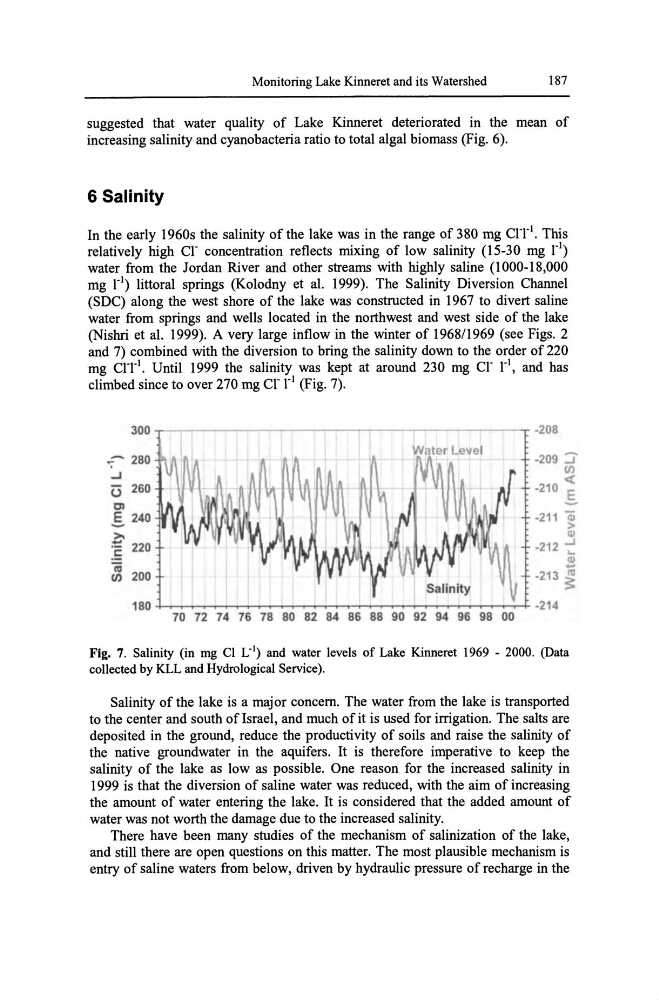
(Nishri et al. 1999). A very large inflow in the winter of 196811969 (see Figs. 2
and 7) combined with the diversion to bring the salinity down to the order of 220
mg en-I. Until 1999 the salinity was kept at around 230 mg e}" }"I, and has
climbed since to over 270 mg cr }"I (Fig. 7).
300 ~--~--------~--~---.-----.,,----------~·208
""";- 280
...J
U 260
Cl
.§.. 240
~ 220
c
~ 200
·209 :J'
en
·210 .§..
-211 ~
> <11
-212 ~
<11
-213 ~
180 +-'-.--~~~-.--......... -.--..-.-...--.-.--.,......,.--r-,................., .................... -.--.,......,.~.,......,.-+ -214
70 72 74 76 78 80 82 84 86 88 90 92 94 96 98 00
Fig. 7. Salinity (in mg CI L- I ) and water levels of Lake Kinneret 1969 - 2000. (Data
collected by KLL and Hydrological Service).
Salinity of the lake is a major concern. The water from the lake is transported
to the center and south of Israel, and much of it is used for irrigation. The salts are
deposited in the ground, reduce the productivity of soils and raise the salinity of
the native groundwater in the aquifers. It is therefore imperative to keep the
salinity of the lake as low as possible. One reason for the increased salinity in
1999 is that the diversion of saline water was reduced, with the aim of increasing
the amount of water entering the lake. It is considered that the added amount of
water was not worth the damage due to the increased salinity.
There have been many studies of the mechanism of salinization of the lake,
and still there are open questions on this matter. The most plausible mechanism is
entry of saline waters from below, driven by hydraulic pressure of recharge in the
187
suggested that water quality of Lake Kinneret deteriorated in the mean of
increasing salinity and cyanobacteria ratio to total algal biomass (Fig. 6).
6 Salinity
In the early 1960s the salinity of the lake was in the range of 380 mg cn- I . This
relatively high C}" concentration reflects mixing of low salinity (15-30 mg }"I)
water from the Jordan River and other streams with highly saline (1000-18,000
mg }"I) littoral springs (Kolodny et al. 1999). The Salinity Diversion Channel
(SDC) along the west shore of the lake was constructed in 1967 to divert saline
water from springs and wells located in the northwest and west side of the lake
(Nishri et al. 1999). A very large inflow in the winter of 196811969 (see Figs. 2
and 7) combined with the diversion to bring the salinity down to the order of 220
mg en-I. Until 1999 the salinity was kept at around 230 mg e}" }"I, and has
climbed since to over 270 mg cr }"I (Fig. 7).
300 ~--~--------~--~---.-----.,,----------~·208
""";- 280
...J
U 260
Cl
.§.. 240
~ 220
c
~ 200
·209 :J'
en
·210 .§..
-211 ~
> <11
-212 ~
<11
-213 ~
180 +-'-.--~~~-.--......... -.--..-.-...--.-.--.,......,.--r-,................., .................... -.--.,......,.~.,......,.-+ -214
70 72 74 76 78 80 82 84 86 88 90 92 94 96 98 00
Fig. 7. Salinity (in mg CI L- I ) and water levels of Lake Kinneret 1969 - 2000. (Data
collected by KLL and Hydrological Service).
Salinity of the lake is a major concern. The water from the lake is transported
to the center and south of Israel, and much of it is used for irrigation. The salts are
deposited in the ground, reduce the productivity of soils and raise the salinity of
the native groundwater in the aquifers. It is therefore imperative to keep the
salinity of the lake as low as possible. One reason for the increased salinity in
1999 is that the diversion of saline water was reduced, with the aim of increasing
the amount of water entering the lake. It is considered that the added amount of
water was not worth the damage due to the increased salinity.
There have been many studies of the mechanism of salinization of the lake,
and still there are open questions on this matter. The most plausible mechanism is
entry of saline waters from below, driven by hydraulic pressure of recharge in the