

Water Sources and Quality Along the Lower Jordan River
141
Tirza well (14100 mgCl e- I ), and Aqraa (30500 mgCl e- I ; eastern side) with
typically low NalCI and SOJCl ratios. (2) Saline water with a Cl range of 1000 to
4800 mg e- I and typically higher NalCI and SOJCl ratios. It seems that the major
shift of the chemical composition of the lower zone is derived from inflow of the
second component. The rise in the salinity in the lower zone is associated also
with an 87Sr/86Sr increase (0.7081 to 0.7083), although we observed a slight
decrease with further distance. This value is consistent with the 87Sr/86Sr ratios
measured in saline inflows in this region (0.70796 - 0.70800). In the southern zone
the 0 18 0 values show a wide range of -5 to -1.5%0. A large range of 0 18 0 values
was also observed in the western surface inflows while groundwater shows
typically lower 0 18 0 values.
3.1.4 Identification of End Members Using Strontium and Boron
Isotopes
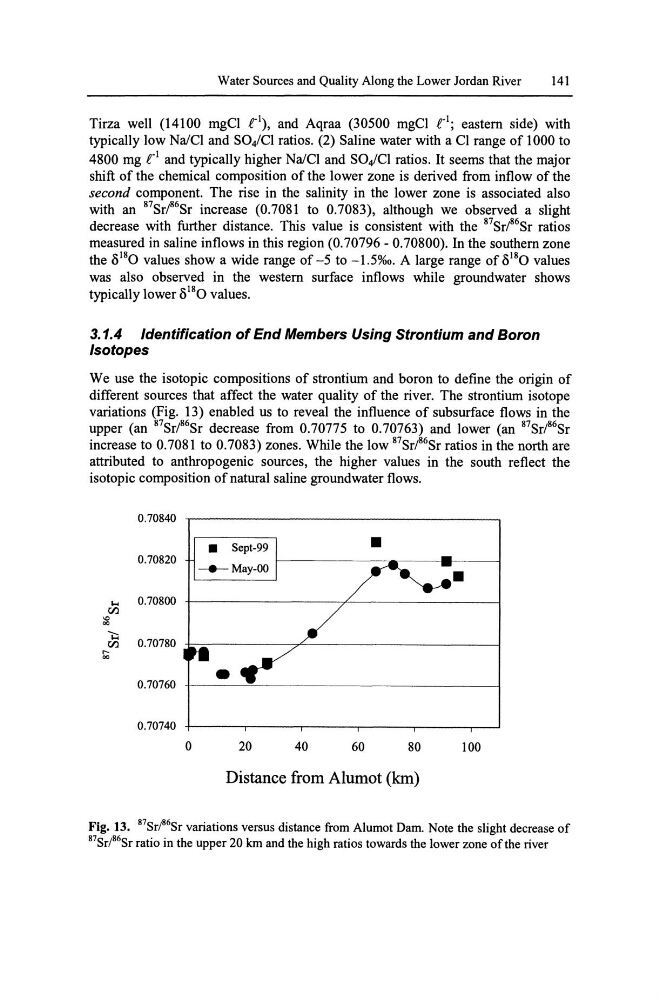
We use the isotopic compositions of strontium and boron to define the origin of
different sources that affect the water quality of the river. The strontium isotope
variations (Fig. 13) enabled us to reveal the influence of subsurface flows in the
upper (an 87Sr;B6Sr decrease from 0.70775 to 0.70763) and lower (an 87Sr/86Sr
increase to 0.7081 to 0.7083) zones. While the low 87Sr/86Sr ratios in the north are
attributed to anthropogenic sources, the higher values in the south reflect the
isotopic composition of natural saline groundwater flows.
0.70840
•
Sept-99
•
0.70820
•
I-<
0.70800
Vl
'"
00
I:< 0.70780
Vl
roo
0.70760
0.70740
0
20
40
60
80
100
Distance from Alumot (Ian)
Fig. 13. 87Sr/86Sr variations versus distance from Alumot Dam. Note the slight decrease of
87Sr/86Sr ratio in the upper 20 Ian and the high ratios towards the lower zone of the river
141
Tirza well (14100 mgCl e- I ), and Aqraa (30500 mgCl e- I ; eastern side) with
typically low NalCI and SOJCl ratios. (2) Saline water with a Cl range of 1000 to
4800 mg e- I and typically higher NalCI and SOJCl ratios. It seems that the major
shift of the chemical composition of the lower zone is derived from inflow of the
second component. The rise in the salinity in the lower zone is associated also
with an 87Sr/86Sr increase (0.7081 to 0.7083), although we observed a slight
decrease with further distance. This value is consistent with the 87Sr/86Sr ratios
measured in saline inflows in this region (0.70796 - 0.70800). In the southern zone
the 0 18 0 values show a wide range of -5 to -1.5%0. A large range of 0 18 0 values
was also observed in the western surface inflows while groundwater shows
typically lower 0 18 0 values.
3.1.4 Identification of End Members Using Strontium and Boron
Isotopes
We use the isotopic compositions of strontium and boron to define the origin of
different sources that affect the water quality of the river. The strontium isotope
variations (Fig. 13) enabled us to reveal the influence of subsurface flows in the
upper (an 87Sr;B6Sr decrease from 0.70775 to 0.70763) and lower (an 87Sr/86Sr
increase to 0.7081 to 0.7083) zones. While the low 87Sr/86Sr ratios in the north are
attributed to anthropogenic sources, the higher values in the south reflect the
isotopic composition of natural saline groundwater flows.
0.70840
•
Sept-99
•
0.70820
•
I-<
0.70800
Vl
'"
00
I:< 0.70780
Vl
roo
0.70760
0.70740
0
20
40
60
80
100
Distance from Alumot (Ian)
Fig. 13. 87Sr/86Sr variations versus distance from Alumot Dam. Note the slight decrease of
87Sr/86Sr ratio in the upper 20 Ian and the high ratios towards the lower zone of the river