

88
G. Langergraber et al.
2.4 The Multicomponent Reactive Transport Model CW2D
To model the biochemical processes in subsurface-flow constructed wetlands
the multicomponent reactive transport model CW2D has been developed. The
mathematical structure of CW2D is based on the ASM2 (Activated Sludge Model
No.2 by Gujer et al. 2000). CW2D is able to model the biochemical elimination
and transformation processes for organic matter, nitrogen and phosphorus. The reaction term rj in Eq. (6) is calculated by
R
Ii =8· LVj,jrej ,
j=1
(8)
where i = I .. N; N = number of components;} = l .. R; R = number of processes;
rj = reaction term for component i (mgj.dm'3s.h,I); e = volumetric water content
(dm3w.dm'3s); Vj,j = stoichiometric factor for component i and process} (mgj.mg/);
and rej = zero-order reaction rate for process j in the aqueous phase
(mgj.dm'3 w.h,I).
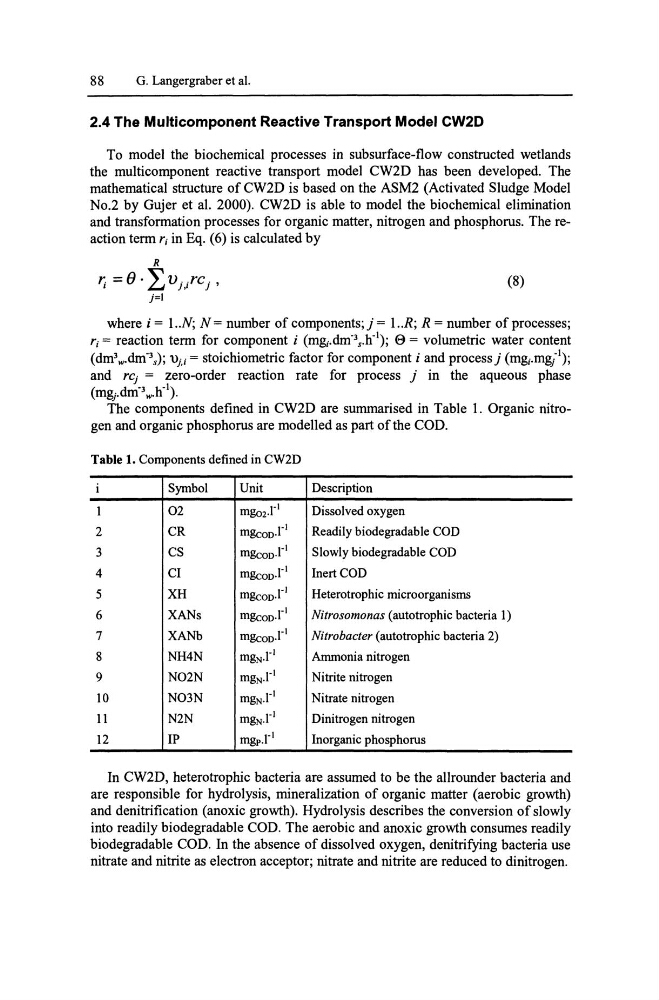
The components defined in CW2D are summarised in Table I. Organic nitrogen and organic phosphorus are modelled as part of the COD.
Table 1. Components defined in CW2D
i
Symbol
Unit
Description
1
02
mgo2. rl
Dissolved oxygen
2
CR
mgcoo. rl
Readily biodegradable COD
3
CS
mgcoo. rl
Slowly biodegradable COD
4
CI
mgcoo.r l
Inert COD
5
XH
mgcoo.r l
Heterotrophic microorganisms
6
XANs
mgcoo.r l
Nitrosomonas (autotrophic bacteria 1)
7
XANb
mgcoo.r l
Nitrobacter (autotrophic bacteria 2)
8
NH4N
mgN.r l
Ammonia nitrogen
9
N02N
mgN.r 1
Nitrite nitrogen
10
N03N
mgN.r 1
Nitrate nitrogen
11
N2N
mgN.r 1
Dinitrogen nitrogen
12
IP
mgp.r 1
Inorganic phosphorus
In CW2D, heterotrophic bacteria are assumed to be the allrounder bacteria and
are responsible for hydrolysis, mineralization of organic matter (aerobic growth)
and denitrification (anoxic growth). Hydrolysis describes the conversion of slowly
into readily biodegradable COD. The aerobic and anoxic growth consumes readily
biodegradable COD. In the absence of dissolved oxygen, denitrifying bacteria use
nitrate and nitrite as electron acceptor; nitrate and nitrite are reduced to dinitrogen.
G. Langergraber et al.
2.4 The Multicomponent Reactive Transport Model CW2D
To model the biochemical processes in subsurface-flow constructed wetlands
the multicomponent reactive transport model CW2D has been developed. The
mathematical structure of CW2D is based on the ASM2 (Activated Sludge Model
No.2 by Gujer et al. 2000). CW2D is able to model the biochemical elimination
and transformation processes for organic matter, nitrogen and phosphorus. The reaction term rj in Eq. (6) is calculated by
R
Ii =8· LVj,jrej ,
j=1
(8)
where i = I .. N; N = number of components;} = l .. R; R = number of processes;
rj = reaction term for component i (mgj.dm'3s.h,I); e = volumetric water content
(dm3w.dm'3s); Vj,j = stoichiometric factor for component i and process} (mgj.mg/);
and rej = zero-order reaction rate for process j in the aqueous phase
(mgj.dm'3 w.h,I).
The components defined in CW2D are summarised in Table I. Organic nitrogen and organic phosphorus are modelled as part of the COD.
Table 1. Components defined in CW2D
i
Symbol
Unit
Description
1
02
mgo2. rl
Dissolved oxygen
2
CR
mgcoo. rl
Readily biodegradable COD
3
CS
mgcoo. rl
Slowly biodegradable COD
4
CI
mgcoo.r l
Inert COD
5
XH
mgcoo.r l
Heterotrophic microorganisms
6
XANs
mgcoo.r l
Nitrosomonas (autotrophic bacteria 1)
7
XANb
mgcoo.r l
Nitrobacter (autotrophic bacteria 2)
8
NH4N
mgN.r l
Ammonia nitrogen
9
N02N
mgN.r 1
Nitrite nitrogen
10
N03N
mgN.r 1
Nitrate nitrogen
11
N2N
mgN.r 1
Dinitrogen nitrogen
12
IP
mgp.r 1
Inorganic phosphorus
In CW2D, heterotrophic bacteria are assumed to be the allrounder bacteria and
are responsible for hydrolysis, mineralization of organic matter (aerobic growth)
and denitrification (anoxic growth). Hydrolysis describes the conversion of slowly
into readily biodegradable COD. The aerobic and anoxic growth consumes readily
biodegradable COD. In the absence of dissolved oxygen, denitrifying bacteria use
nitrate and nitrite as electron acceptor; nitrate and nitrite are reduced to dinitrogen.