

Numerical Simulation as a Tool to Improve SubsUiface Flow
87
hower, is largely attributed to convection and is extremely scale-dependent. From
a mathematical point of view, diffusion and dispersion can be described in the
same way.
In addition to the transport processes as described above, the transport model
considers sources and sinks (e.g. water uptake by plant roots), chemical interactions and decomposing of substances in water, and interactions between solutes
and the soil matrix (e.g. adsorption and ion exchange).
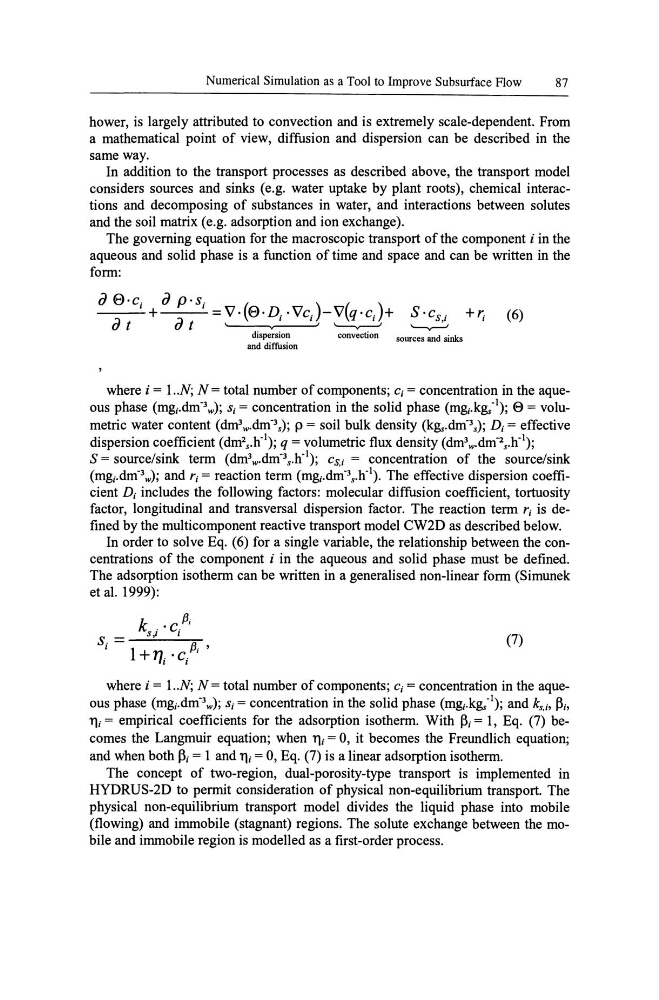
The governing equation for the macroscopic transport of the component i in the
aqueous and solid phase is a function of time and space and can be written in the
form:
a E)·c. a p·s.
- - ' +
' =V.(E).D .. Vc}-V(q.c.}+
at
at ~~
(6)
dispersion
convection
sources and sinks
and diffusion
where i = 1 .. N; N = total number of components; Ci = concentration in the aqueous phase (mgi.dm-3 w); Si = concentration in the solid phase (mgi.kg;\ e = volumetric water content (dm 3 w.dm- 3 s); p = soil bulk density (kg..dm- 3 s); Di = effective
dispersion coefficient (dm 2 s.h- 1 ); q = volumetric flux density (dm3w.dm-2s.h-l);
S= source/sink term (dm3w.dm-3s.h-l); CS,i = concentration of the source/sink
(mgi.dm-3w); and ri = reaction term (mgi.dm-3s.h-l). The effective dispersion coefficient Di includes the following factors: molecular diffusion coefficient, tortuosity
factor, longitudinal and transversal dispersion factor. The reaction term ri is defined by the multi component reactive transport model CW2D as described below.
In order to solve Eq. (6) for a single variable, the relationship between the concentrations of the component i in the aqueous and solid phase must be defined.
The adsorption isotherm can be written in a generalised non-linear form (Simunek
et al. 1999):
k
Pi
s i . C i
S. = -:":;'--'--;,,I
1 + 11 .• c. p , '
'II
I
(7)
where i = 1 .. N; N = total number of components; Ci = concentration in the aqueous phase (mgi.dm-3 w); Si = concentration in the solid phase (mgi.kg.-1); and ks,i, ~i'
lli = empirical coefficients for the adsorption isotherm. With ~i = 1, Eq. (7) becomes the Langmuir equation; when lli = 0, it becomes the Freundlich equation;
and when both ~i = 1 and lli = 0, Eq. (7) is a linear adsorption isotherm.
The concept of two-region, dual-porosity-type transport is implemented in
HYDRUS-2D to permit consideration of physical non-equilibrium transport. The
physical non-equilibrium transport model divides the liquid phase into mobile
(flowing) and immobile (stagnant) regions. The solute exchange between the mobile and immobile region is modelled as a first-order process.
87
hower, is largely attributed to convection and is extremely scale-dependent. From
a mathematical point of view, diffusion and dispersion can be described in the
same way.
In addition to the transport processes as described above, the transport model
considers sources and sinks (e.g. water uptake by plant roots), chemical interactions and decomposing of substances in water, and interactions between solutes
and the soil matrix (e.g. adsorption and ion exchange).
The governing equation for the macroscopic transport of the component i in the
aqueous and solid phase is a function of time and space and can be written in the
form:
a E)·c. a p·s.
- - ' +
' =V.(E).D .. Vc}-V(q.c.}+
at
at ~~
(6)
dispersion
convection
sources and sinks
and diffusion
where i = 1 .. N; N = total number of components; Ci = concentration in the aqueous phase (mgi.dm-3 w); Si = concentration in the solid phase (mgi.kg;\ e = volumetric water content (dm 3 w.dm- 3 s); p = soil bulk density (kg..dm- 3 s); Di = effective
dispersion coefficient (dm 2 s.h- 1 ); q = volumetric flux density (dm3w.dm-2s.h-l);
S= source/sink term (dm3w.dm-3s.h-l); CS,i = concentration of the source/sink
(mgi.dm-3w); and ri = reaction term (mgi.dm-3s.h-l). The effective dispersion coefficient Di includes the following factors: molecular diffusion coefficient, tortuosity
factor, longitudinal and transversal dispersion factor. The reaction term ri is defined by the multi component reactive transport model CW2D as described below.
In order to solve Eq. (6) for a single variable, the relationship between the concentrations of the component i in the aqueous and solid phase must be defined.
The adsorption isotherm can be written in a generalised non-linear form (Simunek
et al. 1999):
k
Pi
s i . C i
S. = -:":;'--'--;,,I
1 + 11 .• c. p , '
'II
I
(7)
where i = 1 .. N; N = total number of components; Ci = concentration in the aqueous phase (mgi.dm-3 w); Si = concentration in the solid phase (mgi.kg.-1); and ks,i, ~i'
lli = empirical coefficients for the adsorption isotherm. With ~i = 1, Eq. (7) becomes the Langmuir equation; when lli = 0, it becomes the Freundlich equation;
and when both ~i = 1 and lli = 0, Eq. (7) is a linear adsorption isotherm.
The concept of two-region, dual-porosity-type transport is implemented in
HYDRUS-2D to permit consideration of physical non-equilibrium transport. The
physical non-equilibrium transport model divides the liquid phase into mobile
(flowing) and immobile (stagnant) regions. The solute exchange between the mobile and immobile region is modelled as a first-order process.