

Metals
37
Nitric Acid Dry Ashing Extraction. Add 35 ml concentrated nitric acid and 5 ml 30 %
hydrogen peroxide to 5-10 g of sample in a beaker and evaporate to dryness on a hot
plate. Ash at 400-425 °c for 1 h in a muffle furnace and cool. Add 25 ml of acid
mixture (200 ml concentrated nitric acid, 50 ml concentrated hydrochloric acid and
750 ml deionized water), 20 mIlO % ammonium chloride and 1 ml Ca(N0 3 )2 • 4Hp
(11.8 gf 100 ml). Heat gently for 15 min and cool for at least 5 min. Separate the
residue by filtration or centrifugation, wash the residue twice with deionized water,
and combine washings and extract in a 250-ml volumetric flask and adjust to volume
with demineralized water.
The mean concentration of four replicate analyses for the major constituents by
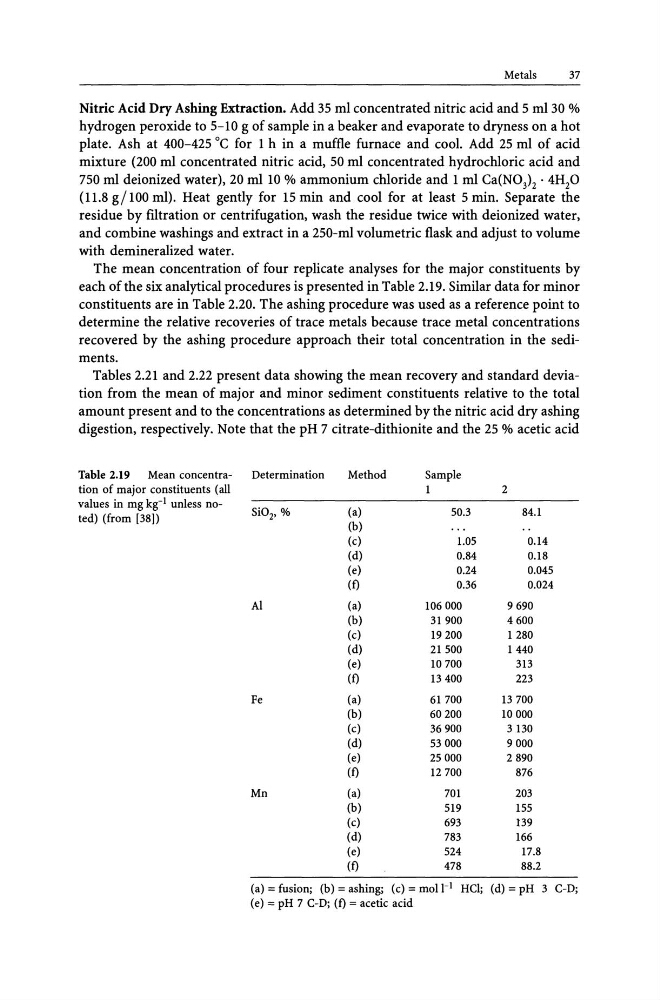
each of the six analytical procedures is presented in Table 2.19. Similar data for minor
constituents are in Table 2.20. The ashing procedure was used as a reference point to
determine the relative recoveries of trace metals because trace metal concentrations
recovered by the ashing procedure approach their total concentration in the sediments.
Tables 2.21 and 2.22 present data showing the mean recovery and standard deviation from the mean of major and minor sediment constituents relative to the total
amount present and to the concentrations as determined by the nitric acid dry ashing
digestion, respectively. Note that the pH 7 citrate-dithionite and the 25 % acetic acid
Table 2.19 Mean concentraDetermination
Method
Sample
tion of major constituents (all
1
2
values in mg kg- 1 unless noSi0 2 , %
(a)
50.3
84.1
ted) (from [38])
(b)
(c)
1.05
0.14
(d)
0.84
0.18
(e)
0.24
0.045
(f)
0.36
0.024
Al
(a)
106000
9690
(b)
31900
4600
(c)
19200
1280
(d)
21500
1440
(e)
10700
313
(f)
13 400
223
Fe
(a)
61700
13700
(b)
60200
10000
(c)
36900
3130
(d)
53000
9000
(e)
25000
2890
(f)
12700
876
Mn
(a)
701
203
(b)
519
155
(c)
693
139
(d)
783
166
(e)
524
17.8
(f)
478
88.2
(a) = fusion; (b) = ashing; (c) = mol 1-1 HC!; (d) = pH 3 C-D;
(e) = pH 7 C-D; (f) = acetic acid
37
Nitric Acid Dry Ashing Extraction. Add 35 ml concentrated nitric acid and 5 ml 30 %
hydrogen peroxide to 5-10 g of sample in a beaker and evaporate to dryness on a hot
plate. Ash at 400-425 °c for 1 h in a muffle furnace and cool. Add 25 ml of acid
mixture (200 ml concentrated nitric acid, 50 ml concentrated hydrochloric acid and
750 ml deionized water), 20 mIlO % ammonium chloride and 1 ml Ca(N0 3 )2 • 4Hp
(11.8 gf 100 ml). Heat gently for 15 min and cool for at least 5 min. Separate the
residue by filtration or centrifugation, wash the residue twice with deionized water,
and combine washings and extract in a 250-ml volumetric flask and adjust to volume
with demineralized water.
The mean concentration of four replicate analyses for the major constituents by
each of the six analytical procedures is presented in Table 2.19. Similar data for minor
constituents are in Table 2.20. The ashing procedure was used as a reference point to
determine the relative recoveries of trace metals because trace metal concentrations
recovered by the ashing procedure approach their total concentration in the sediments.
Tables 2.21 and 2.22 present data showing the mean recovery and standard deviation from the mean of major and minor sediment constituents relative to the total
amount present and to the concentrations as determined by the nitric acid dry ashing
digestion, respectively. Note that the pH 7 citrate-dithionite and the 25 % acetic acid
Table 2.19 Mean concentraDetermination
Method
Sample
tion of major constituents (all
1
2
values in mg kg- 1 unless noSi0 2 , %
(a)
50.3
84.1
ted) (from [38])
(b)
(c)
1.05
0.14
(d)
0.84
0.18
(e)
0.24
0.045
(f)
0.36
0.024
Al
(a)
106000
9690
(b)
31900
4600
(c)
19200
1280
(d)
21500
1440
(e)
10700
313
(f)
13 400
223
Fe
(a)
61700
13700
(b)
60200
10000
(c)
36900
3130
(d)
53000
9000
(e)
25000
2890
(f)
12700
876
Mn
(a)
701
203
(b)
519
155
(c)
693
139
(d)
783
166
(e)
524
17.8
(f)
478
88.2
(a) = fusion; (b) = ashing; (c) = mol 1-1 HC!; (d) = pH 3 C-D;
(e) = pH 7 C-D; (f) = acetic acid