

70.1.6
Multielements
Metals
233
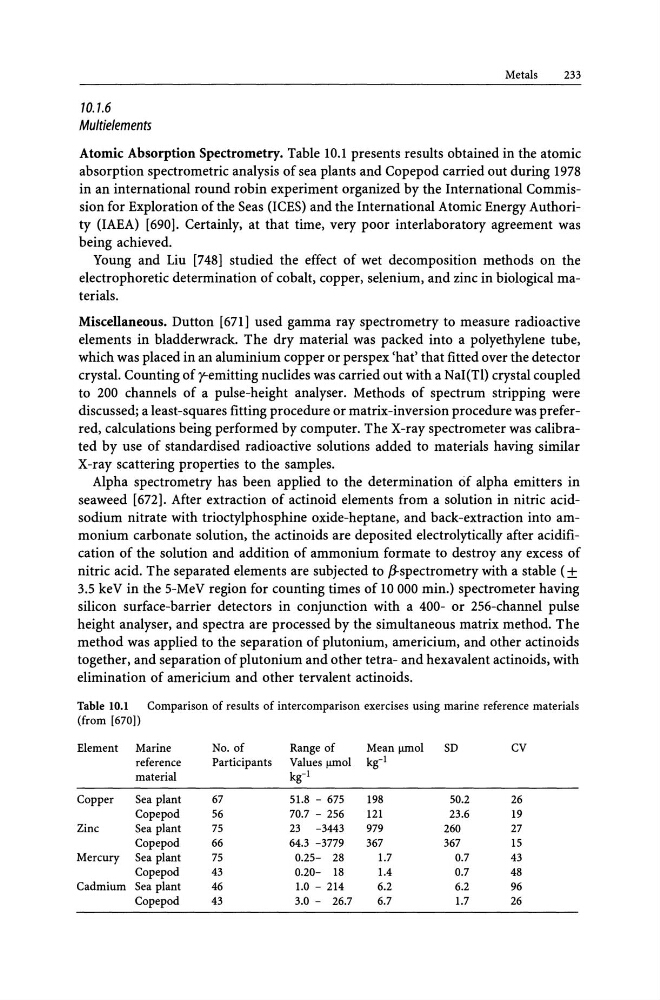
Atomic Absorption Spectrometry. Table 10.1 presents results obtained in the atomic
absorption spectrometric analysis of sea plants and Copepod carried out during 1978
in an international round robin experiment organized by the International Commission for Exploration of the Seas (ICES) and the International Atomic Energy Authority (IAEA) [690]. Certainly, at that time, very poor interlaboratory agreement was
being achieved.
Young and Liu [748] studied the effect of wet decomposition methods on the
electrophoretic determination of cobalt, copper, selenium, and zinc in biological materials.
Miscellaneous. Dutton [671] used gamma ray spectrometry to measure radioactive
elements in bladderwrack. The dry material was packed into a polyethylene tube,
which was placed in an aluminium copper or perspex 'hat' that fitted over the detector
crystal. Counting of r-emitting nuclides was carried out with a NaI(Tl) crystal coupled
to 200 channels of a pulse-height analyser. Methods of spectrum stripping were
discussed; a least-squares fitting procedure or matrix-inversion procedure was preferred, calculations being performed by computer. The X-ray spectrometer was calibrated by use of standardised radioactive solutions added to materials having similar
X-ray scattering properties to the samples.
Alpha spectrometry has been applied to the determination cif alpha emitters in
seaweed [672]. After extraction of actinoid elements from a solution in nitric acidsodium nitrate with trioctylphosphine oxide-heptane, and back-extraction into ammonium carbonate solution, the actinoids are deposited electrolytically after acidification of the solution and addition of ammonium formate to destroy any excess of
nitric acid. The separated elements are subjected to ,B-spectrometry with a stable (±
3.5 keY in the 5-MeV region for counting times of 10 000 min.) spectrometer having
silicon surface-barrier detectors in conjunction with a 400- or 256-channel pulse
height analyser, and spectra are processed by the simultaneous matrix method. The
method was applied to the separation of plutonium, americium, and other actinoids
together, and separation of plutonium and other tetra- and hexavalent actinoids, with
elimination of americium and other tervalent actinoids.
Table 10.1
Comparison of results of intercomparison exercises using marine reference materials
(from [670])
Element Marine
No. of
Range of
Mean l1lllol
SD
CV
reference
Participants Values l1lllol kg-1
material
kg-1
Copper
Sea plant
67
51.8 - 675
198
50.2
26
Copepod
56
70.7 - 256
121
23.6
19
linc
Sea plant
75
23 -3443
979
260
27
Copepod
66
64.3 -3779
367
367
15
Mercury Sea plant
75
0.25- 28
1.7
0.7
43
Copepod
43
0.20- 18
1.4
0.7
48
Cadmium Sea plant
46
1.0 - 214
6.2
6.2
96
Copepod
43
3.0 - 26.7
6.7
1.7
26
Multielements
Metals
233
Atomic Absorption Spectrometry. Table 10.1 presents results obtained in the atomic
absorption spectrometric analysis of sea plants and Copepod carried out during 1978
in an international round robin experiment organized by the International Commission for Exploration of the Seas (ICES) and the International Atomic Energy Authority (IAEA) [690]. Certainly, at that time, very poor interlaboratory agreement was
being achieved.
Young and Liu [748] studied the effect of wet decomposition methods on the
electrophoretic determination of cobalt, copper, selenium, and zinc in biological materials.
Miscellaneous. Dutton [671] used gamma ray spectrometry to measure radioactive
elements in bladderwrack. The dry material was packed into a polyethylene tube,
which was placed in an aluminium copper or perspex 'hat' that fitted over the detector
crystal. Counting of r-emitting nuclides was carried out with a NaI(Tl) crystal coupled
to 200 channels of a pulse-height analyser. Methods of spectrum stripping were
discussed; a least-squares fitting procedure or matrix-inversion procedure was preferred, calculations being performed by computer. The X-ray spectrometer was calibrated by use of standardised radioactive solutions added to materials having similar
X-ray scattering properties to the samples.
Alpha spectrometry has been applied to the determination cif alpha emitters in
seaweed [672]. After extraction of actinoid elements from a solution in nitric acidsodium nitrate with trioctylphosphine oxide-heptane, and back-extraction into ammonium carbonate solution, the actinoids are deposited electrolytically after acidification of the solution and addition of ammonium formate to destroy any excess of
nitric acid. The separated elements are subjected to ,B-spectrometry with a stable (±
3.5 keY in the 5-MeV region for counting times of 10 000 min.) spectrometer having
silicon surface-barrier detectors in conjunction with a 400- or 256-channel pulse
height analyser, and spectra are processed by the simultaneous matrix method. The
method was applied to the separation of plutonium, americium, and other actinoids
together, and separation of plutonium and other tetra- and hexavalent actinoids, with
elimination of americium and other tervalent actinoids.
Table 10.1
Comparison of results of intercomparison exercises using marine reference materials
(from [670])
Element Marine
No. of
Range of
Mean l1lllol
SD
CV
reference
Participants Values l1lllol kg-1
material
kg-1
Copper
Sea plant
67
51.8 - 675
198
50.2
26
Copepod
56
70.7 - 256
121
23.6
19
linc
Sea plant
75
23 -3443
979
260
27
Copepod
66
64.3 -3779
367
367
15
Mercury Sea plant
75
0.25- 28
1.7
0.7
43
Copepod
43
0.20- 18
1.4
0.7
48
Cadmium Sea plant
46
1.0 - 214
6.2
6.2
96
Copepod
43
3.0 - 26.7
6.7
1.7
26