

Metals
219
sampling Zeeman atomic absorption spectrometry. The results confirmed the accuracy of this method and its usefulness for studies of heavy-metal contamination in the
environment.
X-ray Fluorescence Spectroscopy. Pietilainen et al. [6271 used tube excited energy
dispersive X-ray fluorescence to carry out multielement analysis for 20 elements in
plankton algae. The samples were taken from an estuary in the Gulf of Finland and an
archipelago outside the estuary. Both molybdenum and titanium-potassium secondary target radiation were used. Detection limits ranged from 0.3 /lg I-I for bromine to
12 ~g I-I for aluminium. Most of the environmentally important heavy metals were
determined in all samples, and a considerable degree of interrelation was found
between several of them.
Bistricki and Munawar [6281 found that a combination of scanning electron microscopy and energy dispersive X-ray spectroscopy was an effective tool for characterizing heavy metals in green algae, phytoflagellates and diatoms.
Aliquots of the samples were fIltered through Nuclepore membranes of 0.45 ~
porosity, washed with purified 0.05 mol I-I S-collidine buffer which contained no
traces of heavy metals (Polysciences, Warrington, P A), and fixed with a solution of
osmium tetroxide prepared in the above buffer. After being washed and dehydrated in
alcohol, the filtered specimens were dried by the critical point drying technique.
The membrane fIlters were mounted on a specimen support stub and transferred
into a vacuum evaporator. A 20- nm layer of carbon was evaporated on the surface of
the specimens to facilitate thermal and electrical conductivity.
!!! c:
:::I
0
u
10 3
10 2
Si
AI ::
~ ...
. .
..
. ~
K
;' :
Fe
Mg
A:
: ~
:
i
t
:p S :: cal
"A..; CI :., f..
;'~/: v·. Ti
;:
"I'C"
'~",.I
Mn.~
l
1
I
.,
• ;1
Ji
,.
. '1-..::' ~...:
l
,'.
I
"0.
-:-.~ •• ~ •• , : " I".
II,.
. ~~ '.../ :. ) \
cu,
-: *:1. ............ \ I
.. ·r .or;,~, 1 ~~ .. i-•.
.0°
'":""~~-f!." .... ,: .... ,,.c.
•. ~ :?:::'VY."!'i.. . .. ::. 1
. - .
10~----'-----~----~----r---~~--~----~-----r----'-----'
o
2
3
4
5
Energy (keV)
6
7
8
9
10
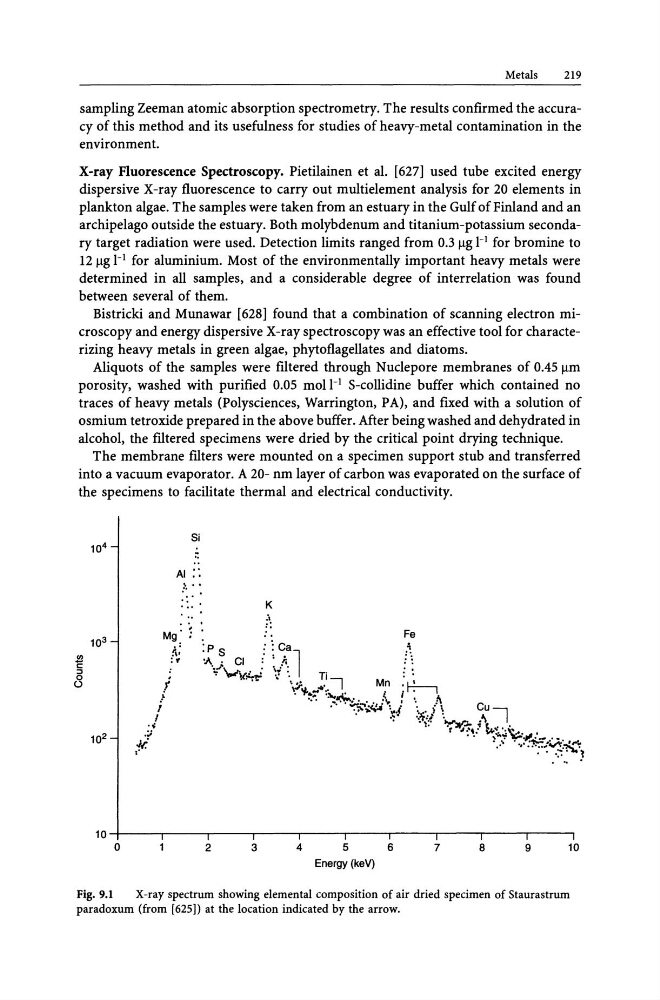
Fig. 9.1
X-ray spectrum showing elemental composition of air dried specimen of Staurastrum
paradoxum (from [625]) at the location indicated by the arrow.
219
sampling Zeeman atomic absorption spectrometry. The results confirmed the accuracy of this method and its usefulness for studies of heavy-metal contamination in the
environment.
X-ray Fluorescence Spectroscopy. Pietilainen et al. [6271 used tube excited energy
dispersive X-ray fluorescence to carry out multielement analysis for 20 elements in
plankton algae. The samples were taken from an estuary in the Gulf of Finland and an
archipelago outside the estuary. Both molybdenum and titanium-potassium secondary target radiation were used. Detection limits ranged from 0.3 /lg I-I for bromine to
12 ~g I-I for aluminium. Most of the environmentally important heavy metals were
determined in all samples, and a considerable degree of interrelation was found
between several of them.
Bistricki and Munawar [6281 found that a combination of scanning electron microscopy and energy dispersive X-ray spectroscopy was an effective tool for characterizing heavy metals in green algae, phytoflagellates and diatoms.
Aliquots of the samples were fIltered through Nuclepore membranes of 0.45 ~
porosity, washed with purified 0.05 mol I-I S-collidine buffer which contained no
traces of heavy metals (Polysciences, Warrington, P A), and fixed with a solution of
osmium tetroxide prepared in the above buffer. After being washed and dehydrated in
alcohol, the filtered specimens were dried by the critical point drying technique.
The membrane fIlters were mounted on a specimen support stub and transferred
into a vacuum evaporator. A 20- nm layer of carbon was evaporated on the surface of
the specimens to facilitate thermal and electrical conductivity.
!!! c:
:::I
0
u
10 3
10 2
Si
AI ::
~ ...
. .
..
. ~
K
;' :
Fe
Mg
A:
: ~
:
i
t
:p S :: cal
"A..; CI :., f..
;'~/: v·. Ti
;:
"I'C"
'~",.I
Mn.~
l
1
I
.,
• ;1
Ji
,.
. '1-..::' ~...:
l
,'.
I
"0.
-:-.~ •• ~ •• , : " I".
II,.
. ~~ '.../ :. ) \
cu,
-: *:1. ............ \ I
.. ·r .or;,~, 1 ~~ .. i-•.
.0°
'":""~~-f!." .... ,: .... ,,.c.
•. ~ :?:::'VY."!'i.. . .. ::. 1
. - .
10~----'-----~----~----r---~~--~----~-----r----'-----'
o
2
3
4
5
Energy (keV)
6
7
8
9
10
Fig. 9.1
X-ray spectrum showing elemental composition of air dried specimen of Staurastrum
paradoxum (from [625]) at the location indicated by the arrow.