

Organics
207
8.2.9
Organophosphorus Insecticides
Deutsch et al. [601] determined dursban in crustacea. After a preliminary cleanup, the
extract is chromatographed on a column packed with 3 % Carbowax 20 m on GasChrom (60 to 80-mesh), which gives excellent separation of dursban from other
organophosphorus insecticides. Both thermionic and flame photometric detectors are
satisfactory. Recoveries range from 75 to 105 % depending on the nature of the
sample. This procedure will detect as little as 0.5 ng of dursban, corresponding to a
level of 0.01 mg kg- 1 in a 10 g sample.
8.2.10
Organosulphur Compounds
Organosulphur compounds are minor components of crude oil and of some fuel oils.
Although the quantity of these compounds depends on the source of production,
generally it ranges from 0.002 to nearly 30 % in crude oil, found as sulphur-containing
hydrocarbons (Nakamura and Kashimoto [602]), and 1600 ppm in # 2 fuel oil (Dillon
et al. [603]). In a field study, these compounds were found in benthic organisms after
an oil spill (Grahl-Nielsen et al. [604]). Researchers have presented several papers on
the accumulation of these compounds in eels and short-necked clams (Ogata et al.
[605]) and have also identified dibenzothiophene through gas chromatography-mass
IS=BT
DBT
100
175
260
Temperature re)
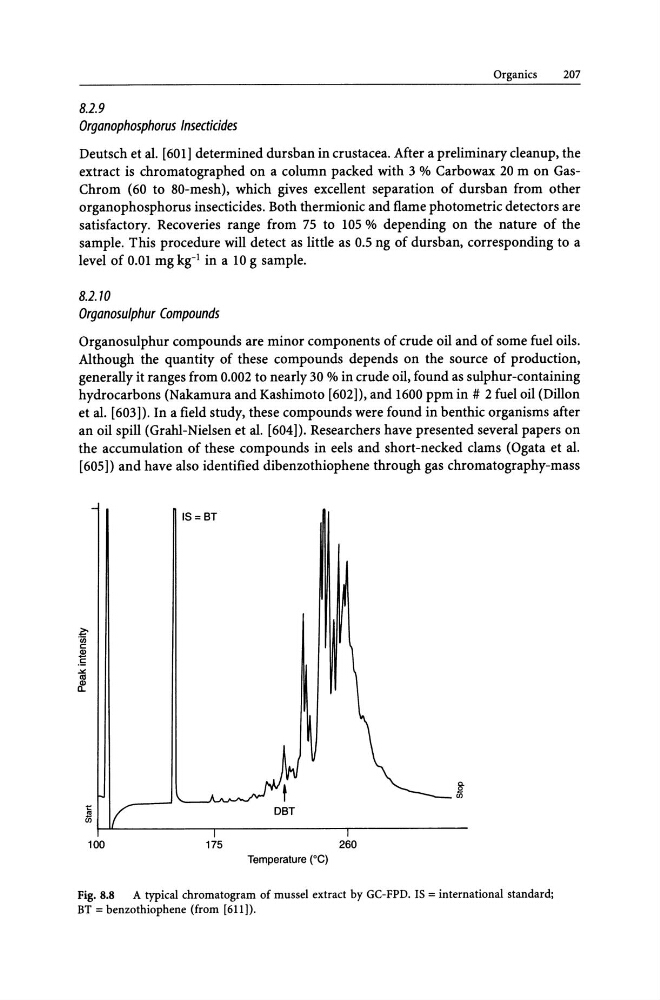
Fig. 8.8
A typical chromatogram of mussel extract by GC-FPD. IS = international standard;
BT = benzothiophene (from [611]).
207
8.2.9
Organophosphorus Insecticides
Deutsch et al. [601] determined dursban in crustacea. After a preliminary cleanup, the
extract is chromatographed on a column packed with 3 % Carbowax 20 m on GasChrom (60 to 80-mesh), which gives excellent separation of dursban from other
organophosphorus insecticides. Both thermionic and flame photometric detectors are
satisfactory. Recoveries range from 75 to 105 % depending on the nature of the
sample. This procedure will detect as little as 0.5 ng of dursban, corresponding to a
level of 0.01 mg kg- 1 in a 10 g sample.
8.2.10
Organosulphur Compounds
Organosulphur compounds are minor components of crude oil and of some fuel oils.
Although the quantity of these compounds depends on the source of production,
generally it ranges from 0.002 to nearly 30 % in crude oil, found as sulphur-containing
hydrocarbons (Nakamura and Kashimoto [602]), and 1600 ppm in # 2 fuel oil (Dillon
et al. [603]). In a field study, these compounds were found in benthic organisms after
an oil spill (Grahl-Nielsen et al. [604]). Researchers have presented several papers on
the accumulation of these compounds in eels and short-necked clams (Ogata et al.
[605]) and have also identified dibenzothiophene through gas chromatography-mass
IS=BT
DBT
100
175
260
Temperature re)
Fig. 8.8
A typical chromatogram of mussel extract by GC-FPD. IS = international standard;
BT = benzothiophene (from [611]).