

Metals
195
bio-accumulating abilities of the mussels of different species, or to the differences in
the silver contents of the food consumed by the mussels. It is suspected the primary
reason is the species difference between the east coast M. edulis and the west coast M.
californian us, since, in the San Francisco Bay, where both species are taken from the
same environment, there is a lower silver concentration in M. edulis.
Cadmium and Plutonium. In addition to lead, plutonium serves as an example of
usefulness of isotopic composition for the identification of sources. The Pu-238/Pu-239
+ 240 ratio resulting from the entry of nuclear weapons debris ranges between 0.03 and
0.08 in the byssal threads of mussels taken from waters where there are no localized
nuclear point sources. On the other hand, the Pu-238/Pu-239 ;:;; 240 ratio in the byssal
thread of mussels taken near the site of nuclear reactors in San Onofre, California, had
values of 0.21 and 0.16. The Pu-238 is used as a fuel and probably leaked into the marine
environment in the cooling water discharges. Thus, the plutonium burden of these coastal
waters has been increased by a factor of three or four over that of the background fallout
of plutonium on this basis. Monitoring of byssal threads, in which the plutonium is
enriched, is a far simpler task than the monitoring of the waters themselves.
Metal concentrations in mussels can achieve unusual values from natural processes.
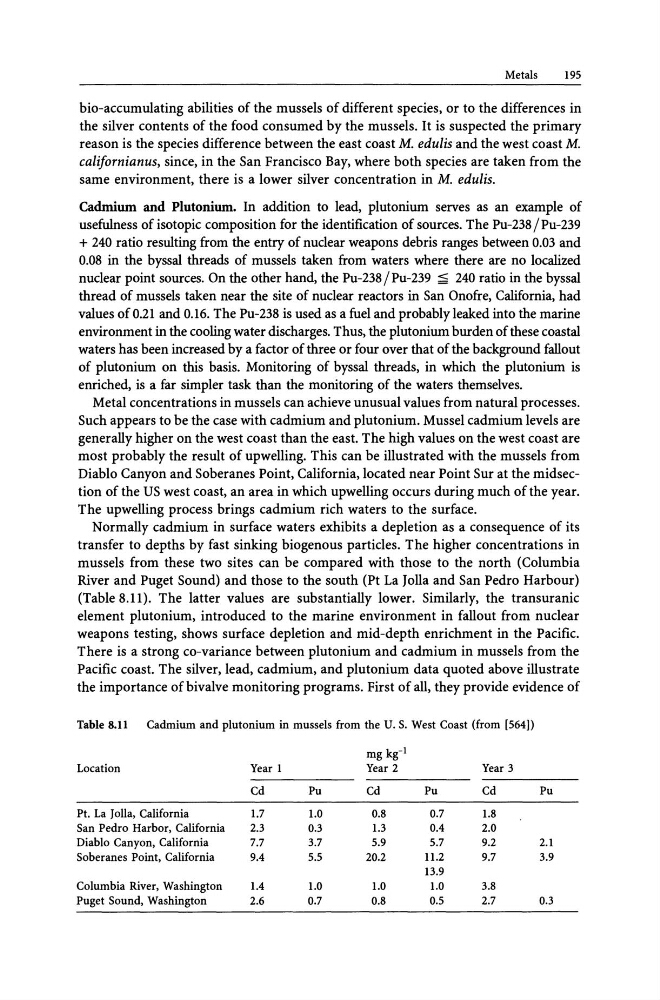
Such appears to be the case with cadmium and plutonium. Mussel cadmium levels are
generally higher on the west coast than the east. The high values on the west coast are
most probably the result of upwelling. This can be illustrated with the mussels from
Diablo Canyon and Soberanes Point, California, located near Point Sur at the midsection of the US west coast, an area in which upwelling occurs during much of the year.
The upwelling process brings cadmium rich waters to the surface.
Normally cadmium in surface waters exhibits a depletion as a consequence of its
transfer to depths by fast sinking biogenous particles. The higher concentrations in
mussels from these two sites can be compared with those to the north (Columbia
River and Puget Sound) and those to the south (Pt La Jolla and San Pedro Harbour)
(Table 8.11). The latter values are substantially lower. Similarly, the transuranic
element plutonium, introduced to the marine environment in fallout from nuclear
weapons testing, shows surface depletion and mid-depth enrichment in the Pacific.
There is a strong co-variance between plutonium and cadmium in mussels from the
Pacific coast. The silver, lead, cadmium, and plutonium data quoted above illustrate
the importance of bivalve monitoring programs. First of all, they provide evidence of
Table 8.11
Cadmium and plutonium in mussels from the U. s. West Coast (from [564])
mgkg- 1
Location
Year 1
Year 2
Year 3
Cd
Pu
Cd
Pu
Cd
Pu
Pt. La Jolla, California
1.7
1.0
0.8
0.7
1.8
San Pedro Harbor, California
2.3
0.3
1.3
0.4
2.0
Diablo Canyon, California
7.7
3.7
5.9
5.7
9.2
2.1
Soberanes Point, California
9.4
5.5
20.2
11.2
9.7
3.9
13.9
Columbia River, Washington
1.4
1.0
1.0
1.0
3.8
Puget Sound, Washington
2.6
0.7
0.8
0.5
2.7
0.3
195
bio-accumulating abilities of the mussels of different species, or to the differences in
the silver contents of the food consumed by the mussels. It is suspected the primary
reason is the species difference between the east coast M. edulis and the west coast M.
californian us, since, in the San Francisco Bay, where both species are taken from the
same environment, there is a lower silver concentration in M. edulis.
Cadmium and Plutonium. In addition to lead, plutonium serves as an example of
usefulness of isotopic composition for the identification of sources. The Pu-238/Pu-239
+ 240 ratio resulting from the entry of nuclear weapons debris ranges between 0.03 and
0.08 in the byssal threads of mussels taken from waters where there are no localized
nuclear point sources. On the other hand, the Pu-238/Pu-239 ;:;; 240 ratio in the byssal
thread of mussels taken near the site of nuclear reactors in San Onofre, California, had
values of 0.21 and 0.16. The Pu-238 is used as a fuel and probably leaked into the marine
environment in the cooling water discharges. Thus, the plutonium burden of these coastal
waters has been increased by a factor of three or four over that of the background fallout
of plutonium on this basis. Monitoring of byssal threads, in which the plutonium is
enriched, is a far simpler task than the monitoring of the waters themselves.
Metal concentrations in mussels can achieve unusual values from natural processes.
Such appears to be the case with cadmium and plutonium. Mussel cadmium levels are
generally higher on the west coast than the east. The high values on the west coast are
most probably the result of upwelling. This can be illustrated with the mussels from
Diablo Canyon and Soberanes Point, California, located near Point Sur at the midsection of the US west coast, an area in which upwelling occurs during much of the year.
The upwelling process brings cadmium rich waters to the surface.
Normally cadmium in surface waters exhibits a depletion as a consequence of its
transfer to depths by fast sinking biogenous particles. The higher concentrations in
mussels from these two sites can be compared with those to the north (Columbia
River and Puget Sound) and those to the south (Pt La Jolla and San Pedro Harbour)
(Table 8.11). The latter values are substantially lower. Similarly, the transuranic
element plutonium, introduced to the marine environment in fallout from nuclear
weapons testing, shows surface depletion and mid-depth enrichment in the Pacific.
There is a strong co-variance between plutonium and cadmium in mussels from the
Pacific coast. The silver, lead, cadmium, and plutonium data quoted above illustrate
the importance of bivalve monitoring programs. First of all, they provide evidence of
Table 8.11
Cadmium and plutonium in mussels from the U. s. West Coast (from [564])
mgkg- 1
Location
Year 1
Year 2
Year 3
Cd
Pu
Cd
Pu
Cd
Pu
Pt. La Jolla, California
1.7
1.0
0.8
0.7
1.8
San Pedro Harbor, California
2.3
0.3
1.3
0.4
2.0
Diablo Canyon, California
7.7
3.7
5.9
5.7
9.2
2.1
Soberanes Point, California
9.4
5.5
20.2
11.2
9.7
3.9
13.9
Columbia River, Washington
1.4
1.0
1.0
1.0
3.8
Puget Sound, Washington
2.6
0.7
0.8
0.5
2.7
0.3