

CHAPTER 8
Crustacea and Molluscs
8.1
Metals
8.7.7
Arsenic
Spectrophotometric Method. The spectrophotometric method [247], described in
Sects. 4.2.1 and 7.1.1 for the determination of arsenic in sediments and in fish, is also
applicable to the determination of arsenic in crustacea. Recoveries of 5-10 IlS arsenic
added to a crayfish with a basal arsenic content of 16.8 ;:;;; 0.5 IlS arsenic were between
98 and 100 %.
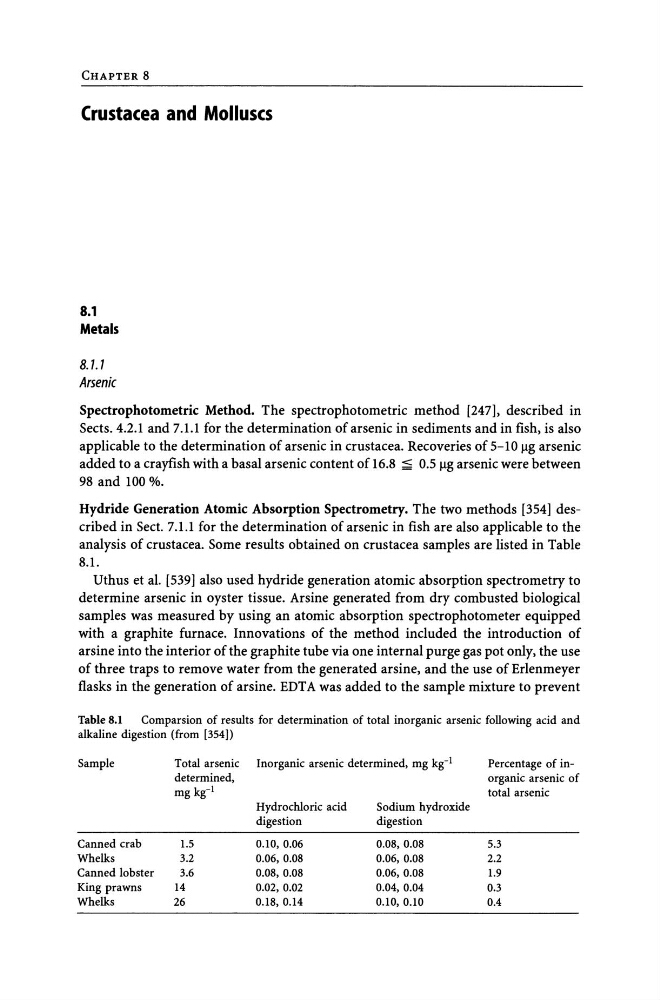
Hydride Generation Atomic Absorption Spectrometry. The two methods [354] described in Sect. 7.1.1 for the determination of arsenic in fish are also applicable to the
analysis of crustacea. Some results obtained on crustacea samples are listed in Table
8.1.
Uthus et al. [539] also used hydride generation atomic absorption spectrometry to
determine arsenic in oyster tissue. Arsine generated from dry combusted biological
samples was measured by using an atomic absorption spectrophotometer equipped
with a graphite furnace. Innovations of the method included the introduction of
arsine into the interior of the graphite tube via one internal purge gas pot only, the use
of three traps to remove water from the generated arsine, and the use of Erlenmeyer
flasks in the generation of arsine. EDTA was added to the sample mixture to prevent
Table 8.1
Comparsion of results for determination of total inorganic arsenic following acid and
alkaline digestion (from [354»
Sample
Total arsenic Inorganic arsenic determined, mg kg- 1
Percentage of indetermined,
organic arsenic of
mgkg-l
total arsenic
Hydrochloric acid
Sodium hydroxide
digestion
digestion
Canned crab
1.5
0.10,0.06
0.08,0.08
5.3
Whelks
3.2
0.06,0.08
0.06,0.08
2.2
Canned lobster
3.6
0.08,0.08
0.06,0.08
1.9
King prawns
14
0.02,0.02
0.04,0.04
0.3
Whelks
26
0.18,0.14
0.10,0.10
0.4
Crustacea and Molluscs
8.1
Metals
8.7.7
Arsenic
Spectrophotometric Method. The spectrophotometric method [247], described in
Sects. 4.2.1 and 7.1.1 for the determination of arsenic in sediments and in fish, is also
applicable to the determination of arsenic in crustacea. Recoveries of 5-10 IlS arsenic
added to a crayfish with a basal arsenic content of 16.8 ;:;;; 0.5 IlS arsenic were between
98 and 100 %.
Hydride Generation Atomic Absorption Spectrometry. The two methods [354] described in Sect. 7.1.1 for the determination of arsenic in fish are also applicable to the
analysis of crustacea. Some results obtained on crustacea samples are listed in Table
8.1.
Uthus et al. [539] also used hydride generation atomic absorption spectrometry to
determine arsenic in oyster tissue. Arsine generated from dry combusted biological
samples was measured by using an atomic absorption spectrophotometer equipped
with a graphite furnace. Innovations of the method included the introduction of
arsine into the interior of the graphite tube via one internal purge gas pot only, the use
of three traps to remove water from the generated arsine, and the use of Erlenmeyer
flasks in the generation of arsine. EDTA was added to the sample mixture to prevent
Table 8.1
Comparsion of results for determination of total inorganic arsenic following acid and
alkaline digestion (from [354»
Sample
Total arsenic Inorganic arsenic determined, mg kg- 1
Percentage of indetermined,
organic arsenic of
mgkg-l
total arsenic
Hydrochloric acid
Sodium hydroxide
digestion
digestion
Canned crab
1.5
0.10,0.06
0.08,0.08
5.3
Whelks
3.2
0.06,0.08
0.06,0.08
2.2
Canned lobster
3.6
0.08,0.08
0.06,0.08
1.9
King prawns
14
0.02,0.02
0.04,0.04
0.3
Whelks
26
0.18,0.14
0.10,0.10
0.4