

Metals
129
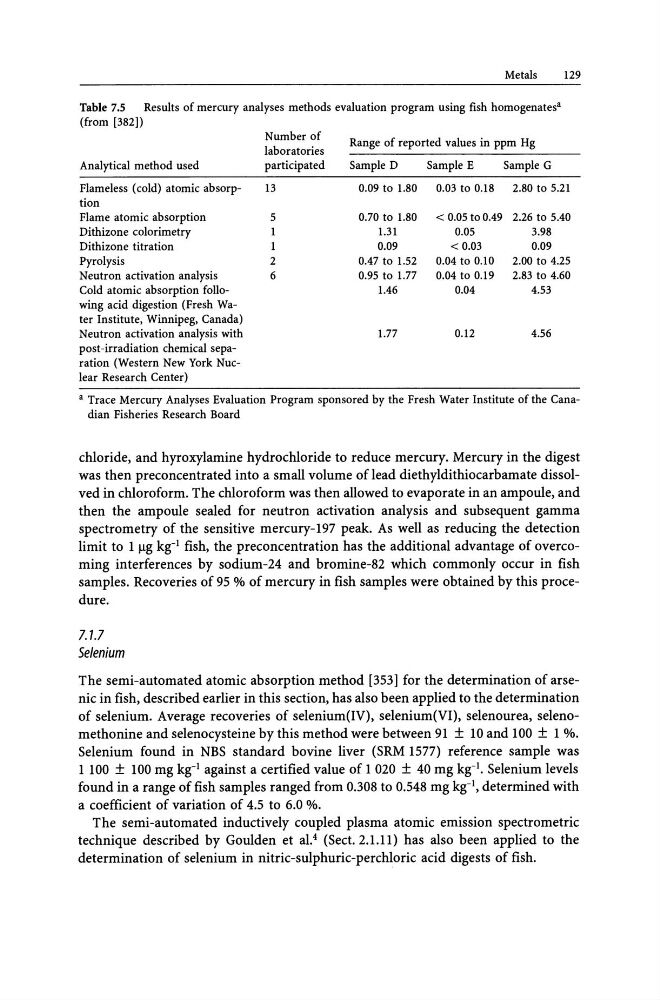
Table 7.5
Results of mercury analyses methods evaluation program using fish homogenates'
(from [382])
Number of
laboratories
Analytical method used
participated
Flameless (cold) atomic absorp13
tion
Flame atomic absorption
5
Dithizone colorimetry
1
Dithizone titration
1
Pyrolysis
2
Neutron activation analysis
6
Cold atomic absorption following acid digestion (Fresh Water Institute, Winnipeg, Canada)
Neutron activation analysis with
post-irradiation chemical separation (Western New York Nuclear Research Center)
Range of reported values in ppm Hg
Sample D
Sample E
Sample G
0.09 to 1.80
0.03 to 0.18
2.80 to 5.21
0.70 to 1.80
< 0.05 to 0.49 2.26 to 5.40
1.31
0.05
3.98
0.09
< 0.03
0.09
0.47 to 1.52
0.04 to 0.10
2.00 to 4.25
0.95 to 1.77
0.04 to 0.19
2.83 to 4.60
1.46
0.04
4.53
1.77
0.12
4.56
• Trace Mercury Analyses Evaluation Program sponsored by the Fresh Water Institute of the Canadian Fisheries Research Board
chloride, and hyroxylamine hydrochloride to reduce mercury. Mercury in the digest
was then preconcentrated into a small volume of lead diethyldithiocarbamate dissolved in chloroform. The chloroform was then allowed to evaporate in an ampoule, and
then the ampoule sealed for neutron activation analysis and subsequent gamma
spectrometry of the sensitive mercury-197 peak. As well as reducing the detection
limit to 1 J.Lg kg-I fish, the preconcentration has the additional advantage of overcoming interferences by sodium-24 and bromine-82 which commonly occur in fish
samples. Recoveries of 95 % of mercury in fish samples were obtained by this procedure.
7.1.1
Selenium
The semi-automated atomic absorption method [353] for the determination of arsenic in fish, described earlier in this section, has also been applied to the determination
of selenium. Average recoveries of selenium(IV), selenium(VI), selenourea, selenomethonine and selenocysteine by this method were between 91 ± 10 and 100 ± 1 %.
Selenium found in NBS standard bovine liver (SRM 1577) reference sample was
1 100 ± 100 mg kg-I against a certified value of 1020 ± 40 mg kg-I. Selenium levels
found in a range of fish samples ranged from 0.308 to 0.548 mg kg-I, determined with
a coefficient of variation of 4.5 to 6.0 %.
The semi-automated inductively coupled plasma atomic emission spectrometric
technique described by Goulden et al. 4 (Sect. 2.1.11) has also been applied to the
determination of selenium in nitric-sulphuric-perchloric acid digests of fish.
129
Table 7.5
Results of mercury analyses methods evaluation program using fish homogenates'
(from [382])
Number of
laboratories
Analytical method used
participated
Flameless (cold) atomic absorp13
tion
Flame atomic absorption
5
Dithizone colorimetry
1
Dithizone titration
1
Pyrolysis
2
Neutron activation analysis
6
Cold atomic absorption following acid digestion (Fresh Water Institute, Winnipeg, Canada)
Neutron activation analysis with
post-irradiation chemical separation (Western New York Nuclear Research Center)
Range of reported values in ppm Hg
Sample D
Sample E
Sample G
0.09 to 1.80
0.03 to 0.18
2.80 to 5.21
0.70 to 1.80
< 0.05 to 0.49 2.26 to 5.40
1.31
0.05
3.98
0.09
< 0.03
0.09
0.47 to 1.52
0.04 to 0.10
2.00 to 4.25
0.95 to 1.77
0.04 to 0.19
2.83 to 4.60
1.46
0.04
4.53
1.77
0.12
4.56
• Trace Mercury Analyses Evaluation Program sponsored by the Fresh Water Institute of the Canadian Fisheries Research Board
chloride, and hyroxylamine hydrochloride to reduce mercury. Mercury in the digest
was then preconcentrated into a small volume of lead diethyldithiocarbamate dissolved in chloroform. The chloroform was then allowed to evaporate in an ampoule, and
then the ampoule sealed for neutron activation analysis and subsequent gamma
spectrometry of the sensitive mercury-197 peak. As well as reducing the detection
limit to 1 J.Lg kg-I fish, the preconcentration has the additional advantage of overcoming interferences by sodium-24 and bromine-82 which commonly occur in fish
samples. Recoveries of 95 % of mercury in fish samples were obtained by this procedure.
7.1.1
Selenium
The semi-automated atomic absorption method [353] for the determination of arsenic in fish, described earlier in this section, has also been applied to the determination
of selenium. Average recoveries of selenium(IV), selenium(VI), selenourea, selenomethonine and selenocysteine by this method were between 91 ± 10 and 100 ± 1 %.
Selenium found in NBS standard bovine liver (SRM 1577) reference sample was
1 100 ± 100 mg kg-I against a certified value of 1020 ± 40 mg kg-I. Selenium levels
found in a range of fish samples ranged from 0.308 to 0.548 mg kg-I, determined with
a coefficient of variation of 4.5 to 6.0 %.
The semi-automated inductively coupled plasma atomic emission spectrometric
technique described by Goulden et al. 4 (Sect. 2.1.11) has also been applied to the
determination of selenium in nitric-sulphuric-perchloric acid digests of fish.