

Metals
127
Table 7.3
Comparison of
Combustion
Digestion
Mercury as
mercury analysis in various
method
method
methyl
fish specimens (from [380])
total Hg
total Hg
Hg
Fish
mgkg- I
mgkg- I
mgkg-I
Carp
2.7
1.5
2.4
1.6
2.3
Shiner
0.39
0.33
0.33
0.28
0.35
Chub
0.19
0.10
0.16
0.09
0.10
Buffalo
0.33
0.14
0.41
0.53
0.12
0.44
Carp
0.54
0.28
0.47
0.64
0.29
0.52
Blue Cat
0.25
0.21
0.21
0.26
0.27
Channel Cat
0.52
0.37
0.42
0.47
0.55
Carp
0.25
0.31
0.26
0.34
0.22
Crappie
0.14
0.12
0.09
0.12
0.11
Crappie
0.20
0.19
0.13
0.14
0.11
expelled into the carrier stream and, after passing through silver oxide absorbent
traps to remove possible interfering gases, is detected and measured in an ultraviolet
photometer at 253.5 nm. Relative error is approximately ± 10 % for inorganic and
organic mercury over a linear response range of 0.05 to 3.0 mg kg-I.
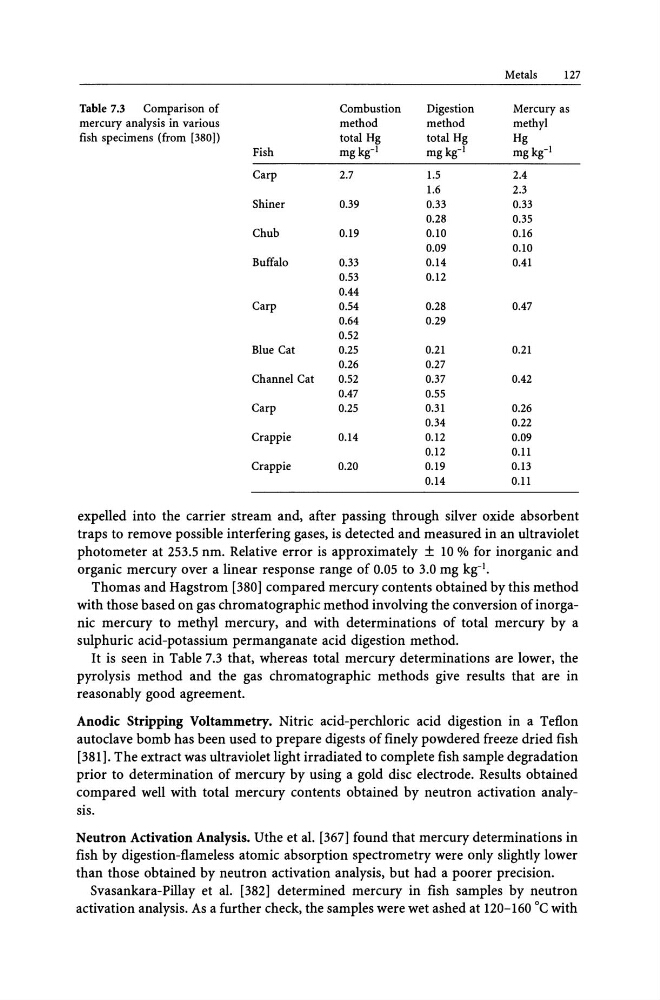
Thomas and Hagstrom [380] compared mercury contents obtained by this method
with those based on gas chromatographic method involving the conversion of inorganic mercury to methyl mercury, and with determinations of total mercury by a
sulphuric acid-potassium permanganate acid digestion method.
It is seen in Table 7.3 that, whereas total mercury determinations are lower, the
pyrolysis method and the gas chromatographic methods give results that are in
reasonably good agreement.
Anodic Stripping VoItammetry. Nitric acid-perchloric acid digestion in a Teflon
autoclave bomb has been used to prepare digests of finely powdered freeze dried fish
[381]. The extract was ultraviolet light irradiated to complete fish sample degradation
prior to determination of mercury by using a gold disc electrode. Results obtained
compared well with total mercury contents obtained by neutron activation analysis.
Neutron Activation Analysis. Uthe et a1. [367] found that mercury determinations in
fish by digestion-flameless atomic absorption spectrometry were only slightly lower
than those obtained by neutron activation analysis, but had a poorer precision.
Svasankara-Pillay et al. [382] determined mercury in fish samples by neutron
activation analysis. As a further check, the samples were wet ashed at 120-160 °c with
127
Table 7.3
Comparison of
Combustion
Digestion
Mercury as
mercury analysis in various
method
method
methyl
fish specimens (from [380])
total Hg
total Hg
Hg
Fish
mgkg- I
mgkg- I
mgkg-I
Carp
2.7
1.5
2.4
1.6
2.3
Shiner
0.39
0.33
0.33
0.28
0.35
Chub
0.19
0.10
0.16
0.09
0.10
Buffalo
0.33
0.14
0.41
0.53
0.12
0.44
Carp
0.54
0.28
0.47
0.64
0.29
0.52
Blue Cat
0.25
0.21
0.21
0.26
0.27
Channel Cat
0.52
0.37
0.42
0.47
0.55
Carp
0.25
0.31
0.26
0.34
0.22
Crappie
0.14
0.12
0.09
0.12
0.11
Crappie
0.20
0.19
0.13
0.14
0.11
expelled into the carrier stream and, after passing through silver oxide absorbent
traps to remove possible interfering gases, is detected and measured in an ultraviolet
photometer at 253.5 nm. Relative error is approximately ± 10 % for inorganic and
organic mercury over a linear response range of 0.05 to 3.0 mg kg-I.
Thomas and Hagstrom [380] compared mercury contents obtained by this method
with those based on gas chromatographic method involving the conversion of inorganic mercury to methyl mercury, and with determinations of total mercury by a
sulphuric acid-potassium permanganate acid digestion method.
It is seen in Table 7.3 that, whereas total mercury determinations are lower, the
pyrolysis method and the gas chromatographic methods give results that are in
reasonably good agreement.
Anodic Stripping VoItammetry. Nitric acid-perchloric acid digestion in a Teflon
autoclave bomb has been used to prepare digests of finely powdered freeze dried fish
[381]. The extract was ultraviolet light irradiated to complete fish sample degradation
prior to determination of mercury by using a gold disc electrode. Results obtained
compared well with total mercury contents obtained by neutron activation analysis.
Neutron Activation Analysis. Uthe et a1. [367] found that mercury determinations in
fish by digestion-flameless atomic absorption spectrometry were only slightly lower
than those obtained by neutron activation analysis, but had a poorer precision.
Svasankara-Pillay et al. [382] determined mercury in fish samples by neutron
activation analysis. As a further check, the samples were wet ashed at 120-160 °c with