

1. Cadet et at. : DNA Modifications Due to Oxidative Damage
283
(Only DNA)
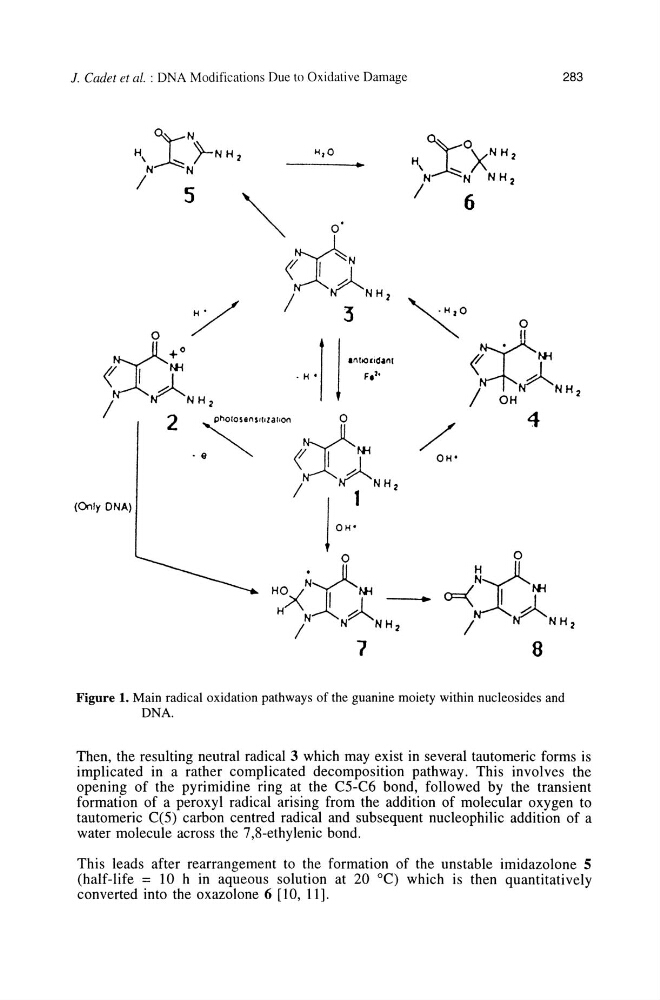
Figure 1. Main radical oxidation pathways of the guanine moiety within nucleosides and
DNA.
Then, the resulting neutral radical 3 which may exist in several tautomeric forms is
implicated in a rather complicated decomposition pathway. This involves the
opening of the pyrimidine ring at the C5-C6 bond, followed by the transient
formation of a peroxyl radical arising from the addition of molecular oxygen to
tautomeric C(5) carbon centred radical and subsequent nucleophilic addition of a
water molecule across the 7,8-ethylenic bond.
This leads after rearrangement to the formation of the unstable imidazolone 5
(half-life = 10 h in aqueous solution at 20°C) which is then quantitatively
converted into the oxazolone 6 [10, 11].
283
(Only DNA)
Figure 1. Main radical oxidation pathways of the guanine moiety within nucleosides and
DNA.
Then, the resulting neutral radical 3 which may exist in several tautomeric forms is
implicated in a rather complicated decomposition pathway. This involves the
opening of the pyrimidine ring at the C5-C6 bond, followed by the transient
formation of a peroxyl radical arising from the addition of molecular oxygen to
tautomeric C(5) carbon centred radical and subsequent nucleophilic addition of a
water molecule across the 7,8-ethylenic bond.
This leads after rearrangement to the formation of the unstable imidazolone 5
(half-life = 10 h in aqueous solution at 20°C) which is then quantitatively
converted into the oxazolone 6 [10, 11].