

O. G. Mekenyan et al. : Photo-Induced Toxicity of PARs
(1 .5)
(2)
S' « 2. (2.5)
01
o
-J
(3)
(3.5)
~27
5
6
19
5 :
4
b'63
<0>6017
~\~
~~Jm ~ ____ ----,2'Ol,~~
7
8
9
10
HOMO-LUMO Gap leV]
267
11
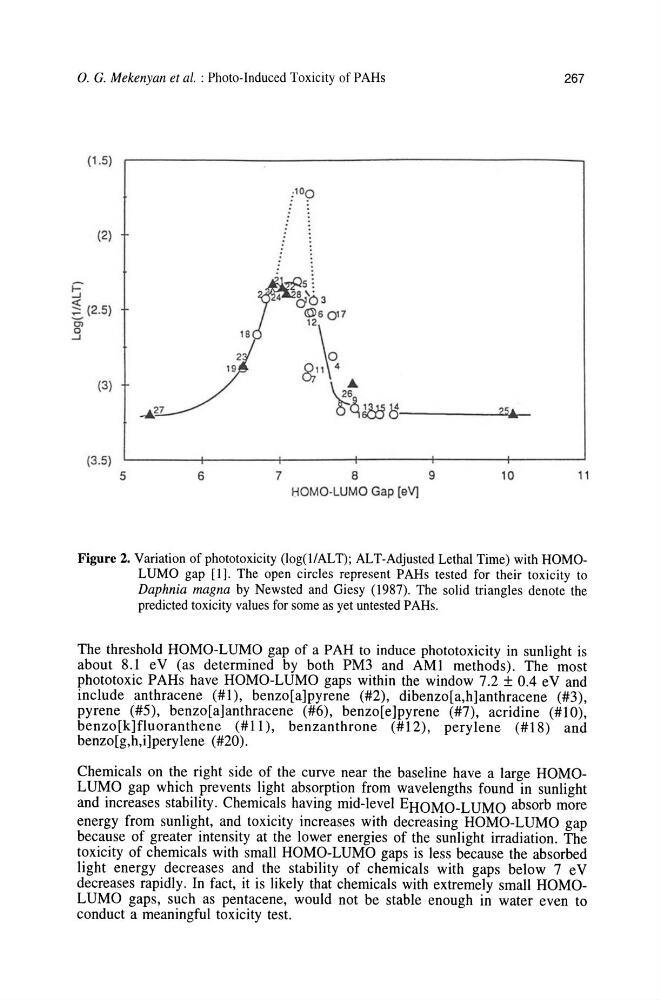
Figure 2. Variation of phototoxicity (Iog(l/ALT); ALT-Adjusted Lethal Time) with ROMOLUMO gap [I] . The open circles represent PARs tested for their toxicity to
Daphnia magna by Newsted and Giesy (1987). The solid triangles denote the
predicted toxicity values for some as yet untested PARs.
The threshold ROMO-LUMO gap of a PAH to induce phototoxicity in sunlight is
about 8.1 eV (as determined by both PM3 and AM] methods) . The most
phototoxic PARs have HOMO-LUMO gaps within the window 7.2 ± 0.4 eV and
include anthracene (#1), benzo[a]pyrene (#2), dibenzo[a,h]anthracene (#3),
pyrene (#5), benzo[a]anthracene (#6), benzo[e]pyrene (#7), acridine (#10),
benzo[k]fluoranthene (#11), benzanthrone (#12), perylene (#] 8) and
benzo[g,h,i]perylene (#20).
Chemicals on the right side of the curve near the baseline have a large HOMOLUMO gap which prevents light absorption from wavelengths found in sunlight
and increases stability. Chemicals having mid-level EHOMO-LUMO absorb more
energy from sunlight, and toxicity increases with decreasing HOMO-LUMO gap
because of greater intensity at the lower energies of the sunlight irradiation. The
toxicity of chemicals with small HOMO-LUMO gaps is less because the absorbed
light energy decreases and the stability of chemicals with gaps below 7 e V
decreases rapidly. In fact, it is likely that chemicals with extremely small HOMOLUMO gaps, such as pentacene, would not be stable enough in water even to
conduct a meaningful toxicity test.
(1 .5)
(2)
S' « 2. (2.5)
01
o
-J
(3)
(3.5)
~27
5
6
19
5 :
4
b'63
<0>6017
~\~
~~Jm ~ ____ ----,2'Ol,~~
7
8
9
10
HOMO-LUMO Gap leV]
267
11
Figure 2. Variation of phototoxicity (Iog(l/ALT); ALT-Adjusted Lethal Time) with ROMOLUMO gap [I] . The open circles represent PARs tested for their toxicity to
Daphnia magna by Newsted and Giesy (1987). The solid triangles denote the
predicted toxicity values for some as yet untested PARs.
The threshold ROMO-LUMO gap of a PAH to induce phototoxicity in sunlight is
about 8.1 eV (as determined by both PM3 and AM] methods) . The most
phototoxic PARs have HOMO-LUMO gaps within the window 7.2 ± 0.4 eV and
include anthracene (#1), benzo[a]pyrene (#2), dibenzo[a,h]anthracene (#3),
pyrene (#5), benzo[a]anthracene (#6), benzo[e]pyrene (#7), acridine (#10),
benzo[k]fluoranthene (#11), benzanthrone (#12), perylene (#] 8) and
benzo[g,h,i]perylene (#20).
Chemicals on the right side of the curve near the baseline have a large HOMOLUMO gap which prevents light absorption from wavelengths found in sunlight
and increases stability. Chemicals having mid-level EHOMO-LUMO absorb more
energy from sunlight, and toxicity increases with decreasing HOMO-LUMO gap
because of greater intensity at the lower energies of the sunlight irradiation. The
toxicity of chemicals with small HOMO-LUMO gaps is less because the absorbed
light energy decreases and the stability of chemicals with gaps below 7 e V
decreases rapidly. In fact, it is likely that chemicals with extremely small HOMOLUMO gaps, such as pentacene, would not be stable enough in water even to
conduct a meaningful toxicity test.