

P. Alii: Modeling Paleoclimatic Changes Using a Feedback Energetic System
121
The last equation represents the greenhouse effect feedback. The black body
temperature T' superior to the surface temperature by an amount tuned with ex and
~. The previous one describes the closure of the system (Er = oT'4).
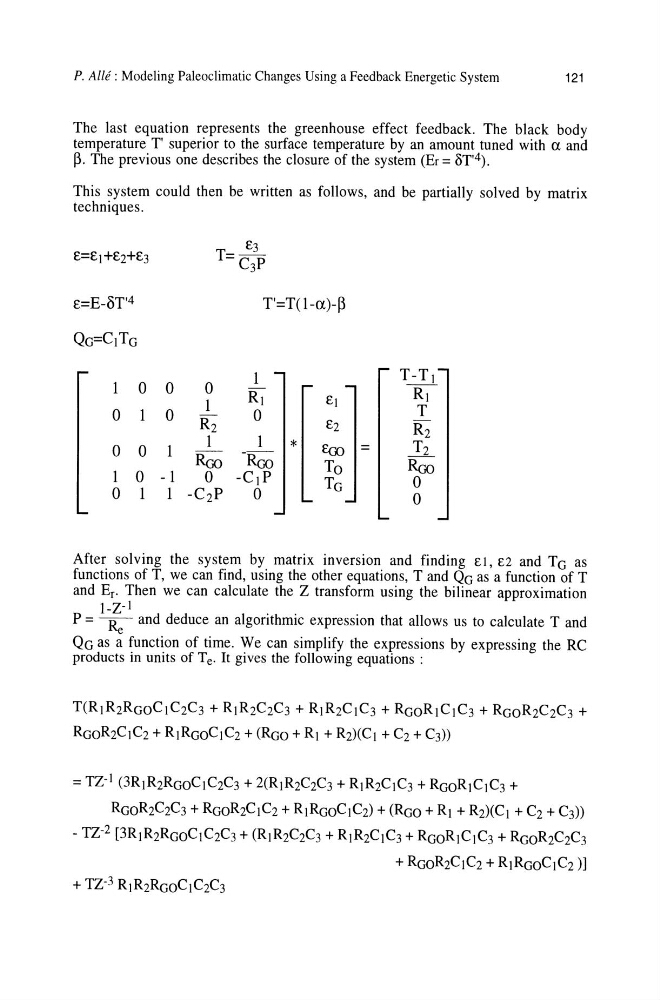
This system could then be written as follows, and be partially solved by matrix
techniques.
£=£j+£2+£3
£3
T=C3 P
£=E-()T4
T=T( l-a)-~
QG=CjTG
T-Tj
1 0 0
0
1
R j
£j
Rj
0 1 0
0
T
R2
£2
R2
0 0 1
1
1
* fm =
T2
Roo
-
Roo
To
Roo
1 0 - 1
0 -CjP
TG
0
0 1 1 -C2 P
0
0
After solving the system by matrix inversion and finding £ j, £2 and T G as
functions of T, we can find, using the other equations, T and QG as a function of T
and Er. Then we can calculate the Z transform using the bilinear approximation
l-Zj
d d d
I ' h .
.
h
P = T an e uce an a gont mlC expressIOn t at allows us to calculate T and
QG as a function of time. We can simplify the expressions by expressing the RC
products in units of T e' It gives the following equations:
T(Rj R 2R GOCj C 2C 3 + Rj R 2C 2C 3 + Rj R 2C jC 3 + RGoRjCj C 3 + RGOR2C 2C 3 +
RGoR2CjC2 + RjRGOCjC2 + (RGO + Rj + R2)(Cj + C2 + C3))
= TZ-l (3RjR2RGOCjC2C3 + 2(RjR2C2C3 + RjR2CjC3 + RGORjCj C3 +
RGOR2C2C3 + RGOR2C]C2 + RjRGOCjC2) + (RGO + Rj + R2)(Cj + C2 + C3))
- TZ-2 [3RjR2RGOCjC2C3 + (RjR2C2C3 + R]R2CjC3 + RGORjCjC3 + RGOR2C2C3
+ RGOR2C jC2 + RjRGOCj C2)]
121
The last equation represents the greenhouse effect feedback. The black body
temperature T' superior to the surface temperature by an amount tuned with ex and
~. The previous one describes the closure of the system (Er = oT'4).
This system could then be written as follows, and be partially solved by matrix
techniques.
£=£j+£2+£3
£3
T=C3 P
£=E-()T4
T=T( l-a)-~
QG=CjTG
T-Tj
1 0 0
0
1
R j
£j
Rj
0 1 0
0
T
R2
£2
R2
0 0 1
1
1
* fm =
T2
Roo
-
Roo
To
Roo
1 0 - 1
0 -CjP
TG
0
0 1 1 -C2 P
0
0
After solving the system by matrix inversion and finding £ j, £2 and T G as
functions of T, we can find, using the other equations, T and QG as a function of T
and Er. Then we can calculate the Z transform using the bilinear approximation
l-Zj
d d d
I ' h .
.
h
P = T an e uce an a gont mlC expressIOn t at allows us to calculate T and
QG as a function of time. We can simplify the expressions by expressing the RC
products in units of T e' It gives the following equations:
T(Rj R 2R GOCj C 2C 3 + Rj R 2C 2C 3 + Rj R 2C jC 3 + RGoRjCj C 3 + RGOR2C 2C 3 +
RGoR2CjC2 + RjRGOCjC2 + (RGO + Rj + R2)(Cj + C2 + C3))
= TZ-l (3RjR2RGOCjC2C3 + 2(RjR2C2C3 + RjR2CjC3 + RGORjCj C3 +
RGOR2C2C3 + RGOR2C]C2 + RjRGOCjC2) + (RGO + Rj + R2)(Cj + C2 + C3))
- TZ-2 [3RjR2RGOCjC2C3 + (RjR2C2C3 + R]R2CjC3 + RGORjCjC3 + RGOR2C2C3
+ RGOR2C jC2 + RjRGOCj C2)]