

120
Global Atmospheric Evolution: Impact of Anthropogenic Activities
These reservoirs can be filled more or less easily from the atmosphere, which is
modeled by the resistance Rj and R2, and can directly exchange energy between
them, resistance RGo. For the generation of the 100 000 year dominant cycle, we
use the main results of the rheology and elasticity based model, commuting R 1
and RGO values to Rl' and RGO' with a phase delay t after the last glacial
maximum. The system is made closed-loop by the emission of an energy Er,
depending on the temperature T', according to the black body law. The
temperature T' is shifted from the surface temperature T by a value itself a linear
function of T (modeling of the greenhouse effect with the concentration of C02
and H20 considered as positive feedback).
4
MATHEMATICAL EXPRESSION OF THE PHYSICAL
MODEL
Such a physical model can be represented by a system of differential equations.
The main part of this system is equivalent to the one describing the following
electrical circuit (Fig. 3) :
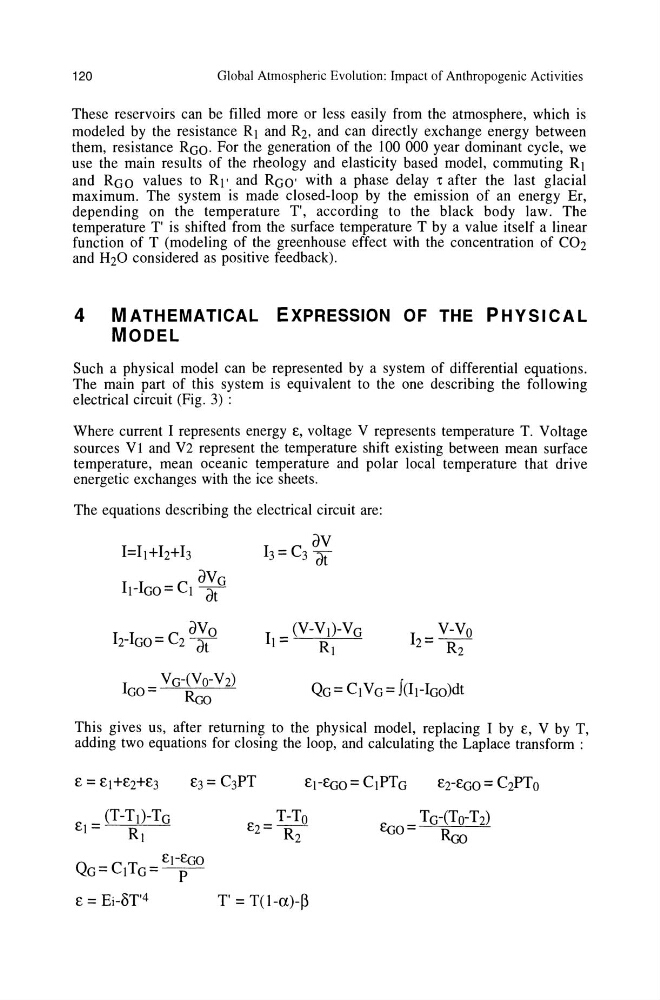
Where current I represents energy E, voltage V represents temperature T. Voltage
sources VI and V2 represent the temperature shift existing between mean surface
temperature, mean oceanic temperature and polar local temperature that drive
energetic exchanges with the ice sheets.
The equations describing the electrical circuit are:
1=lj+12+13
aVG
Ij-IGo= Cj dt
avo
12-IGO = C2 dt
I
VG-(VO-V2)
GO=
Roo
This gives us, after returning to the physical model, replacing I by E, V by T,
adding two equations for closing the loop, and calculating the Laplace transform :
Cj-tao
QG=CjTG=-pC = Ei-~T'4
T-To
c2= R2
T' = T(l-a)-~
TG-(To-T2)
tao = Roo
Global Atmospheric Evolution: Impact of Anthropogenic Activities
These reservoirs can be filled more or less easily from the atmosphere, which is
modeled by the resistance Rj and R2, and can directly exchange energy between
them, resistance RGo. For the generation of the 100 000 year dominant cycle, we
use the main results of the rheology and elasticity based model, commuting R 1
and RGO values to Rl' and RGO' with a phase delay t after the last glacial
maximum. The system is made closed-loop by the emission of an energy Er,
depending on the temperature T', according to the black body law. The
temperature T' is shifted from the surface temperature T by a value itself a linear
function of T (modeling of the greenhouse effect with the concentration of C02
and H20 considered as positive feedback).
4
MATHEMATICAL EXPRESSION OF THE PHYSICAL
MODEL
Such a physical model can be represented by a system of differential equations.
The main part of this system is equivalent to the one describing the following
electrical circuit (Fig. 3) :
Where current I represents energy E, voltage V represents temperature T. Voltage
sources VI and V2 represent the temperature shift existing between mean surface
temperature, mean oceanic temperature and polar local temperature that drive
energetic exchanges with the ice sheets.
The equations describing the electrical circuit are:
1=lj+12+13
aVG
Ij-IGo= Cj dt
avo
12-IGO = C2 dt
I
VG-(VO-V2)
GO=
Roo
This gives us, after returning to the physical model, replacing I by E, V by T,
adding two equations for closing the loop, and calculating the Laplace transform :
Cj-tao
QG=CjTG=-pC = Ei-~T'4
T-To
c2= R2
T' = T(l-a)-~
TG-(To-T2)
tao = Roo